Review
. 2010 Nov;238(1):233-46.
doi: 10.1111/j.1600-065X.2010.00952.x.

Molecular mechanisms by which T-bet regulates T-helper cell commitment

Affiliations
Review

Molecular mechanisms by which T-bet regulates T-helper cell commitment

Sara A Miller et al. Immunol Rev. 2010 Nov.

Abstract

Current research suggests that a number of newly identified T-helper cell subsets retain a degree of context-dependent plasticity in their signature cytokine expression patterns. To understand this process, a major challenge is to determine the molecular mechanisms by which lineage-defining transcription factors regulate gene expression profiles in T-helper cells. This mechanistic information will aid in our interpretation of whether a T-helper cell state that expresses or retains the capacity to re-express a combination of lineage-defining transcription factors will have a stable or more flexible gene expression profile. Studies examining the developmental T-box transcription factor T-bet demonstrate the powerful information that is gained from combining in vivo analysis with basic biochemical and molecular mechanism approaches. Significantly, T-bet's ability to physically recruit epigenetic modifying complexes, in particular a Jmjd3 H3K27-demethylase and a Set7/9 H3K4-methyltransferase complex, to its target genes allows T-bet to effectively reverse and establish new epigenetic states. This observation suggests that until T-bet is permanently extinguished, T-helper cells will retain some plasticity toward a T-helper 1-like program. Therefore, insight into the complexity of T-helper cell commitment decisions will be aided by determining the molecular mechanisms for lineage-defining transcription factors.


Figures

Fig. 1
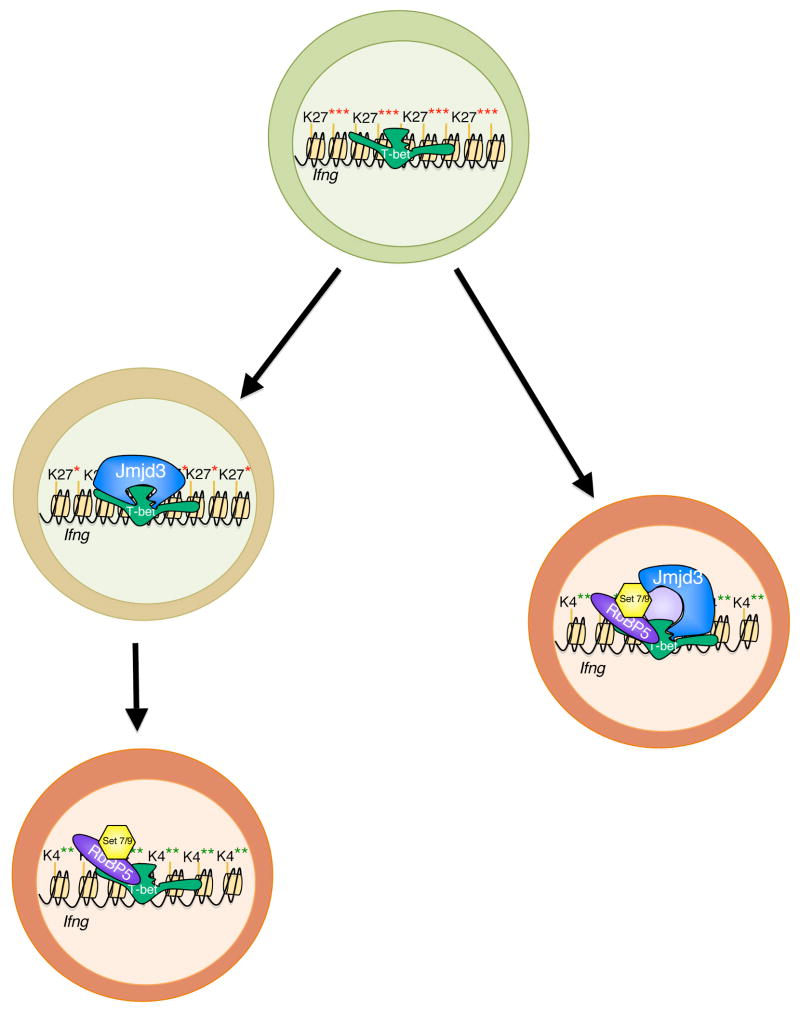
Fig. 1. T-bet interacts with H3K27-demethylase and H3K4-methyltransferase complexes in helper T-cell differentiation
In naive helper T cells (green), loci that are expressed upon differentiation are kept in a repressed epigenetic state (i.e. H3K27me3). T-bet is able to physically recruit an H3K27-demethylase complex (such as Jmjd3) to its target loci during T-helper cell differentiation to effectively reverse the repressive epigenetic state. Subsequently or alternatively in a simultaneous manner, T-bet has the ability to physically interact with and recruit a permissive H3K4-methyltransferase complex (such as Set7/9) to target genes to establish a permissive epigenetic environment (i.e. H3K4me2) compatible with transcription. T-bet's ability to influence the epigenetic environment of the cell gives it the potential to alter the expression of its target genes in any of the T-helper cells in which it is expressed (see Fig. 2).
Fig. 2
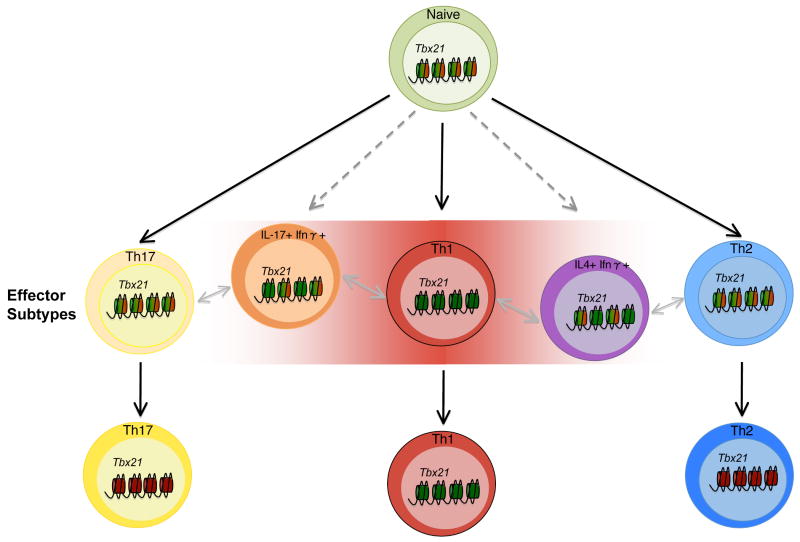
Fig. 2. Model for how T-bet expression patterns regulate T-helper cell commitment
T-bet has the ability to recruit H3K27-demethylase and H3K4-methyltransferase complexes to its target genes to establish their epigenetic profile. Therefore, if T-bet is expressed, or re-expressed in response to an environmental stimuli, a Th1-like epigenetic signature will be established in the cell. Illustrated here is a gradient model for helper T cell commitment based upon the levels of T-bet (shaded red box). The epigenetic modification at the Tbx21 locus (the gene that encodes T-bet) can be contained within either a permissive (green), repressive (red), or a poised, bivalent (red and green) state in various helper T-cell populations. Importantly, until the Tbx21 locus is permanently extinguished in repressive chromatin, T-bet has the potential to be re-expressed and alter the epigenetic profile of the cell to contain a Th1-like signature. This model is focused on T-bet, but as more studies assess the functional capabilities of the other important transcription factors in T-helper cells, similar and overlapping gradients may exist for their mechanistic role in commitment decisions as well.

References

    1. Miller SA, Weinmann AS. Common themes emerge in the transcriptional control of T helper and developmental cell fate decisions regulated by the T-box, GATA and ROR families. Immunology. 2009;126:306–315. - PMC - PubMed
    1. Miller SA, Huang AC, Miazgowicz MM, Brassil MM, Weinmann AS. Coordinated but physically separable interaction with H3K27-demethylase and H3K4-methyltransferase activities are required for T-box protein-mediated activation of developmental gene expression. Genes Dev. 2008;22:2980–2993. - PMC - PubMed
    1. O'Shea JJ, Paul WE. Mechanisms Underlying Lineage Commitment and Plasticity of Helper CD4+ T cells. Science. 2010;327:1098–1102. - PMC - PubMed
    1. Bluestone JA, Mackay CR, O'Shea JJ, Stockinger B. The functional plasticity of T cell subsets. Nat Rev Immunol. 2009;9:811–816. - PMC - PubMed
    1. Zhou L, Chong MM, Littman DR. Plasticity of CD4+ T cell lineage differentiation. Immunity. 2009;30:646–655. - PubMed

Publication types

MeSH terms

Substances