


Peripheral CD4+ T-cell differentiation regulated by networks of cytokines and transcription factors
- PMID: 20969597
- PMCID: PMC2975272
- DOI: 10.1111/j.1600-065X.2010.00951.x
Peripheral CD4+ T-cell differentiation regulated by networks of cytokines and transcription factors
Erratum in
- Immunol Rev. 2011 Mar;240(1):317
Abstract
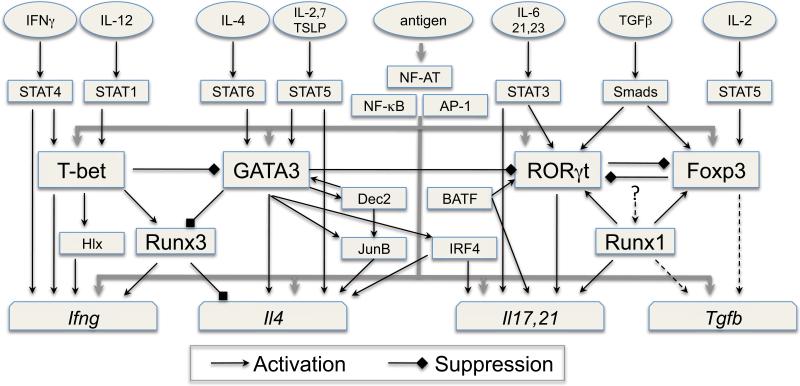
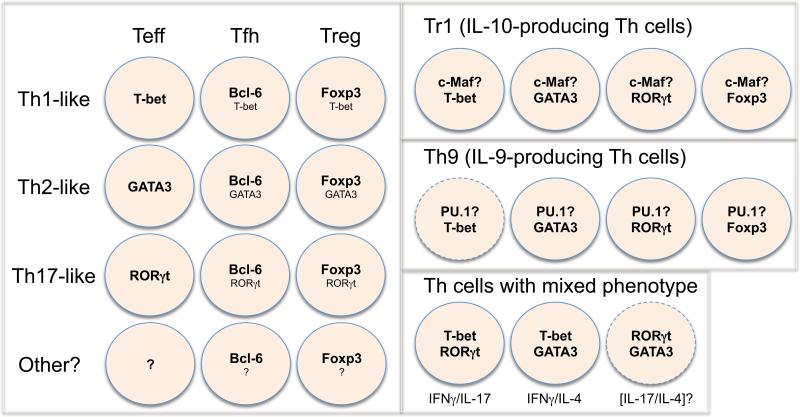
CD4(+) T cells, also known as T-helper (Th) cells, play an important role in orchestrating adaptive immune responses to various infectious agents. They are also involved in the induction of autoimmune and allergic diseases. Upon T-cell receptor (TCR)-mediated cell activation, naive CD4(+) T cells can differentiate into at least four major lineages, Th1, Th2, Th17, and iTreg cells, that participate in different types of immune responses. Networks of cytokines and transcription factors are critical for determining CD4(+) T-cell fates and effector cytokine production. Here, we review collaboration and cross-regulation between various essential cytokines in the activation/induction of key transcription factors during the process of Th cell differentiation towards these distinct lineages. We also discuss the interactions of key transcription factors at both genetic and protein levels and the function of the resulting network(s) in regulating the expression of effector cytokines.
Published 2010. This article is a US Government work and is in the public domain in the USA.
Figures
References
-
- Swain SL, Weinberg AD, English M, Huston G. IL-4 directs the development of Th2-like helper effectors. J Immunol. 1990;145:3796–806. - PubMed
-
- Hsieh CS, Heimberger AB, Gold JS, O'Garra A, Murphy KM. Differential regulation of T helper phenotype development by interleukins 4 and 10 in an alpha beta T-cell-receptor transgenic system. Proceedings of the National Academy of Sciences of the United States of America. 1992;89:6065–9. - PMC - PubMed
Publication types
MeSH terms
Substances
Grants and funding
LinkOut - more resources
Full Text Sources
Other Literature Sources
Medical
Research Materials
