


Synaptic dysfunction in genetic models of Parkinson's disease: a role for autophagy?
- PMID: 20969957
- PMCID: PMC3049988
- DOI: 10.1016/j.nbd.2010.10.011
Synaptic dysfunction in genetic models of Parkinson's disease: a role for autophagy?
Abstract
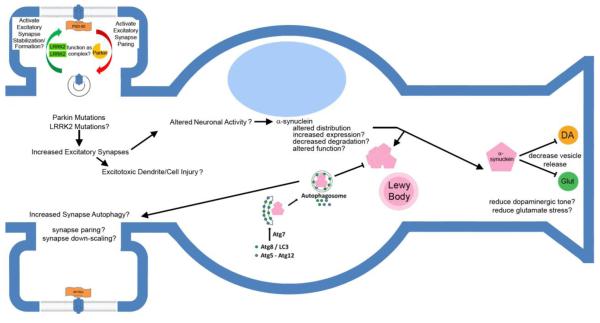
The past decade in Parkinson's disease (PD) research has been punctuated by numerous advances in understanding genetic factors that contribute to the disease. Common to most of the genetic models of Parkinsonian neurodegeneration are pathologic mechanisms of mitochondrial dysfunction, secretory vesicle dysfunction and oxidative stress that likely trigger common cell death mechanisms. Whereas presynaptic function is implicated in the function/dysfunction of α-synuclein, the first gene shown to contribute to PD, synaptic function has not comprised a major focus in most other genetic models. However, recent advances in understanding the impact of mutations in parkin and LRRK2 have also yielded insights into synaptic dysfunction as a possible early pathogenic mechanism. Autophagy is a common neuronal response in each of these genetic models of PD, participating in the clearance of protein aggregates and injured mitochondria. However, the potential consequences of autophagy upregulation on synaptic structure and function remain unknown. In this review, we discuss the evidence that supports a role for synaptic dysfunction in the neurodegenerative cascade in PD, and highlight unresolved questions concerning a potential role for autophagy in either pathological or compensatory synaptic remodeling. This article is part of a Special Issue entitled "Autophagy and protein degradation in neurological diseases."
Copyright © 2010 Elsevier Inc. All rights reserved.
Figures
References
-
- Abeliovich A, et al. Mice lacking alpha-synuclein display functional deficits in the nigrostriatal dopamine system. Neuron. 2000;25:239–52. - PubMed
-
- Bamber BA, Rowland AM. Shaping cellular form and function by autophagy. Autophagy. 2006;2:247–9. - PubMed
-
- Biskup S, et al. Localization of LRRK2 to membranous and vesicular structures in mammalian brain. Ann Neurol. 2006;60:557–569. - PubMed
Publication types
MeSH terms
Substances
Grants and funding
LinkOut - more resources
Full Text Sources
Medical
Miscellaneous
