


Association of shoulder pain with the use of mobility devices in persons with chronic spinal cord injury
- PMID: 20970758
- PMCID: PMC3078578
- DOI: 10.1016/j.pmrj.2010.05.004
Association of shoulder pain with the use of mobility devices in persons with chronic spinal cord injury
Abstract
Objective: To assess the prevalence of shoulder pain and its association with the use of assistive devices for mobility in persons with chronic spinal cord injury (SCI).
Design: Cross-sectional analysis conducted within a cohort study.
Setting: SCI service in a hospital and the community.
Participants: Between August 2005 and January 2008, 93 participants with chronic SCI completed a standardized health questionnaire and pain questionnaire.
Main outcome measures: Shoulder pain in last 6 months elicited by use of the McGill Pain Questionnaire pain diagram.
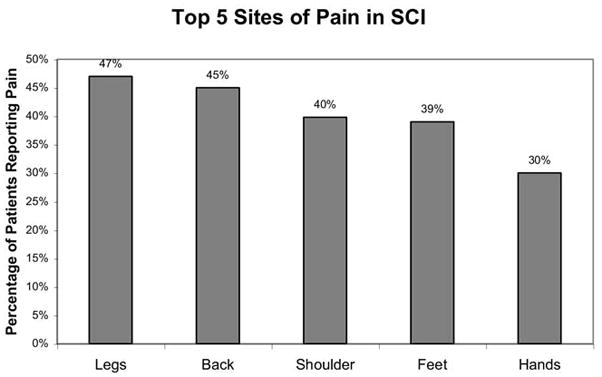
Results: Of the 93 participants, 65 (69.9%) reported pain at any site in the 6 months before testing. Shoulder pain, reported by 39.8% of participants, was the third most common site of pain after the legs and back. When stratified by the use of assistive mobility devices, shoulder pain was reported by 46.7% of motorized wheelchair users, 35.4% of manual wheelchair users, 47.6% of participants using aids such as crutch(es) or canes, and 33.3% of participants walking without assistance (P = .7 for comparison of 4 groups).
Conclusions: Shoulder pain is highly prevalent in SCI. The authors of previous studies have largely attributed shoulder pain in SCI to manual wheelchair use. However, our results provide evidence for similarly elevated prevalence of shoulder pain among motorized wheelchair users and those patients using crutches or canes. This finding suggests that in addition to overuse injury from cyclic wheelchair propulsion, the assessment of other mechanical and nonmechanical factors that lead to shoulder pain in SCI is an unmet research need that may have treatment implications.
Copyright © 2010 American Academy of Physical Medicine and Rehabilitation. Published by Elsevier Inc. All rights reserved.
Figures
References
-
- Dalyan M, Cardenas DD, Gerard B. Upper extremity pain after spinal cord injury. Spinal Cord. 1999;37:191–195. - PubMed
-
- Meislin RJ, Sperling JW, Stitik TP. Persistent shoulder pain: Epidemiology, pathophysiology, and diagnosis. Am J Orthop (Belle Mead NJ) 2005;34:5–9. - PubMed
-
- Alm M, Saraste H, Norrbrink C. Shoulder pain in persons with thoracic spinal cord injury: Prevalence and characteristics. J Rehabil Med. 2008;40:277–283. - PubMed
Publication types
MeSH terms
Grants and funding
LinkOut - more resources
Full Text Sources
Medical
