


Review
doi: 10.1016/j.emc.2010.06.005.
Emergency orthogeriatrics: concepts and therapeutic alternatives
Affiliations
- PMID: 20971398
- PMCID: PMC3217215
- DOI: 10.1016/j.emc.2010.06.005
Item in Clipboard
Review
Emergency orthogeriatrics: concepts and therapeutic alternatives
Emerg Med Clin North Am.
2010 Nov.
Abstract
Multidisciplinary orthogeriatric care can enhance prompt ED diagnosis, optimal pre- and postoperative care, and functional recovery in older adults with bony injuries. Emergency care providers should be cognizant of prevalent geriatric syndromes including delirium and standing level falls to minimize fracture-related morbidity. Recognizing the implications of aging physiology, acute care physicians should be aware of effective alternatives to analgesia, procedural sedation, and definitive imaging to promote early surgical management and postoperative recovery.
Copyright © 2010 Elsevier Inc. All rights reserved.
Figures
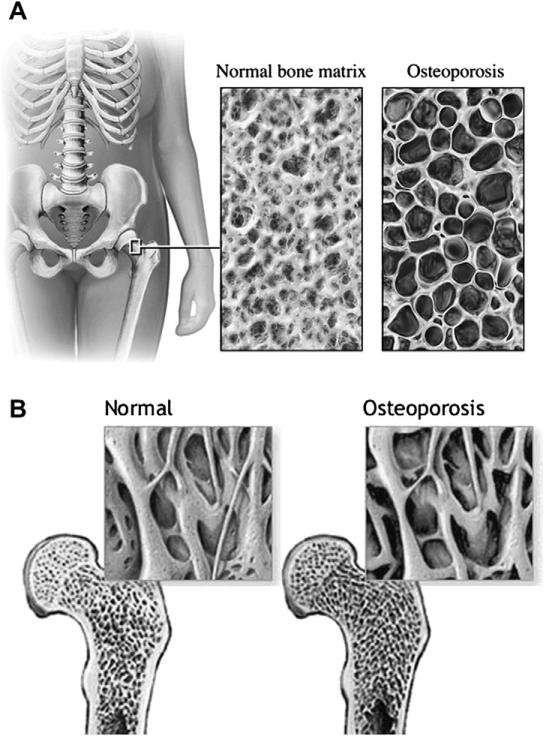
(A, B) Osteoporosis. This artistic rendition of normal and osteoporotic bone demonstrates the striking difference in bone density and bone microstructure. (From Nucleus Medical Media, Inc, Kennesaw, Georgia; with permission; MedlinePlus Medical Encyclopedia. Available at: http://www.nlm.nih.gov/medlineplus/ency/imagepages/17156.htm . Accessed June 18, 2010.)
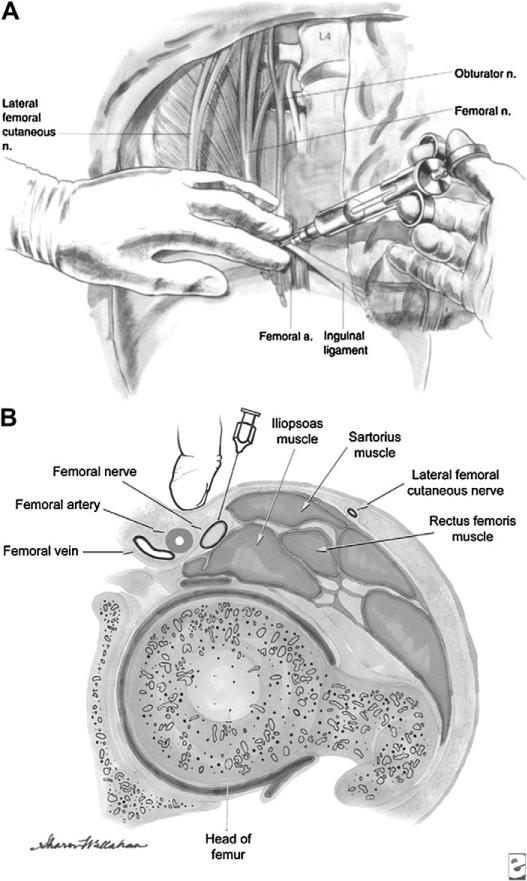
(A, B) Femoral nerve block. A femoral nerve block can be easily performed in the ED by using anatomic landmarks (ie, palpation of the femoral artery) or by using ultrasound guidance to localize the femoral artery and the high-signal femoral nerve that lies lateral to the artery. (A: From Brown DL, Clifford JA, Wild J. Atlas of regional anesthesia 2006. p. 113–21, Fig. 13-4. Available at: http://polanest.webd.pl/pliki/varia/books/AtRegAn/micro189.lib3.hawaii.edu_3a2127/das/book/body/0/1353/i4-u1.0-b1-4160-2239-2..50017-5–f4.fig.htm . Accessed June 18, 2010; with permission; B: Reprinted from eMedicine.com , 2009. Available at: http://emedicine.medscape.com/article/1143675-overview . Accessed June 18, 2010; with permission.)
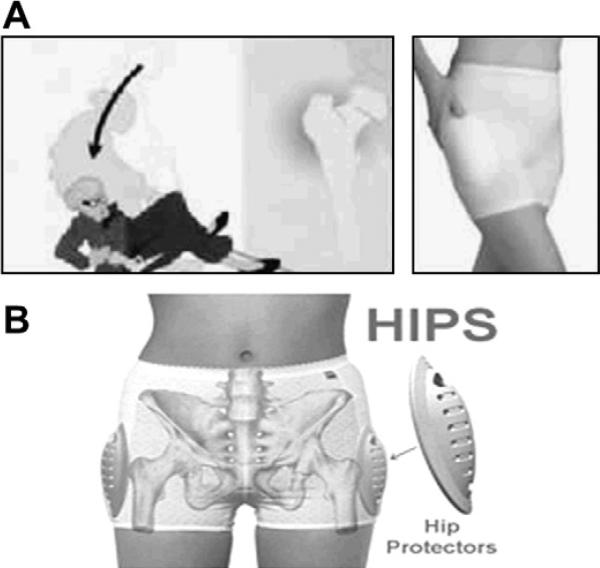
(A, B) Hip protectors. Several trials have shown that polypropylene hip protectors reduce hip fracture, although low compliance rates impede widespread use. (From Kiel D. Hip protectors. Slide presentation at the Surgeon General's Workshop on Osteoporosis and Bone Health. Washington, DC; 12–13 December 2002. Available at: http://www.surgeongeneral.gov/library/bonehealth/chapter_6.html . Accessed June 18, 2010; with permission). (From e-pill, LLC, Wellesley, MA. Available at: http://www.hipprotectors.com . Accessed June 18, 2010; with permisssion.)
Multidisciplinary geriatric fracture management model. (Data from De Jonge KE, Christmas C, Andersen R, et al. Hip fracture service – an interdisciplinary model of care. J Am Geriatr Soc 2001;49(12):1737–8.)
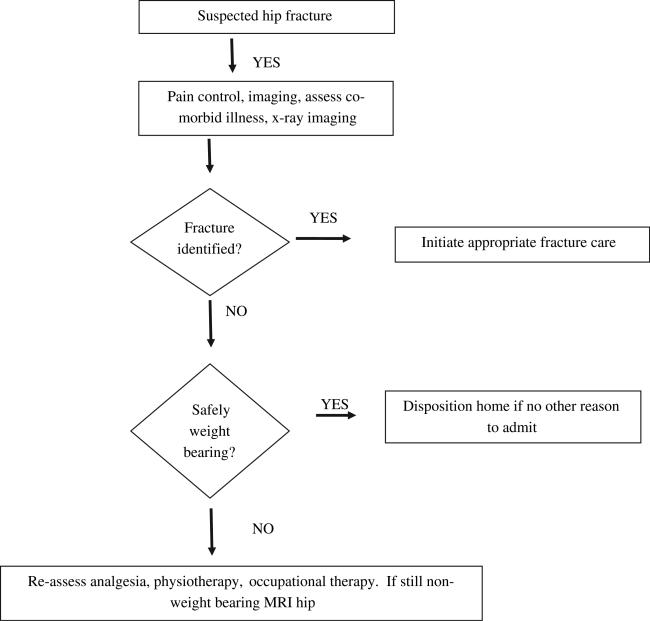
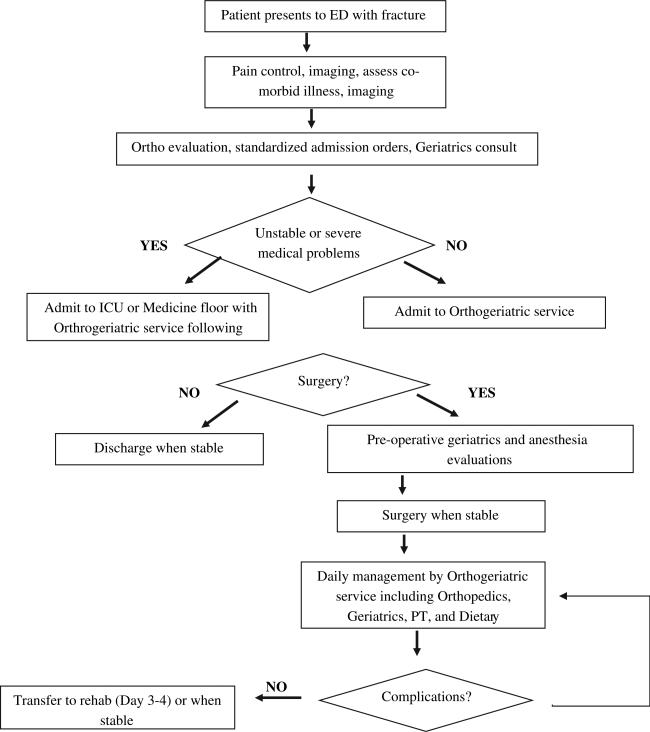
Pathway for elderly patients with suspected hip fracture. (Data from Smith JE, Jenkin A, Hennessy C. A retrospective chart review of elderly patients who cannot weight bear following a hip injury but whose initial x rays are normal. Emerg Med J 2009;26(1):50–1.)
References
-
- Roberts DC, McKay MP, Shaffer A. Increasing rates of emergency department visits for elderly patients in the United States, 1993 to 2003. Ann Emerg Med. 2008;51:769–74. - PubMed
-
- Downing A, Wilson R. Older people's use of accident and emergency services. Age Ageing. 2005;34:24–30. - PubMed
-
- McNamara RM, Rousseau E, Sanders AB. Geriatric emergency medicine: a survey of practicing emergency physicians. Ann Emerg Med. 1992;21:796–801. - PubMed
-
- Lips P. Epidemiology and predictors of fractures associated with osteoporosis. Am J Med. 1997;103:3S–8S. - PubMed
-
- Carter MW, Gupta S. Characteristics and outcomes of injury-related ED visits among older adults. Am J Emerg Med. 2008;26:296–303. - PubMed
Publication types
MeSH terms
Grants and funding
LinkOut - more resources
Full Text Sources
Medical
