. 2010 Dec;16(12):2336-40.
doi: 10.1261/rna.2296210. Epub 2010 Oct 22.

Persistence of seed-based activity following segmentation of a microRNA guide strand

Affiliations

Persistence of seed-based activity following segmentation of a microRNA guide strand

Guillaume Chorn et al. RNA. 2010 Dec.

Abstract

microRNAs are ∼ 22 nucleotide regulatory RNAs that are processed into duplexes from hairpin structures and incorporated into Argonaute proteins. Here, we show that a nick in the middle of the guide strand of an miRNA sequence allows for seed-based targeting characteristic of miRNA activity. Insertion of an inverted abasic, a dye, or a small gap between the two segments still permits target knockdown. While activity from the seed region of the segmented miRNA is apparent, activity from the 3' half of the guide strand is impaired, suggesting that an intact guide backbone is required for contribution from the 3' half. miRNA activity was also observed following nicking of a miRNA precursor. These results illustrate a structural flexibility in miRNA duplexes and may have applications in the design of miRNA mimetics.


Figures
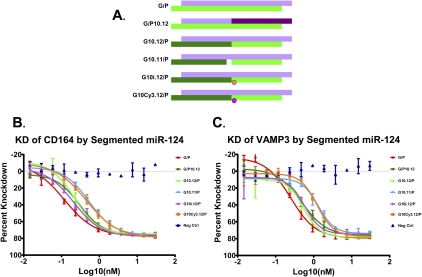
FIGURE 1.
FIGURE 1.
miR-124 activity tolerates segmentation of the guide and the passenger strands. (A) Schematics of the miR-124 duplex designs. The top strand represents the passenger strand (5′ to 3′), while the bottom strand represents the annealed guide strand. Change in color indicates the site of a break in the strand backbone. (Pink circle) A Cy3 label; (orange circle) an inverted abasic modification. Dose-dependent response of CD164 (B) and VAMP3 (C) mRNA in HCT-116 cells, as measured by qRT-PCR. EC50s of the CD164 knockdown curves are: G/P, 0.12 nM; G/P10.12, 0.29 nM; G10.12/P, 0.22 nM; G10.11/P, 0.53 nM; G10i.12/P, 0.21 nM; G10Cy3.12/P, 0.45 nM. EC50s of the VAMP3 knockdown curves are: G/P, 0.25 nM; G/P10.12, 0.48 nM; G10.12/P, 0.55 nM; G10.11/P, 1.32 nM; G10i.12/P, 0.58 nM; G10Cy3.12/P, 1.23 nM.
FIGURE 2.
FIGURE 2.
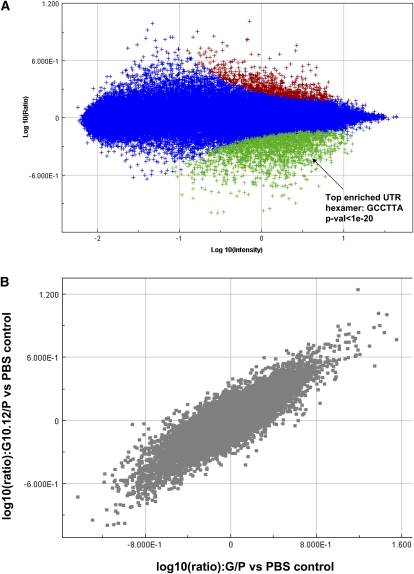
Microarray analysis shows seed-based activity from a segmented guide strand. (A) Microarray signature 24 h after transfection of 10 nM G10.12/P into HCT116 dicer hypomorphs, plotted as ratio of probe fluorescence intensity (relative to mock transfection) on the y-axis, and mean fluorescence intensity for the experimental and mock samples on the x-axis. (Green) Significantly down-regulated probes (P < 1 × 10⁻⁶); (red) up-regulated probes. Hypergeometric analysis of the hexamer content of the down-regulated UTRs showed that the most significantly enriched hexamer was GCCTTA, corresponding to positions 2–7 of the transfected miR-124. (B) Comparison of gene expression data from G10.12/P transfected cells and G/P transfected cells. Expression ratio of the G/P transfection versus the mock transfection is plotted on the x-axis, and G10.12/P expression ratio (versus mock) is plotted on the y-axis. The correlation coefficient (weighted by microarray error model) was calculated to be 0.9, illustrating the similar effects of both RNA complexes on gene expression.
FIGURE 3.
FIGURE 3.
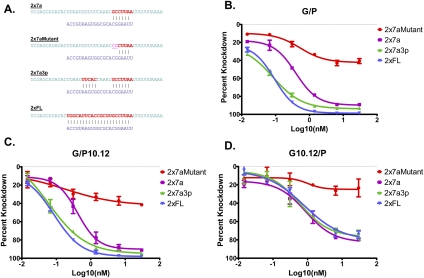
Activity of an unsegmented miR-124 guide strand is enhanced by additional complementarity beyond the seed region, but activity of a segmented guide strand is not. (A) Schematic of miR-124 target sites that were duplicated and inserted into a dual luciferase reporter vector. (B) G/P exhibits suppression of activity from a reporter with a seed-region match, which is enhanced by reporters containing additional complementarity to the 3′ end of the guide strand (2x7a3p), or full-length complementarity (2xFL). EC50s for these curves are: 2x7a, 0.39 nM; 2x7a3p, 0.08 nM; 2xFL, 0.09 nM. (C) Segmentation of the passenger strand (G/P10.12) preserves the trends observed in B. EC50s for the curves are: 2x7a, 0.41 nM; 2x7a3p, 0.06 nM; 2xFL, 0.09 nM. (D) When the guide strand is segmented (G10.12/P), activity from reporters with 3′ complementarity is identical to that observed from the seed-only reporter. EC50s for the curves are: 2x7a, 0.89 nM; 2x7a3p, 0.61 nM; 2xFL, 0.80 nM.
FIGURE 4.
FIGURE 4.
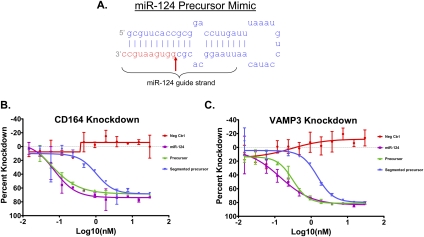
Activity from a segmented miR-124 hairpin precursor. (A) miR-124 hairpin precursor schematic. This precursor was transfected either fully intact or with a nick at the position indicated with a red arrow. The hairpin precursors, a miR-124 duplex, or a negative control siRNA (guide sequence UACGCGUAGUCGGUCAUACUU, passenger sequence GUAUGACCGACUACGCGUAUU, both 5′ to 3′) were transfected into HCT-116 cells and target knockdown assayed by qRT-PCR. (B) CD164 mRNA dose response. EC50s of the curves shown for CD164 knockdown are: miR-124, 0.07 nM; Precursor, 0.05 nM; Segmented Precursor, 1.02 nM. (C) VAMP3 mRNA dose response. EC50s of the curves shown for VAMP3 knockdown are: miR-124, 0.14 nM; Precursor, 0.31 nM; Segmented Precursor, 1.48 nM.

References

    1. Bartel DP 2009. MicroRNAs: Target recognition and regulatory functions. Cell 136: 215–233 - PMC - PubMed
    1. Bramsen JB, Laursen MB, Damgaard CK, Lena SW, Babu BR, Wengel J, Kjems J 2007. Improved silencing properties using small internally segmented interfering RNAs. Nucleic Acids Res 35: 5886–5897 - PMC - PubMed
    1. Diederichs S, Haber DA 2007. Dual role for argonautes in microRNA processing and posttranscriptional regulation of microRNA expression. Cell 131: 1097–1108 - PubMed
    1. Grimson A, Farh KK, Johnston WK, Garrett-Engele P, Lim LP, Bartel DP 2007. MicroRNA targeting specificity in mammals: Determinants beyond seed pairing. Mol Cell 27: 91–105 - PMC - PubMed
    1. Jackson AL, Burchard J, Schelter J, Chau BN, Cleary M, Lim L, Linsley PS 2006. Widespread siRNA “off-target” transcript silencing mediated by seed region sequence complementarity. RNA 12: 1179–1187 - PMC - PubMed

MeSH terms