


Adiposity and cardiovascular risk factors in a large contemporary population of pre-pubertal children
- PMID: 20972265
- PMCID: PMC3001590
- DOI: 10.1093/eurheartj/ehq355
Adiposity and cardiovascular risk factors in a large contemporary population of pre-pubertal children
Abstract
Aims: to examine the associations of several markers of adiposity and a wide range of cardiovascular risk factors and biomarkers in pre-pubertal children.
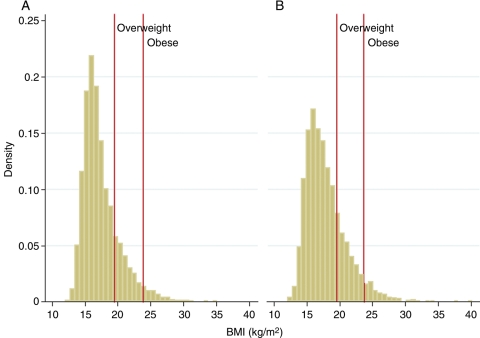
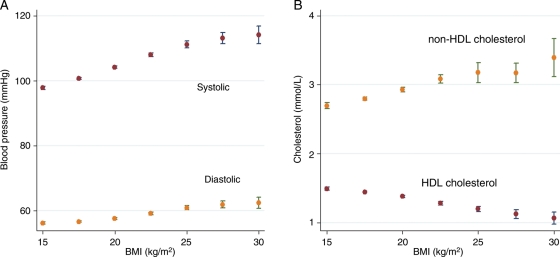
Methods and results: four measures of adiposity,body mass index (BMI), waist circumference, dual-energy X-ray absorptiometry (DXA)-determined fat mass, and leptin concentration, were available in up to 7589 children aged 8.8-11.7 (9.9 mean) years from the Avon Longitudinal Study of Parents and Children (ALSPAC). Thirteen per cent of boys and 18.8% of girls were overweight, and 5.3% of boys and 5% of girls were obese. Body mass index was highly correlated with waist circumference (r = 0.91), DXA fat mass (r = 0.87), and leptin concentration (r = 0.75), and all had similar associations with cardiovascular risk factors. A 1 kg/m(2) greater BMI was associated with 1.4 mmHg (95% CI 1.25-1.44) higher systolic blood pressure (BP). In 5002 children, a 1 kg/m(2) greater BMI was associated with a 0.05 mmol/L (95% CI 0.036-0.055) higher non-high-density lipoprotein (HDL) cholesterol and 0.03 mmol/L (95% CI -0.034 to -0.025) lower HDL cholesterol. There were also graded associations with apolipoproteins A1 and B, interleukin-6, and C-reactive protein. Comparing children who were obese with those who were normal weight, the odds ratio for hypertension was 10.7 (95% CI 7.2-15.9) for boys and 13.5 (95% CI 9.4-19.5) for girls.
Conclusion: in pre-pubertal UK children, overweight/obesity is common and has broadly similar associations with BP, HDL cholesterol, and non-HDL cholesterol to those observed in adults. Future research should evaluate whether effective interventions to maintain healthy weight in childhood could have important benefits for adult cardiovascular risk.
Figures
References
-
- Kipping RR, Jago R, Lawlor DA. Obesity in children. Part 1: epidemiology, measurement, risk factors and screening. BMJ. 2008;337:a1824. doi:10.1136/bmj.a1824. - DOI - PubMed
-
- Ogden CL, Carroll MD, Flegal KM. High body mass index for age among US children and adolescents, 2003–2006. JAMA. 2008;299:2401–2405. doi:10.1001/jama.299.20.2401. - DOI - PubMed
-
- Prospective Studies Collaborations. Body-mass index and cause-specific mortality in 900 000 adults: collaborative analyses of 57 prospective studies. Lancet. 2009;373:1083–1096. doi:10.1016/S0140-6736(09)60318-4. - DOI - PMC - PubMed
-
- Visser M, Bouter LM, McQuillan GM, Wener MH, Harris TB. Elevated C-reactive protein levels in overweight and obese adults. JAMA. 1999;282:2131–2135. doi:10.1001/jama.282.22.2131. - DOI - PubMed
-
- Greenberg AS, Obin MS. Obesity and the role of adipose tissue in inflammation and metabolism. Am J Clin Nutr. 2006;83(suppl.):461S–465S. - PubMed
Publication types
MeSH terms
Substances
Grants and funding
LinkOut - more resources
Full Text Sources
Medical
Research Materials
