


Comment
doi: 10.1172/JCI45105.
Epub 2010 Oct 25.
The cellular response to hypoxia: tuning the system with microRNAs
Affiliations
- PMID: 20972325
- PMCID: PMC2965005
- DOI: 10.1172/JCI45105
Item in Clipboard
Comment
The cellular response to hypoxia: tuning the system with microRNAs
J Clin Invest.
2010 Nov.
Abstract
Adaptation to hypoxia is an essential cellular response controlled by the oxygen-sensitive master transcription factor hypoxia-inducible factor 1 (HIF-1). HIF-1 expression is also controlled by specific microRNAs and, in turn, controls the expression of other microRNAs, which fine-tune adaptation to low oxygen tension. In this issue of the JCI, Ghosh and colleagues identify a unique microRNA in hypoxic endothelial cells, miR424, that promotes HIF-1 stabilization and angiogenesis. The actions of this microRNA are considered in the context of the complex interactions that act to ensure optimal endothelial adaptation to this critical environmental condition.
Figures
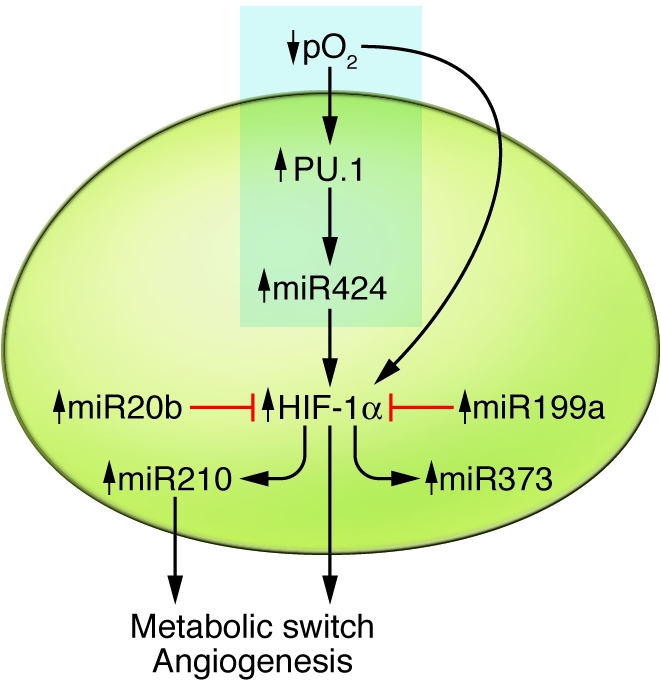
The endothelium is poised between flowing blood and metabolizing tissue. Under the hypoxic (ischemic) conditions accompanying reductions in blood flow, the endothelial response is governed by HIF, as well as hypoxamirs, which are themselves either induced by HIF or affect HIF expression and action. The net effect is a metabolic switch to glycolysis and endothelial proliferation and differentiation, actions that facilitate durable adaptation to hypoxia sufficient to promote angiogenesis and restore blood flow. The text highlighted in the blue rectangle indicates how the work of Ghosh and colleagues integrates with current understanding of hypoxamirs.
Comment on
-
Hypoxia-induced microRNA-424 expression in human endothelial cells regulates HIF-α isoforms and promotes angiogenesis.J Clin Invest. 2010 Nov;120(11):4141-54. doi: 10.1172/JCI42980. Epub 2010 Oct 25. J Clin Invest. 2010. PMID: 20972335 Free PMC article.
References
-
- Wang V, Davis DA, Haque M, Huang LE, Yarchoan R. Differential gene up-regulation by hypoxia-inducible factor-1alpha and hypoxia-inducible factor-2alpha in HEK293T cells. Cancer Res. 2005;65(8):3299–3306. - PubMed
Publication types
MeSH terms
Substances
Grants and funding
LinkOut - more resources
Full Text Sources
Other Literature Sources
