Personality and risk for Alzheimer's disease in adults 72 years of age and older: a 6-year follow-up
- PMID: 20973606
- PMCID: PMC3115437
- DOI: 10.1037/a0021377
Personality and risk for Alzheimer's disease in adults 72 years of age and older: a 6-year follow-up
Erratum in
- Psychol Aging. 2011 Jun;26(2):338
Abstract
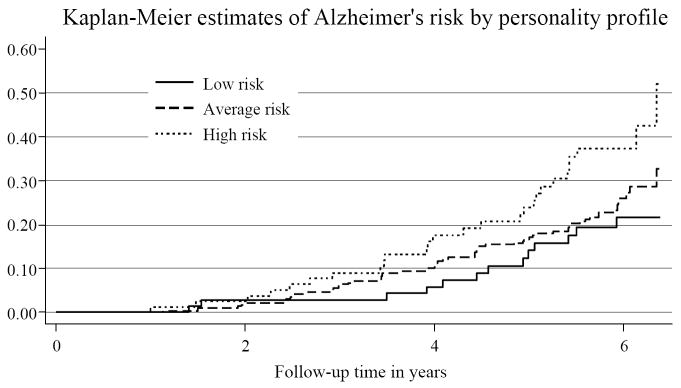
[Correction Notice: An erratum for this article was reported in Vol 26(2) of Psychology and Aging (see record 2011-05802-001). This article contains an error in the Discussion, under the Implications, Caveats, Future Directions heading. The third paragraph includes the sentences that should have been removed. The corrected paragraph appears in the correction.] We conducted secondary analyses to determine the relationship between longstanding personality traits and risk for Alzheimer's disease (AD) among 767 participants 72 years of age or older who were followed for more than 6 years. Personality was assessed with the NEO-FFI. We hypothesized that elevated Neuroticism, lower Openness, and lower Conscientiousness would be independently associated with risk of AD. Hypotheses were supported. The finding that AD risk is associated with elevated Neuroticism and lower Conscientiousness can be added to the accumulating literature documenting the pathogenic effects of these two traits. The link between lower Openness and AD risk is consistent with recent findings on cognitive activity and AD risk. Findings have implications for prevention research and for the conceptualization of the etiology of AD.
(c) 2011 APA, all rights reserved.
Figures
References
-
- Allemand M, Zimprich D, Hertzog C. Cross-sectional age differences and longitudinal age changes of personality in middle adulthood and old age. Journal of Personality. 2007;73:323–358. - PubMed
-
- American Psychiatric Association. Diagnostic and statistical manual of mental disorders. 4. Washington, DC: Author; 1994.
-
- Andel R, Kareholt I, Parker MG, Thorslund M, Gatz M. Complexity of primary lifetime occupation and cognition in advanced old age. Journal of Aging and Health. 2007;19:397–415. - PubMed
-
- Archer N, Brown RG, Reeves S, Nicholas H, Boothby H, Lovestone S. Midlife neuroticism and the age of onset of Alzheimer’s Disease. Psychological Medicine. 2009;39:665–673. - PubMed
-
- Balsis S, Carpenter BD, Storandt M. Personality change precedes clinical diagnosis of dementia of the Alzheimer type. Journals of Gerontology B: Psychological Sciences and Social Sciences. 2005;60:P98–P101. - PubMed