Classical conditioning of autonomic fear responses is independent of contingency awareness
- PMID: 20973611
- PMCID: PMC6510249
- DOI: 10.1037/a0020263
Classical conditioning of autonomic fear responses is independent of contingency awareness
Abstract
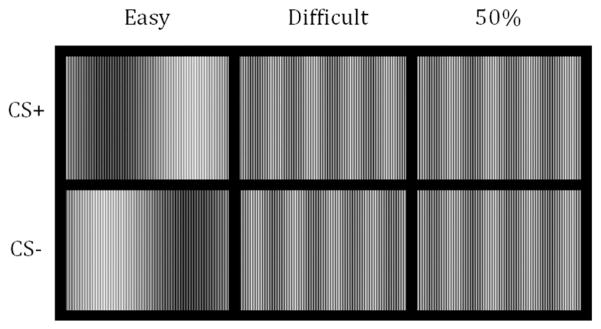
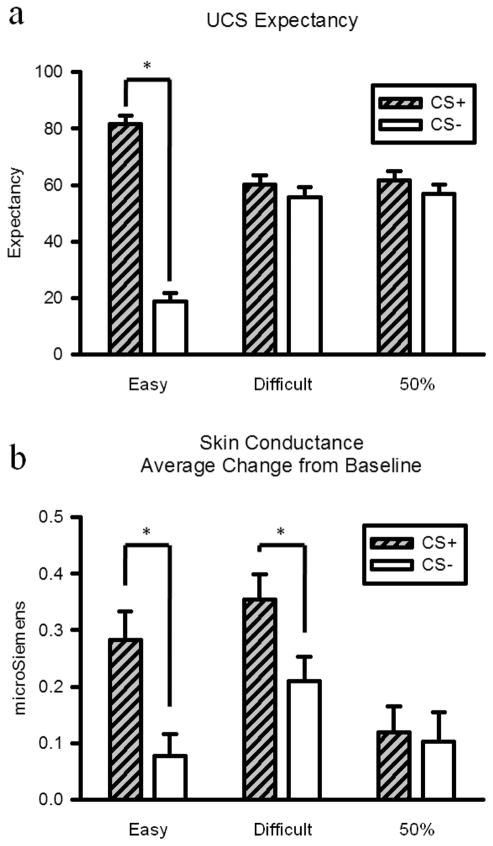
The role of contingency awareness in classical conditioning experiments using human subjects is currently under debate. This study took a novel approach to manipulating contingency awareness in a differential Pavlovian conditioning paradigm. Complex sine wave gratings were used as visual conditional stimuli (CS). By manipulating the fundamental spatial frequency of the displays, we were able to construct pairs of stimuli that varied in discriminability. One group of subjects was given an "easy" discrimination, and another was exposed to a "difficult" CS+ and CS-. A 3rd group was exposed to a stimulus that was paired with the unconditional stimulus (UCS) 50% of the time and served as a control. Skin conductance response (SCR) and continuous UCS expectancy data were measured concurrently throughout the experiment. Differential UCS expectancy was found only in the easy discrimination group. Differential SCRs were found in the easy discrimination group as well as in the difficult discrimination group, but not in the 50% contingency control. The difficult discrimination group did not exhibit differential UCS expectancy but did show clear differential SCR. These observations support a dual process interpretation of classical conditioning whereby conditioning on an implicit level can occur without explicit knowledge about the contingencies. The role of contingency awareness in classical conditioning experiments using human subjects is currently under debate. This study took a novel approach to manipulating contingency awareness in a differential Pavlovian conditioning paradigm. Complex sine wave gratings were used as visual conditional stimuli (CS). By manipulating the fundamental spatial frequency of the displays, we were able to construct pairs of stimuli that varied in discriminability. One group of subjects was given an "easy" discrimination, and another was exposed to a "difficult" CS+ and CS-. A 3rd group was exposed to a stimulus that was paired with the unconditional stimulus (UCS) 50% of the time and served as a control. Skin conductance response (SCR) and continuous UCS expectancy data were measured concurrently throughout the experiment. Differential UCS expectancy was found only in the easy discrimination group. Differential SCRs were found in the easy discrimination group as well as in the difficult discrimination group, but not in the 50% contingency control. The difficult discrimination group did not exhibit differential UCS expectancy but did show clear differential SCR. These observations support a dual process interpretation of classical conditioning whereby conditioning on an implicit level can occur without explicit knowledge about the contingencies.
2010 APA, all rights reserved
Figures
References
-
- Baer P, Fuhrer M. Cognitive processes during differential trace and delayed conditioning of the GSR. Journal of Experimental Psychology. 1968;78:81–88. - PubMed
-
- Baeyens F, Eelen P, Van den Bergh O. Contingency awareness in evaluative conditioning: A case for unaware affective-evaluative learning. Cognition & Emotion. 1990;4:3–18.
-
- Bechara A, Tranel D, Damasio H, Adolphs R, Rockland C, Damasio A. Double dissociation of conditioning and declarative knowledge relative to the amygdala and hippocampus in humans. Science. 1995 Aug 25;269:1115–1118. - PubMed
-
- Cheng D, Knight D, Smith C, Helmstetter F. Human amygdala activity during the expression of fear responses. Behavioral Neuroscience. 2006;120:1187–1195. - PubMed