


Co-operative signalling through DP(1) and DP(2) prostanoid receptors is required to enhance leukotriene C(4) synthesis induced by prostaglandin D(2) in eosinophils
- PMID: 20973774
- PMCID: PMC3081113
- DOI: 10.1111/j.1476-5381.2010.01086.x
Co-operative signalling through DP(1) and DP(2) prostanoid receptors is required to enhance leukotriene C(4) synthesis induced by prostaglandin D(2) in eosinophils
Abstract
Background and purpose: Prostaglandin (PG) D(2) has emerged as a key mediator of allergic inflammatory pathologies and, particularly, PGD(2) induces leukotriene (LT) C(4) secretion from eosinophils. Here, we have characterized how PGD(2) signals to induce LTC(4) synthesis in eosinophils.
Experimental approach: Antagonists and agonists of DP(1) and DP(2) prostanoid receptors were used in a model of PGD(2) -induced eosinophilic inflammation in vivo and with PGD(2) -stimulated human eosinophils in vitro, to identify PGD(2) receptor(s) mediating LTC(4) secretion. The signalling pathways involved were also investigated.
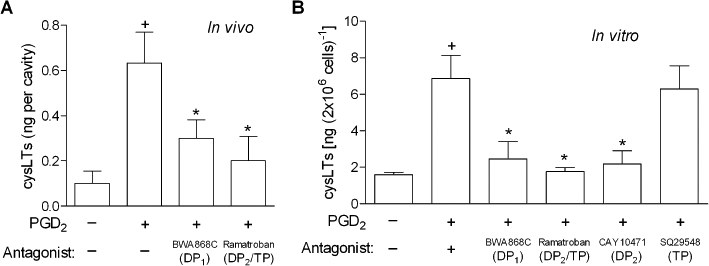
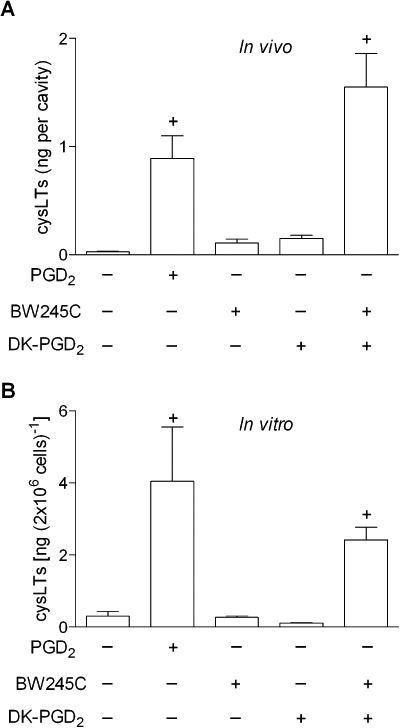
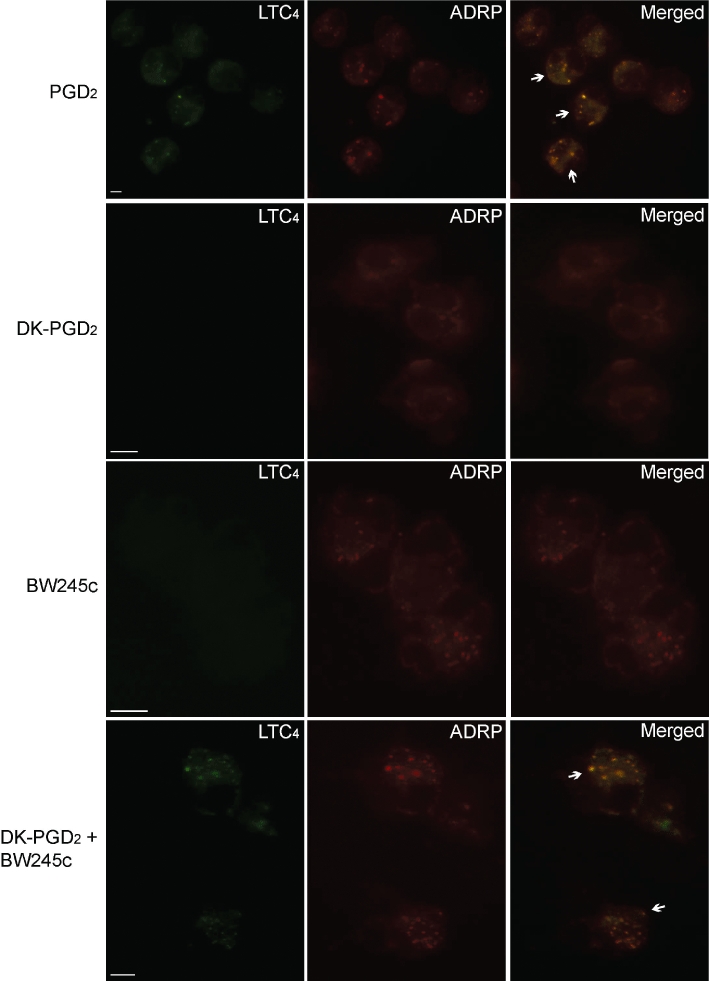
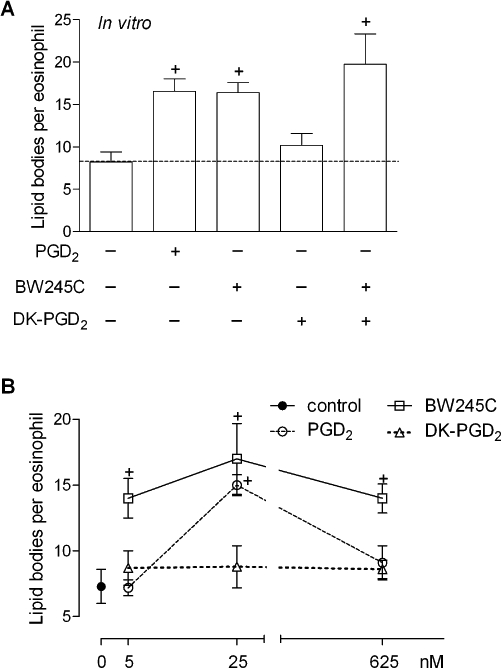
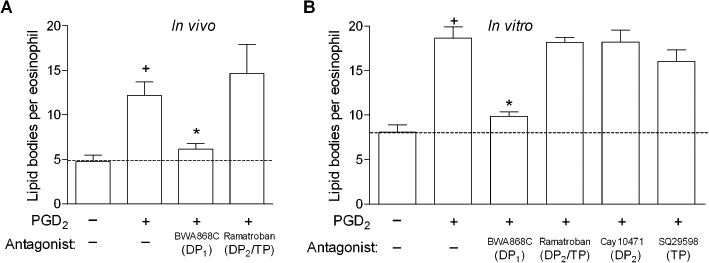
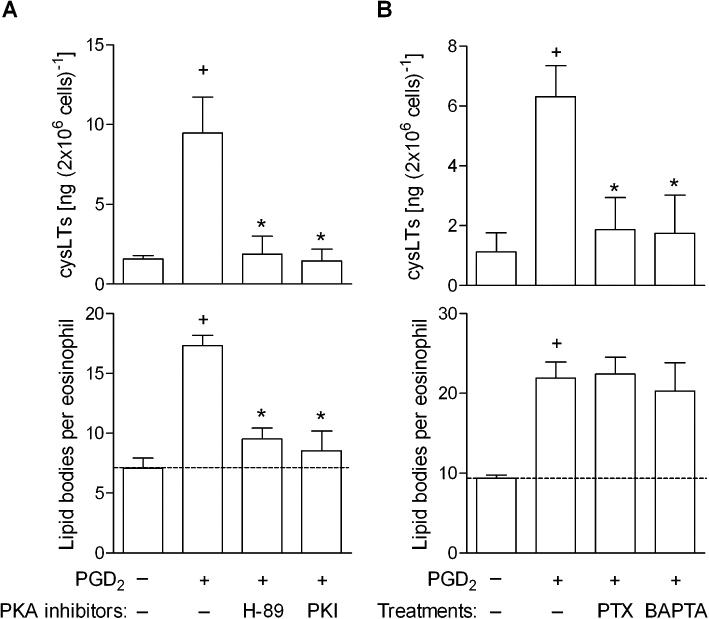
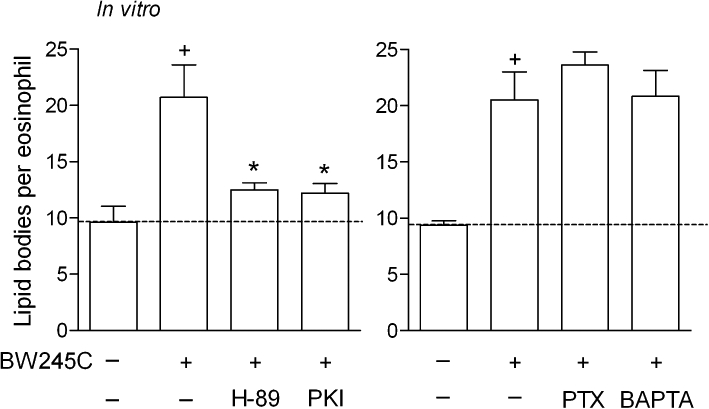
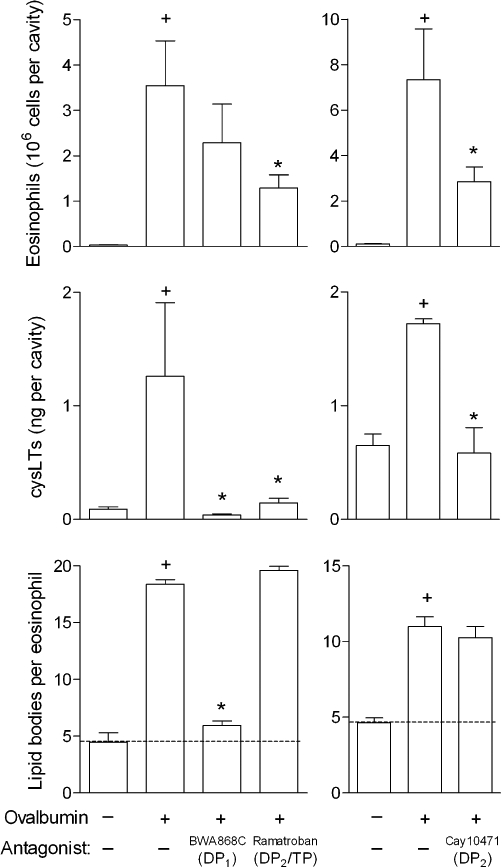
Key results: In vivo and in vitro assays with receptor antagonists showed that PGD(2) -triggered cysteinyl-LT (cysLT) secretion depends on the activation of both DP(1) and DP(2) receptors. DP(1) and DP(2) receptor agonists elicited cysLTs production only after simultaneous activation of both receptors. In eosinophils, LTC(4) synthesis, but not LTC(4) transport/export, was activated by PGD(2) receptor stimulation, and lipid bodies (lipid droplets) were the intracellular compartments of DP(1) /DP(2) receptor-driven LTC(4) synthesis. Although not sufficient to trigger LTC(4) synthesis by itself, DP(1) receptor activation, signalling through protein kinase A, did activate the biogenesis of eosinophil lipid bodies, a process crucial for PGD(2) -induced LTC(4) synthesis. Similarly, concurrent DP(2) receptor activation used Pertussis toxin-sensitive and calcium-dependent signalling pathways to achieve effective PGD(2) -induced LTC(4) synthesis.
Conclusions and implications: Based on pivotal roles of cysLTs in allergic inflammatory pathogenesis and the collaborative interaction between PGD(2) receptors described here, our data suggest that both DP(1) and DP(2) receptor antagonists might be attractive candidates for anti-allergic therapies.
© 2011 The Authors. British Journal of Pharmacology © 2011 The British Pharmacological Society.
Figures
Comment in
-
R2D(2) for C(4)Eo: an 'alliance' of PGD(2) receptors is required for LTC(4) production by human eosinophils.Br J Pharmacol. 2011 Apr;162(8):1671-3. doi: 10.1111/j.1476-5381.2011.01236.x. Br J Pharmacol. 2011. PMID: 21426314 Free PMC article.
References
-
- Bandeira-Melo C, Weller PF. Eosinophils and cysteinyl leukotrienes. Prostaglandins Leukot Essent Fatty Acids. 2003;69:135–143. - PubMed
-
- Bandeira-Melo C, Phoofolo M, Weller PF. Extranuclear lipid bodies, elicited by CCR3-mediated signaling pathways, are the sites of chemokine-enhanced leukotriene C4 production in eosinophils and basophils. J Biol Chem. 2001;276:22779–22787. - PubMed
-
- Bandeira-Melo C, Bozza PT, Weller PF. The cellular biology of eosinophil eicosanoid formation and function. J Allergy Clin Immunol. 2002a;109:393–400. - PubMed
Publication types
MeSH terms
Substances
LinkOut - more resources
Full Text Sources
Other Literature Sources
Miscellaneous
