. 2011 Jan;39(Database issue):D612-9.
doi: 10.1093/nar/gkq1006. Epub 2010 Oct 24.

AmoebaDB and MicrosporidiaDB: functional genomic resources for Amoebozoa and Microsporidia species

Affiliations

AmoebaDB and MicrosporidiaDB: functional genomic resources for Amoebozoa and Microsporidia species

Cristina Aurrecoechea et al. Nucleic Acids Res. 2011 Jan.

Abstract

AmoebaDB (http://AmoebaDB.org) and MicrosporidiaDB (http://MicrosporidiaDB.org) are new functional genomic databases serving the amoebozoa and microsporidia research communities, respectively. AmoebaDB contains the genomes of three Entamoeba species (E. dispar, E. invadens and E. histolityca) and microarray expression data for E. histolytica. MicrosporidiaDB contains the genomes of Encephalitozoon cuniculi, E. intestinalis and E. bieneusi. The databases belong to the National Institute of Allergy and Infectious Diseases (NIAID) funded EuPathDB (http://EuPathDB.org) Bioinformatics Resource Center family of integrated databases and assume the same architectural and graphical design as other EuPathDB resources such as PlasmoDB and TriTrypDB. Importantly they utilize the graphical strategy builder that affords a database user the ability to ask complex multi-data-type questions with relative ease and versatility. Genomic scale data can be queried based on BLAST searches, annotation keywords and gene ID searches, GO terms, sequence motifs, protein characteristics, phylogenetic relationships and functional data such as transcript (microarray and EST evidence) and protein expression data. Search strategies can be saved within a user's profile for future retrieval and may also be shared with other researchers using a unique strategy web address.


Figures
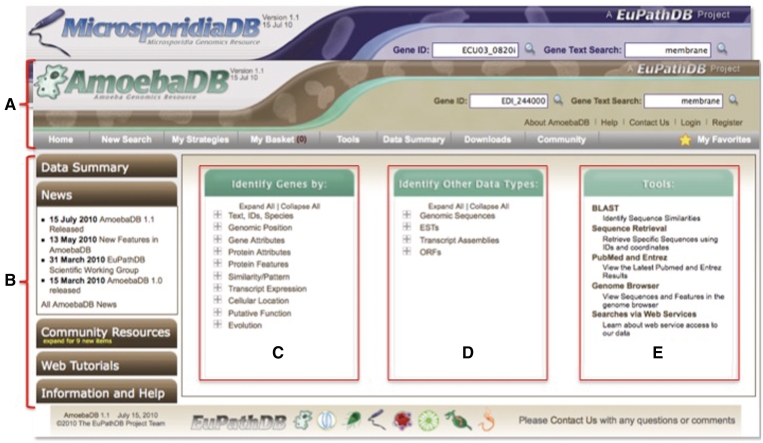
Figure 1.
Figure 1.
Screen shot of the AmoebaDB homepage. The layout of the MicrosporidiaDB homepage is exactly the same. (A) The banner section is a constant fixture on all AmoebaDB and MicrosporidiaDB web pages. It contains links to register and login, all searches, tools and information pages, the basket and favorites and ID and text search windows for rapid access from anywhere on the sites. (B) The side panel on the homepage provides expandable tabs that reveal links to a EuPathDB data summary table, community news items, links to community resources, web tutorials and additional information and help links. The central portion of the home page includes all available searches and tools—gene specific searches in (C), searches against other data types such as genomic sequence, open reading frames and ESTs in (D) and tools, such as BLAST, sequence retrieval and the genome browser in (E).
Figure 2.
Figure 2.
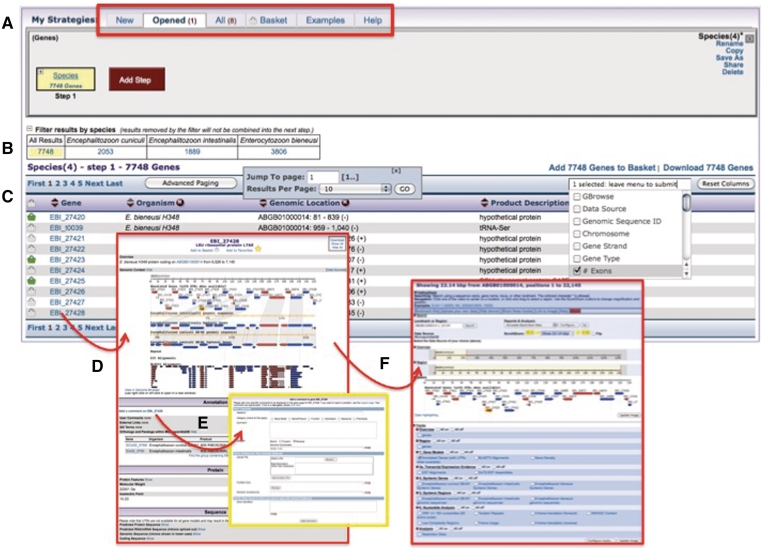
AmoebaDB or MicrosporidiaDB results page. Once a user runs a search they are taken to the result summary page that includes a search strategy builder in (A), a filter table showing the distribution of results among related species in (B) and an interactive and configurable table of results in (C). Clicking on the IDs in the results reveals the record page—a gene record page is shown in (D) where a user can view gene-specific information such as synteny and available data, and can add user comments (E) or link to the genome browser to view additional data displayed in the genomic context (F).
Figure 3.
Figure 3.
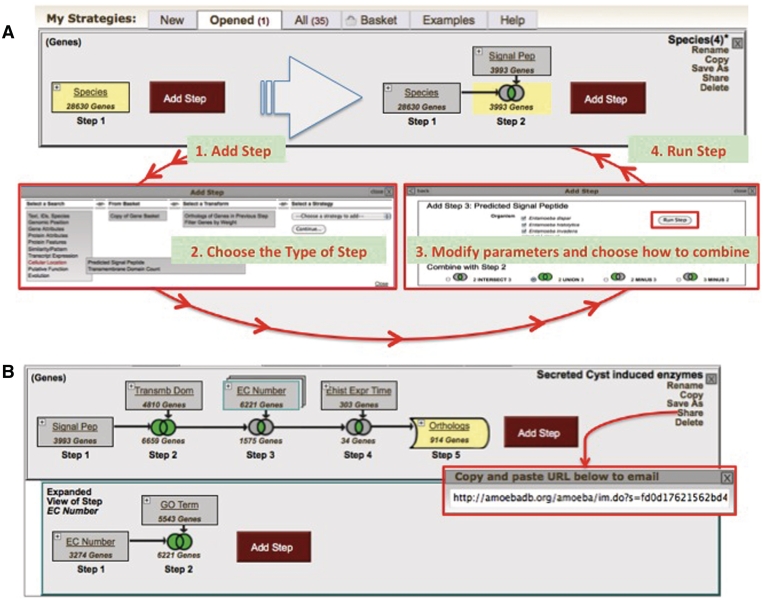
A search strategy. (A) The search strategy cycle begins with adding a step to the first search (1), which reveals a popup window with all search options. Once a search type is selected (2), search parameters can be modified and a user chooses how to combine these results with the previous step (3). Clicking on the run step button completes the cycle and expands the strategy horizontally (4). This cycle can be repeated to develop complex search strategies (B). Individual steps in a strategy can be revised, renamed, deleted or transformed into orthologs. Also, the strategy itself can be renamed, copied, saved, deleted and shared with a unique URL (red insert).

References

    1. Aurrecoechea C, Brestelli J, Brunk BP, Fischer S, Gajria B, Gao X, Gingle A, Grant G, Harb OS, Heiges M, et al. EuPathDB: a portal to eukaryotic pathogen databases. Nucleic Acids Res. 2010;38:D415–D419. - PMC - PubMed
    1. Aslett M, Aurrecoechea C, Berriman M, Brestelli J, Brunk BP, Carrington M, Depledge DP, Fischer S, Gajria B, Gao X, et al. TriTrypDB: a functional genomic resource for the Trypanosomatidae. Nucleic Acids Res. 2010;38:D457–D462. - PMC - PubMed
    1. Aurrecoechea C, Brestelli J, Brunk BP, Carlton JM, Dommer J, Fischer S, Gajria B, Gao X, Gingle A, Grant G, et al. GiardiaDB and TrichDB: integrated genomic resources for the eukaryotic protist pathogens Giardia lamblia and Trichomonas vaginalis. Nucleic Acids Res. 2009;37:D526–D530. - PMC - PubMed
    1. Aurrecoechea C, Brestelli J, Brunk BP, Dommer J, Fischer S, Gajria B, Gao X, Gingle A, Grant G, Harb OS, et al. PlasmoDB: a functional genomic database for malaria parasites. Nucleic Acids Res. 2009;37:D539–D543. - PMC - PubMed
    1. Gajria B, Bahl A, Brestelli J, Dommer J, Fischer S, Gao X, Heiges M, Iodice J, Kissinger JC, Mackey AJ, et al. ToxoDB: an integrated Toxoplasma gondii database resource. Nucleic Acids Res. 2008;36:D553–D556. - PMC - PubMed

Publication types