. 2011 Jun;62(10):3359-74.
doi: 10.1093/jxb/erq321. Epub 2010 Oct 25.

Conservation and divergence of autonomous pathway genes in the flowering regulatory network of Beta vulgaris

Affiliations

Conservation and divergence of autonomous pathway genes in the flowering regulatory network of Beta vulgaris

Salah F Abou-Elwafa et al. J Exp Bot. 2011 Jun.

Abstract

The transition from vegetative growth to reproductive development is a complex process that requires an integrated response to multiple environmental cues and endogenous signals. In Arabidopsis thaliana, which has a facultative requirement for vernalization and long days, the genes of the autonomous pathway function as floral promoters by repressing the central repressor and vernalization-regulatory gene FLC. Environmental regulation by seasonal changes in daylength is under control of the photoperiod pathway and its key gene CO. The root and leaf crop species Beta vulgaris in the caryophyllid clade of core eudicots, which is only very distantly related to Arabidopsis, is an obligate long-day plant and includes forms with or without vernalization requirement. FLC and CO homologues with related functions in beet have been identified, but the presence of autonomous pathway genes which function in parallel to the vernalization and photoperiod pathways has not yet been reported. Here, this begins to be addressed by the identification and genetic mapping of full-length homologues of the RNA-regulatory gene FLK and the chromatin-regulatory genes FVE, LD, and LDL1. When overexpressed in A. thaliana, BvFLK accelerates bolting in the Col-0 background and fully complements the late-bolting phenotype of an flk mutant through repression of FLC. In contrast, complementation analysis of BvFVE1 and the presence of a putative paralogue in beet suggest evolutionary divergence of FVE homologues. It is further shown that BvFVE1, unlike FVE in Arabidopsis, is under circadian clock control. Together, the data provide first evidence for evolutionary conservation of components of the autonomous pathway in B. vulgaris, while also suggesting divergence or subfunctionalization of one gene. The results are likely to be of broader relevance because B. vulgaris expands the spectrum of evolutionarily diverse species which are subject to differential developmental and/or environmental regulation of floral transition.


Figures
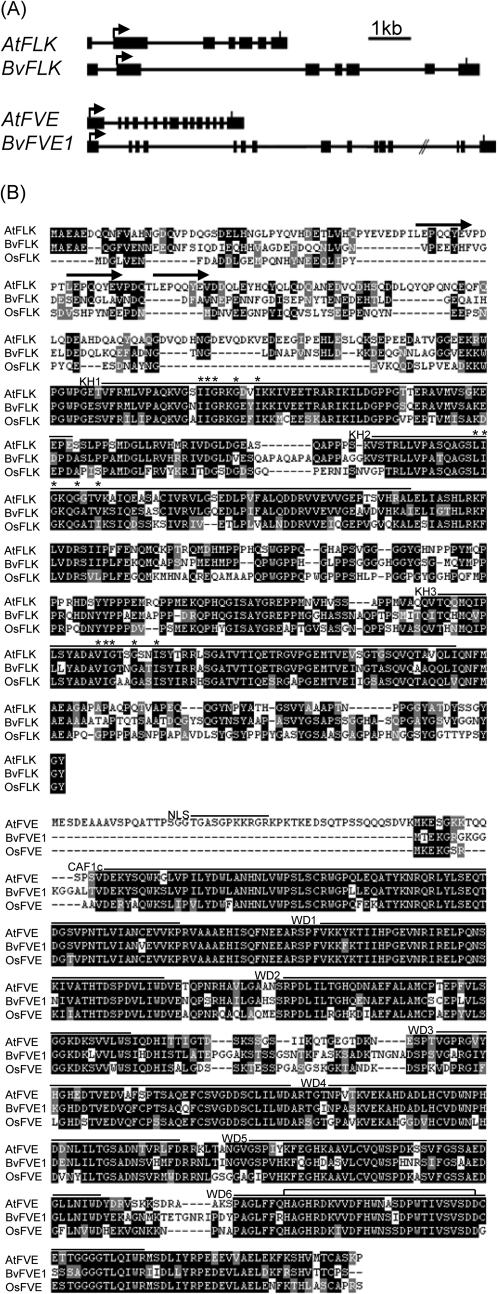
Fig. 1.
Fig. 1.
Sequence and structure of the autonomous pathway gene homologues BvFLK and BvFVE1. (A) Exon–intron structure of BvFLK, BvFVE1, and the respective A. thaliana genes (FLK, accession number AAX51268; FVE, accession number AF498101). Exons are indicated as black rectangles, and the position of start and stop codons is indicated by arrows and vertical bars, respectively. (B) Pairwise sequence alignments and domain organization. The alignments were generated using ClustalW2 (http://www.ebi.ac.uk/Tools/clustalw2/index.html). Identical and similar residues are highlighted by black or grey boxes, respectively. The position of protein domains according to Pfam 22.0 (http://pfam.sanger.ac.uk/) is marked by horizontal lines above the alignment. In FLK, the positions of three perfect eight-residue repeats and the core residues of K-homology RNA-binding (KH) domains (Mockler et al., 2004) are indicated by arrows and asterisks, respectively. The first and sixth WD40 repeat domains (WD1 and WD6) were not identified by Pfam and were annotated according to Ausin et al. (2004). A putative nuclear localization signal (NLS; black line) in FVE according to Ausin et al. (2004) and a potential zinc-binding site (unfilled box) in WD6 (Kenzior and Folk, 1998) are also indicated. WD, WD40 repeat domain; CAF1c, CAF1 subunit C/histone-binding protein RBBP4 domain.
Fig. 2.
Fig. 2.
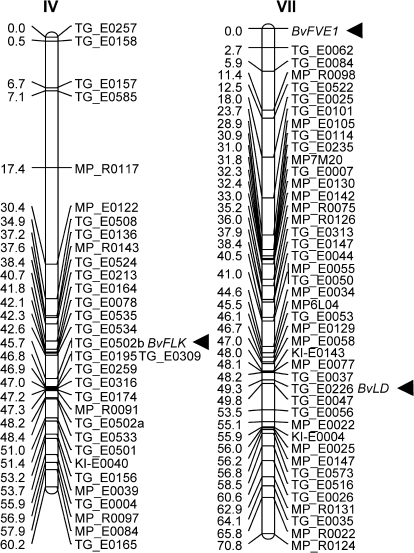
Genetic map positions. BvFLK and BvFVE1 (arrowheads) were mapped to position 45.7 cM on chromosome IV and the top end of chromosome VII, respectively, on a reference map of the sugar beet genome (Schneider et al., 2007). The map position of an EST which had been mapped previously (Schneider et al., 2007) and corresponds to BvLD is also indicated. Genetic distances in centiMorgans (cM) are given on the left, and marker names on the right.
Fig. 3.
Fig. 3.
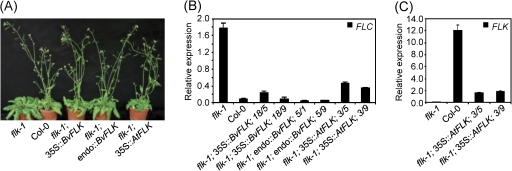
BvFLK complements the A. thaliana flk-1 mutant. (A) Phenotypes at 51 d after sowing of the A. thaliana flk-1 mutant, the ecotype Col-0, and the flk-1 mutant transformed with BvFLK driven by the CaMV 35S promoter (35S::BvFLK), BvFLK driven by the endogenous promoter of BvFLK in sugar beet (endo::BvFLK), or A. thaliana FLK driven by the CaMV 35S promoter (35S::AtFLK) (T1 plants). Plants were grown under long-day conditions. (B) RT-qPCR expression analysis of FLC in flk-1, Col-0, and transgenic T3 plants carrying the 35S::BvFLK, endo::BvFLK, or 35S::AtFLK transgene in the flk-1 mutant background. For each of the transgenic lines, two T3 plants were tested that were derived from different transgenic individuals of a T2 family. (C) RT-qPCR expression analysis of FLK in flk-1, Col-0, and transgenic 35S::AtFLK T3 plants. Expression levels in B and C were normalized against GAPDH and measured in triplicate. Error bars indicate the standard deviations of the mean. (This figure is available in colour at JXB online.)
Fig. 4.
Fig. 4.
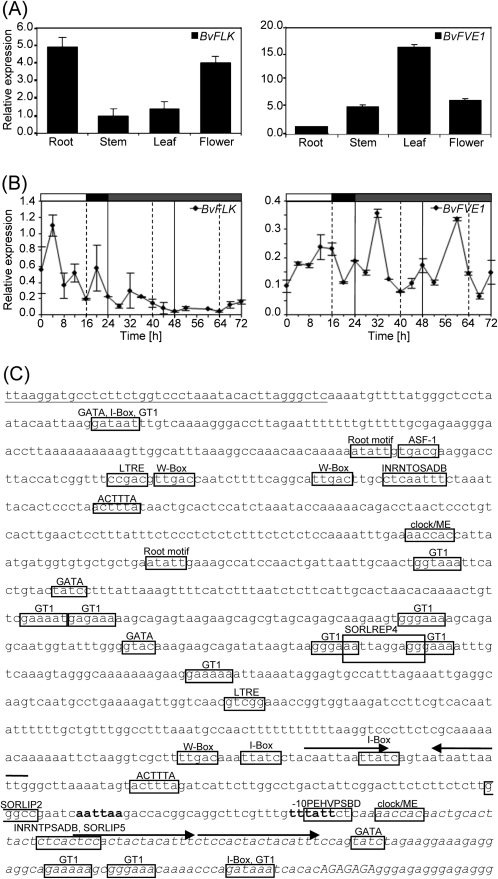
Expression of BvFLK and BvFVE1 in B. vulgaris. (A) Expression across major plant organs in the biennial genotype A906001. Plants were vernalized and grown under long-day conditions. RT-qPCR expression levels were normalized against BvGAPDH and measured in triplicate. (B) Diurnal and circadian RT-qPCR expression profiles. Relative expression levels in leaves are shown for a 24 h period under long-day conditions, followed by 48 h under continuous low light at a constant temperature of 22 °C. Expression was measured every 4 h. Expression was normalized using BvGAPDH, BvEF2, and BvTUB. Error bars indicate the standard deviations of the mean. (C) BvFVE1 promoter and 5′ UTR. A total of 1116 bp of the genomic sequence upstream of the start codon are shown. The transcription start site was determined by RACE. The 5′ UTR sequence is printed in italics. Bold letters at positions –9 and –36 (relative to the transcription start site) indicate a TATA-box-like sequence (de Pater et al., 1990) and a TATA-box according to the transcription start site prediction program TSSP (http://www.softberry.ru/berry.phtml), respectively. A GA repeat motif (Santi et al., 2003) in the 5′ UTR just upstream of the ATG start codon is shown in upper case letters. Putative light- and circadian clock-regulated promoter elements are boxed [SORLIP and SORLREP (Hudson and Quail, 2003), GT1 consensus sequence (Terzaghi and Cashmore, 1995), IBOX core motif (Terzaghi and Cashmore, 1995), GATA box (Gilmartin et al., 1990), INRNTPSADB (Nakamura et al., 2002), –10PEHVPSBD (Thum et al., 2001), and a six nucleotide motif (clock/ME) which is common to a promoter element over-represented in circadian clock-regulated genes and a morning element (Harmer and Kay, 2005)]. Arrows above the sequence denote inverted and tandem repeat units. The 3′ end of a sequence tract with homology to the subtelomeric satellite AM076746 of B. vulgaris [clone pAv34-32 (Dechyeva and Schmidt, 2006)] is underlined.

References

    1. Abegg FA. A genetic factor for the annual habit in beets and linkage relationship. Journal of Agricultural Research. 1936;53:493–511.
    1. Albert VA, Soltis DE, Carlson JE, et al. Floral gene resources from basal angiosperms for comparative genomics research. BMC Plant Biology. 2005;5:5. - PMC - PubMed
    1. Alonso JM, Stepanova AN, Leisse TJ, et al. Genome-wide insertional mutagenesis of Arabidopsis thaliana. Science. 2003;301:653–657. - PubMed
    1. Altschul SF, Gish W, Miller W, Myers E, Lipman DJ. Basic local alignment search tool. Journal of Molecular Biology. 1990;215:403–410. - PubMed
    1. Amasino R. Take a cold flower. Nature Genetics. 2004;36:111–112. - PubMed

Publication types

MeSH terms