


Fission yeast receptor of activated C kinase (RACK1) ortholog Cpc2 regulates mitotic commitment through Wee1 kinase
- PMID: 20974849
- PMCID: PMC3009862
- DOI: 10.1074/jbc.M110.173815
Fission yeast receptor of activated C kinase (RACK1) ortholog Cpc2 regulates mitotic commitment through Wee1 kinase
Abstract
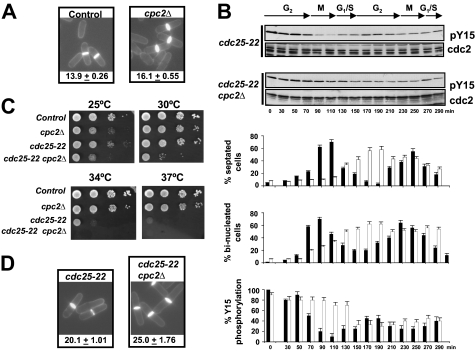
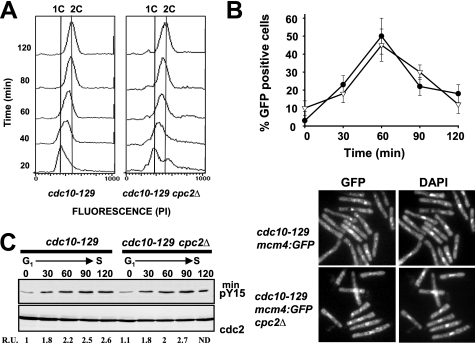
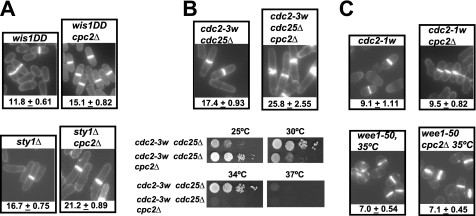
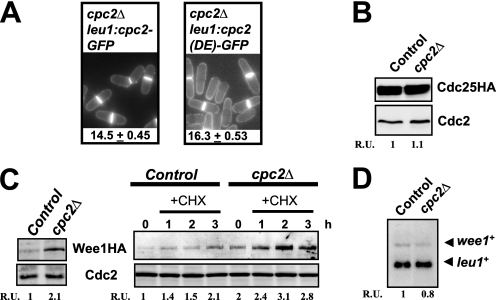
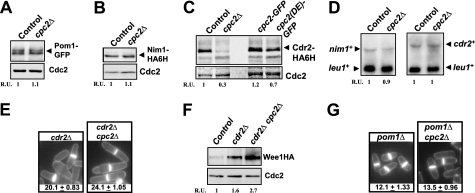
In the fission yeast Schizosaccharomyces pombe, Wee1-dependent inhibitory phosphorylation of the highly conserved Cdc2/Cdk1 kinase determines the mitotic onset when cells have reached a defined size. The receptor of activated C kinase (RACK1) is a scaffolding protein strongly conserved among eukaryotes which binds to other proteins to regulate multiple processes in mammalian cells, including the modulation of cell cycle progression during G(1)/S transition. We have recently described that Cpc2, the fission yeast ortholog to RACK1, controls from the ribosome the activation of MAPK cascades and the cellular defense against oxidative stress by positively regulating the translation of specific genes whose products participate in the above processes. Intriguingly, mutants lacking Cpc2 display an increased cell size at division, suggesting the existence of a specific cell cycle defect at the G(2)/M transition. In this work we show that protein levels of Wee1 mitotic inhibitor are increased in cells devoid of Cpc2, whereas the levels of Cdr2, a Wee1 inhibitor, are down-regulated in the above mutant. On the contrary, the kinetics of G(1)/S transition was virtually identical both in control and Cpc2-less strains. Thus, our results suggest that in fission yeast Cpc2/RACK1 positively regulates from the ribosome the mitotic onset by modulating both the protein levels and the activity of Wee1. This novel mechanism of translational control of cell cycle progression might be conserved in higher eukaryotes.
Figures
References
Publication types
MeSH terms
Substances
LinkOut - more resources
Full Text Sources
Molecular Biology Databases
Research Materials
Miscellaneous
