. 2010 Nov 9;107(45):19579-84.
doi: 10.1073/pnas.1014419107. Epub 2010 Oct 25.

Linking differential domain functions of the GS3 protein to natural variation of grain size in rice

Affiliations

Linking differential domain functions of the GS3 protein to natural variation of grain size in rice

Hailiang Mao et al. Proc Natl Acad Sci U S A. .

Abstract

Grain yield in many cereal crops is largely determined by grain size. Here we report the genetic and molecular characterization of GS3, a major quantitative trait locus for grain size. It functions as a negative regulator of grain size and organ size. The wild-type isoform is composed of four putative domains: a plant-specific organ size regulation (OSR) domain in the N terminus, a transmembrane domain, a tumor necrosis factor receptor/nerve growth factor receptor (TNFR/NGFR) family cysteine-rich domain, and a von Willebrand factor type C (VWFC) in the C terminus. These domains function differentially in grain size regulation. The OSR domain is both necessary and sufficient for functioning as a negative regulator. The wild-type allele corresponds to medium grain. Loss of function of OSR results in long grain. The C-terminal TNFR/NGFR and VWFC domains show an inhibitory effect on the OSR function; loss-of-function mutations of these domains produced very short grain. This study linked the functional domains of the GS3 protein to natural variation of grain size in rice.


Conflict of interest statement

The authors declare no conflict of interest.

Figures
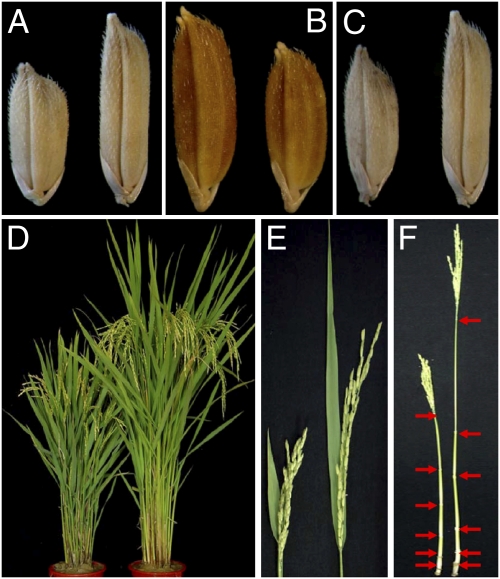
Fig. 1.
Fig. 1.
Effect of GS3 on grain size and plant morphology exhibited by transgenics. (A–C) Grains of positive (Left) and negative (Right) segregants from T1 family by (A) transforming Minghui 63 with CT9.8 containing the genomic fragment of Chuan 7; (B) transforming Chuan 7 with the RNAi-GS3 construct; and (C) overexpressing GS3 using the 35SFL construct. (D–F) Positive (Left) and negative (Right) segregants from T1 family overexpressing GS3 using the 35SFL construct: (D) whole plants; (E) panicles and flag leaves; and (F) main culms, with arrowheads indicating the internodes.
Fig. 2.
Fig. 2.
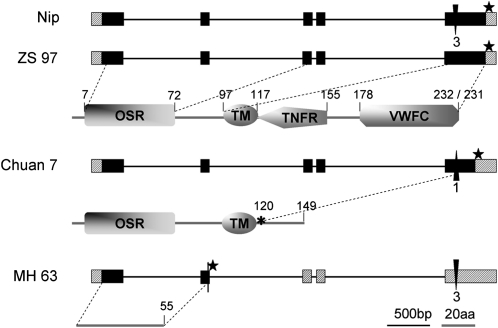
Comparison of the genomic DNA and predicted protein sequences of GS3 in Zhenshan 97 (ZS97, GS3-1), Nipponbare (Nip, GS3-2), Minghui 63 (MH63, GS3-3), and Chuan 7 (GS3-4), relative to ZS97. Genomic DNA: hatched boxes represent 5′ and 3′ UTR, and five exons are indicated by black boxes. The thin lines between black boxes represent introns. Black triangles represent a 3-bp insertion (Nip) and a 1-bp deletion (Chuan 7). Stop codons are marked by stars. Protein structure (underneath each genomic DNA fragment): the domains encoded by Nip/ZS97 allele are shown, with the numbers indicating the positions of the domains. The 1-bp deletion in Chuan 7 causes frameshift from site 120 (marked with asterisk), resulting in the loss of TNFR and VWFC domains. The putative protein encoded by Minghui 63 allele contains no functional domain because of premature termination.
Fig. 3.
Fig. 3.
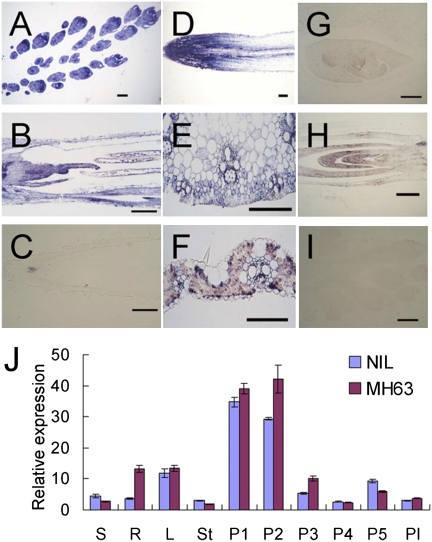
Expression pattern of GS3. (A–H) Expression of GS3 in various tissues revealed by in situ hybridization: (A) panicle at stage of pollen mother cell formation, (B) panicle at pollen mother cell meiosis, (C) panicle at pollen grain filling, (D) root at trefoil stage, (E) stem at heading stage, (F) leaf at tillering stage, (G) endosperm and embryo 14 d after flowering, and (H) longitudinal section of 7-d-old seedling. (I) Negative control by hybridizing the young panicle with the sense probe. All tissues were sampled from Zhenshan 97 (medium grain). (Scale bars, 200 μm.) (J) Comparative expression pattern of GS3 in Minghui 63 and NIL(c7) in various organs using real-time RT-PCR analysis: S, seedling at trefoil stage; R, root at trefoil stage; L, leaf at tillering stage; St, stem at heading stage; P1, young panicle <1 cm in length; P2, young panicle <5 cm in length; P3, young panicle 5–10 cm in length; P4, panicle before heading >10 cm in length; P5, panicle 5 d after heading; Pl, plumule.
Fig. 4.
Fig. 4.
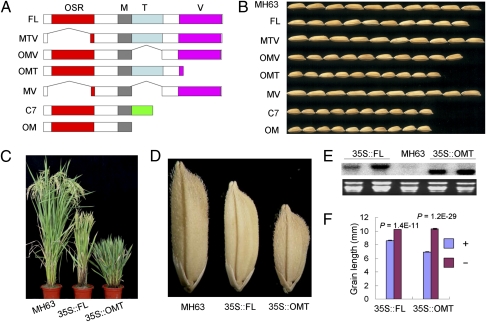
Effects on grain size of the various domains assessed using transgenics. (A) Schematic representation of the coding sequences of the constructs with one or more domains deleted; (B) grains of the T1 generation transgenic plants compared with Minghui 63. OSR, organ size regulation domain; M, putative transmembrane domain; T, TNFR/NGRF domain; V, VWFC domain. Green box represents the polypeptide sequence resulting from frameshift. (C and D) Effect of VWFC in inhibiting OSR in regulating growth of plant and grain size. From left to right: Minghui 63, transgenic plants overexpressing the fl-cDNA (FL), or the truncated cDNA (OMT). (E) Northern blot analysis of GS3 transcripts in wild-type plants and in two positive segregants from respective T1 generations. (F) Grain length of T1 plants overexpressing fl-cDNA (FL) or the truncated cDNA (OMT). + and −, positive and negative segregants. Data are given as mean ± SEM. Student's t test was used to generate the P values.

References

    1. Schruff MC, et al. The AUXIN RESPONSE FACTOR 2 gene of Arabidopsis links auxin signalling, cell division, and the size of seeds and other organs. Development. 2006;133:251–261. - PubMed
    1. Frary A, et al. fw2.2: A quantitative trait locus key to the evolution of tomato fruit size. Science. 2000;289:85–88. - PubMed
    1. Mizukami Y, Fischer RL. Plant organ size control: AINTEGUMENTA regulates growth and cell numbers during organogenesis. Proc Natl Acad Sci USA. 2000;97:942–947. - PMC - PubMed
    1. Li Y, Zheng L, Corke F, Smith C, Bevan MW. Control of final seed and organ size by the DA1 gene family in Arabidopsis thaliana. Genes Dev. 2008;22:1331–1336. - PMC - PubMed
    1. Luo M, Dennis ES, Berger F, Peacock WJ, Chaudhury A. MINISEED3 (MINI3), a WRKY family gene, and HAIKU2 (IKU2), a leucine-rich repeat (LRR) KINASE gene, are regulators of seed size in Arabidopsis. Proc Natl Acad Sci USA. 2005;102:17531–17536. - PMC - PubMed

Publication types

LinkOut - more resources