


Cancer risks after radiation exposure in middle age
- PMID: 20975037
- PMCID: PMC2970575
- DOI: 10.1093/jnci/djq346
Cancer risks after radiation exposure in middle age
Abstract
Background: Epidemiological data show that radiation exposure during childhood is associated with larger cancer risks compared with exposure at older ages. For exposures in adulthood, however, the relative risks of radiation-induced cancer in Japanese atomic bomb survivors generally do not decrease monotonically with increasing age of adult exposure. These observations are inconsistent with most standard models of radiation-induced cancer, which predict that relative risks decrease monotonically with increasing age at exposure, at all ages.
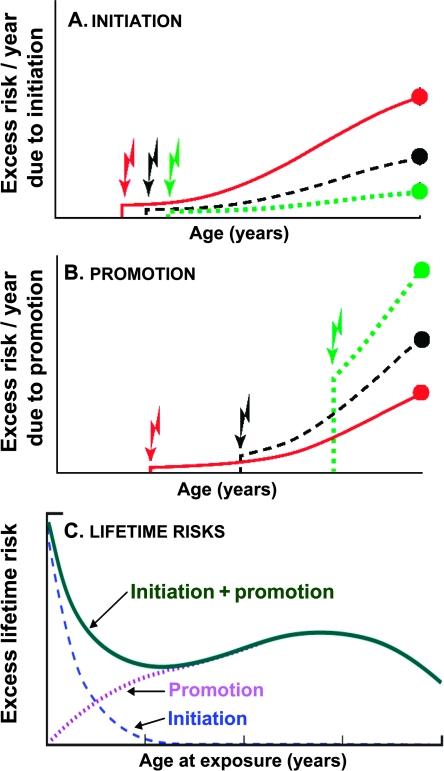
Methods: We analyzed observed cancer risk patterns as a function of age at exposure in Japanese atomic bomb survivors by using a biologically based quantitative model of radiation carcinogenesis that incorporates both radiation induction of premalignant cells (initiation) and radiation-induced promotion of premalignant damage. This approach emphasizes the kinetics of radiation-induced initiation and promotion, and tracks the yields of premalignant cells before, during, shortly after, and long after radiation exposure.
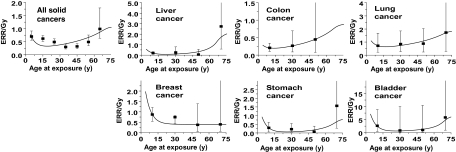
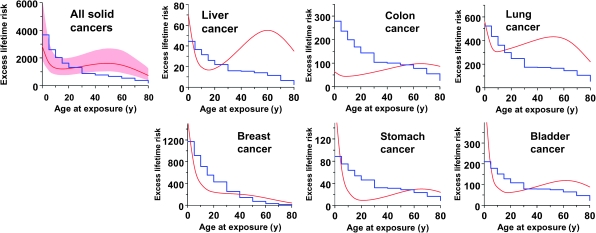
Results: Radiation risks after exposure in younger individuals are dominated by initiation processes, whereas radiation risks after exposure at later ages are more influenced by promotion of preexisting premalignant cells. Thus, the cancer site-dependent balance between initiation and promotion determines the dependence of cancer risk on age at radiation exposure. For example, in terms of radiation induction of premalignant cells, a quantitative measure of the relative contribution of initiation vs promotion is 10-fold larger for breast cancer than for lung cancer. Reflecting this difference, radiation-induced breast cancer risks decrease with age at exposure at all ages, whereas radiation-induced lung cancer risks do not.
Conclusion: For radiation exposure in middle age, most radiation-induced cancer risks do not, as often assumed, decrease with increasing age at exposure. This observation suggests that promotional processes in radiation carcinogenesis become increasingly important as the age at exposure increases. Radiation-induced cancer risks after exposure in middle age may be up to twice as high as previously estimated, which could have implications for occupational exposure and radiological imaging.
Figures
Comment in
-
Models, models everywhere--is there a fit for lifetime risks?J Natl Cancer Inst. 2010 Nov 3;102(21):1606-9. doi: 10.1093/jnci/djq412. Epub 2010 Oct 25. J Natl Cancer Inst. 2010. PMID: 20975038 No abstract available.
References
-
- Preston DL, Ron E, Tokuoka S, et al. Solid cancer incidence in atomic bomb survivors: 1958–1998. Radiat Res. 2007;168(1):1–64. - PubMed
-
- Preston DL, Shimizu Y, Pierce DA, Suyama A, Mabuchi K. Studies of mortality of atomic bomb survivors. Report 13: Solid cancer and noncancer disease mortality: 1950–1997. Radiat Res. 2003;160(4):381–407. - PubMed
-
- Heidenreich WF, Cullings HM, Funamoto S, Paretzke HG. Promoting action of radiation in the atomic bomb survivor carcinogenesis data? Radiat Res. 2007;168(6):750–756. - PubMed
-
- Heidenreich WF, Luebeck EG, Hazelton WD, Paretzke HG, Moolgavkar SH. Multistage models and the incidence of cancer in the cohort of atomic bomb survivors. Radiat Res. 2002;158(5):607–614. - PubMed
-
- Walsh L. Heterogeneity of variation of relative risk by age at exposure in the Japanese atomic bomb survivors. Radiat Environ Biophys. 2009;48(3):345–347. - PubMed
