doi: 10.1371/journal.pbio.1000519.
Trying to avoid your sister
Affiliations
- PMID: 20976046
- PMCID: PMC2957405
- DOI: 10.1371/journal.pbio.1000519
Item in Clipboard
Trying to avoid your sister
PLoS Biol.
.
Abstract
During meiosis, the template for homologous recombination is not chosen at random as described in this Primer by Jessica Lao and Neil Hunter.
Conflict of interest statement
The authors have declared that no competing interests exist.
Figures
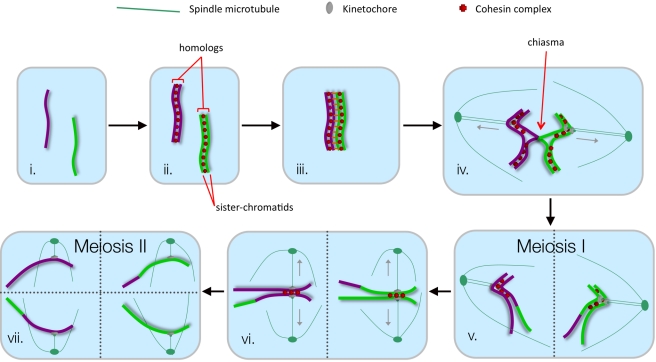
(i) Diploid cell with a single pair of homologous chromosomes (purple and green lines). Stages ii–iv; meiotic prophase. (ii) Chromosomes replicate to give pairs of sister chromatids connected by cohesion. (iii) Homologs pair and become synapsed along their lengths. Crossing-over occurs during this period. (iv) The resulting chiasma links the homologs and thereby facilitates stable bipolar attachment to the meiosis-I spindle. (v) Cohesion between the chromosome arms is lost and homologs are pulled to opposite poles. (vi) Maintenance of cohesion between centromeres allows bipolar attachment of sister chromatid pairs to the meiosis-II spindle. (vii) The remaining cohesion is lost and sister chromatids are segregated. Grey arrows indicate directions of the pulling forces generated by microtubules. Dashed lines indicate the planes of cell division.
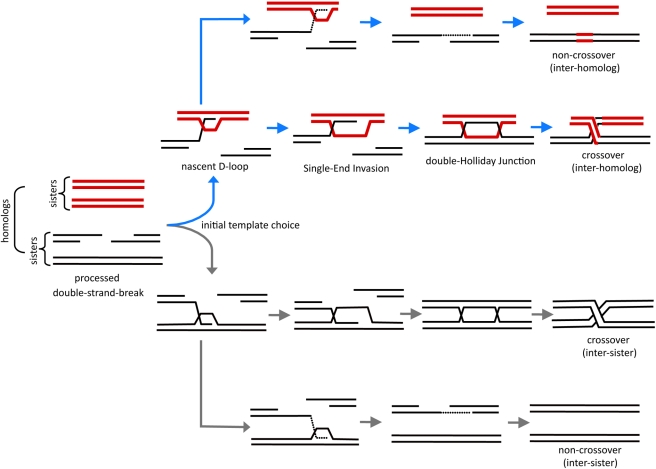
The size difference between duplexes from the two homologs represents restriction-site polymorphisms that have been engineered at specific loci and utilized to monitor meiotic recombination intermediates by molecular assays ,, (see Figure 3). Dashed lines indicate new DNA synthesis. SEIs comprise a DSB end and a homologous duplex , but their exact structure remains uncertain. dHJs can also be resolved to produce non-crossover products, but resolution into crossovers appears to predominate during meiosis.
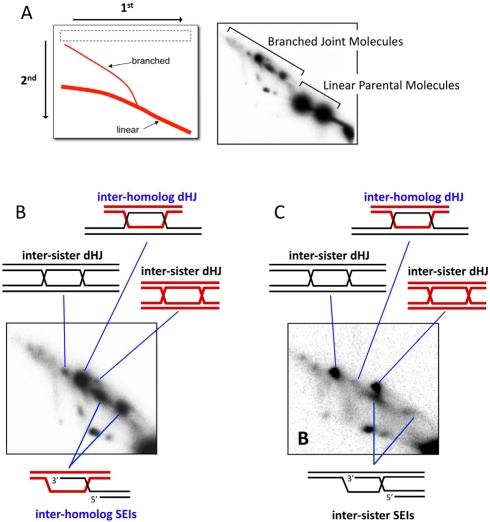
(A) The second dimension of a 2-D gel accentuates the shape element of DNA molecules such that branched species migrate more slowly than linear duplexes of identical mass. The right hand panel shows detection of JM intermediates via Southern hybridization of a 2-D gel. The analyzed locus contains restriction-site polymorphisms between the two parental homologs. (B) Close-up of the JMs in (A), highlighting the SEI and dHJ intermediates. Note the preponderance of inter-homolog dHJs relative to the inter-sister dHJs. (C) 2-D gel analysis of a mutant with a defect in template choice. In this strain, inter-homolog dHJs are almost absent and nearly all JMs, both SEIs and dHJs, are formed between sister chromatids.
Comment on
- PLoS Biol. 8:e1000520.
References
-
- Hunter N. Meiotic recombination. In: Aguilera A, Rothstein R, editors. Molecular Genetics of Recombination. Heidelberg: Springer-Verlag; 2006. pp. 381–442.
-
- Nasmyth K, Haering C. H. Cohesin: its roles and mechanisms. Annu Rev Genet. 2009;43:525–558. - PubMed
-
- Johnson R. D, Jasin M. Double-strand-break-induced homologous recombination in mammalian cells. Biochem Soc Trans. 2001;29:196–201. - PubMed
Publication types
MeSH terms
Grants and funding
LinkOut - more resources
Full Text Sources