


Walking with music is a safe and viable tool for gait training in Parkinson's disease: the effect of a 13-week feasibility study on single and dual task walking
- PMID: 20976086
- PMCID: PMC2957229
- DOI: 10.4061/2010/483530
Walking with music is a safe and viable tool for gait training in Parkinson's disease: the effect of a 13-week feasibility study on single and dual task walking
Abstract
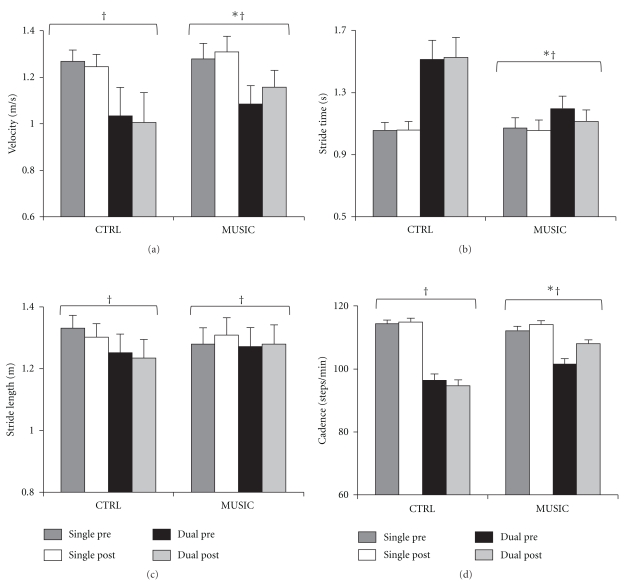
This study explored the viability and efficacy of integrating cadence-matched, salient music into a walking intervention for patients with Parkinson's disease (PD). Twenty-two people with PD were randomised to a control (CTRL, n = 11) or experimental (MUSIC, n = 11) group. MUSIC subjects walked with an individualised music playlist three times a week for the intervention period. Playlists were designed to meet subject's musical preferences. In addition, the tempo of the music closely matched (±10-15 bpm) the subject's preferred cadence. CTRL subjects continued with their regular activities during the intervention. The effects of training accompanied by "walking songs" were evaluated using objective measures of gait score. The MUSIC group improved gait velocity, stride time, cadence, and motor symptom severity following the intervention. This is the first study to demonstrate that music listening can be safely implemented amongst PD patients during home exercise.
Figures
References
-
- Grimbergen YAM, Munneke M, Bloem BR. Falls in Parkinson’s disease. Current Opinion in Neurology. 2004;17(4):405–415. - PubMed
-
- Stolze H, Klebe S, Zechlin C, Baecker C, Friege L, Deuschl G. Falls in frequent neurological diseases: prevalence, risk factors and aetiology. Journal of Neurology. 2004;251(1):79–84. - PubMed
-
- Shulman LM, Gruber-Baldini AL, Anderson KE, et al. The evolution of disability in Parkinson disease. Movement Disorders. 2008;23(6):790–796. - PubMed
-
- Rahman S, Griffin HJ, Quinn NP, Jahanshahi M. Quality of life in Parkinson’s disease: the relative importance of the symptoms. Movement Disorders. 2008;23(10):1428–1434. - PubMed
LinkOut - more resources
Full Text Sources
