


The dopamine metabolite 3-methoxytyramine is a neuromodulator
- PMID: 20976142
- PMCID: PMC2956650
- DOI: 10.1371/journal.pone.0013452
The dopamine metabolite 3-methoxytyramine is a neuromodulator
Erratum in
- PLoS One. 2010;5(10) doi: 10.1371/annotation/a2019934-b1cc-4781-80cb-9e09fc7ff6dc. doi: 10.1371/annotation/a2019934-b1cc-4781-80cb-9e09fc7ff6dc.
Abstract
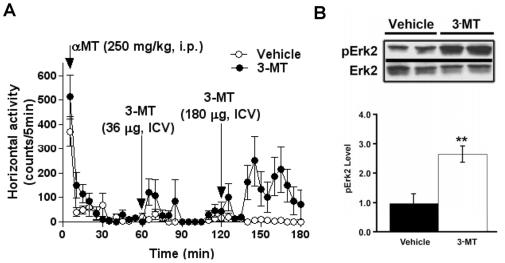
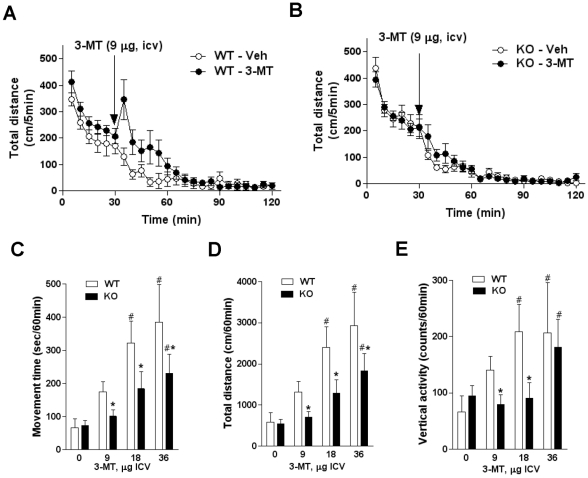
Dopamine (3-hydroxytyramine) is a well-known catecholamine neurotransmitter involved in multiple physiological functions including movement control. Here we report that the major extracellular metabolite of dopamine, 3-methoxytyramine (3-MT), can induce behavioral effects in a dopamine-independent manner and these effects are partially mediated by the trace amine associated receptor 1 (TAAR1). Unbiased in vivo screening of putative trace amine receptor ligands for potential effects on the movement control revealed that 3-MT infused in the brain is able to induce a complex set of abnormal involuntary movements in mice acutely depleted of dopamine. In normal mice, the central administration of 3-MT caused a temporary mild hyperactivity with a concomitant set of abnormal movements. Furthermore, 3-MT induced significant ERK and CREB phosphorylation in the mouse striatum, signaling events generally related to PKA-mediated cAMP accumulation. In mice lacking TAAR1, both behavioral and signaling effects of 3-MT were partially attenuated, consistent with the ability of 3-MT to activate TAAR1 receptors and cause cAMP accumulation as well as ERK and CREB phosphorylation in cellular assays. Thus, 3-MT is not just an inactive metabolite of DA, but a novel neuromodulator that in certain situations may be involved in movement control. Further characterization of the physiological functions mediated by 3-MT may advance understanding of the pathophysiology and pharmacology of brain disorders involving abnormal dopaminergic transmission, such as Parkinson's disease, dyskinesia and schizophrenia.
Conflict of interest statement
Figures


References
-
- Molinoff PB, Axelrod J. Biochemistry of catecholamines. Annu Rev Biochem. 1971;40:465–500. - PubMed
-
- Zhou QY, Palmiter RD. Dopamine-deficient mice are severely hypoactive, adipsic, and aphagic. Cell. 1995;83:1197–1209. - PubMed
-
- Carlsson A. Biochemical and pharmacological aspects of Parkinsonism. Acta Neurol Scand. 1972;51(Suppl):11–42. - PubMed
-
- Fon EA, Pothos EN, Sun BC, Killeen N, Sulzer D, et al. Vesicular transport regulates monoamine storage and release but is not essential for amphetamine action. Neuron. 1997;19:1271–1283. - PubMed
-
- Wang YM, Gainetdinov RR, Fumagalli F, Xu F, Jones SR, et al. Knockout of the vesicular monoamine transporter 2 gene results in neonatal death and supersensitivity to cocaine and amphetamine. Neuron. 1997;19:1285–1296. - PubMed
Publication types
MeSH terms
Substances
Grants and funding
LinkOut - more resources
Full Text Sources
Other Literature Sources
Molecular Biology Databases
Miscellaneous
