The spectrum of coincident entities with small lymphocytic lymphoma/chronic lymphocytic leukemia (SLL/CLL) diagnosed by cytology
- PMID: 20976208
- PMCID: PMC2955352
- DOI: 10.4103/1742-6413.70966
The spectrum of coincident entities with small lymphocytic lymphoma/chronic lymphocytic leukemia (SLL/CLL) diagnosed by cytology
Abstract
Background: The cytologic diagnosis of Small lymphocytic lymphoma/chronic lymphocytic leukemia (SLL/CLL) often relies on finding a small lymphoid population with the characteristic immunoprofile by ancillary testing. There are only a few reports of other processes identified with SLL/CLL. The aim of this study was to review the fine needle aspiration (FNA) and touch prep (TP) diagnoses of SLL/CLL in order to identify any coincident entities.
Materials and methods: We retrospectively reviewed all FNA and TP cytology cases between January 2005 and May 2009 with a diagnosis of SLL/CLL to determine the presence of any coincident process.
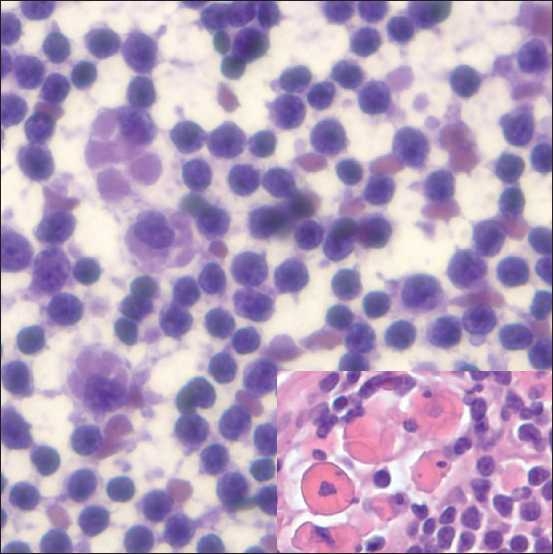
Results: We identified 29 cases, including 23 FNAs and six TPs, from 23 patients. Ancillary studies were utilized in 97% of the cases, including flow cytometry (FC, 79%), immunohistochemistry (IHC, 55%), fluorescent in situ hybridization studies (24%) and special stains (7%). Coincident entities were identified in nine cases (31%) and included seven (28%) neoplastic entities (Hodgkin lymphoma [HL], adenocarcinoma, squamous cell carcinoma, seminoma) and two (7%) non-neoplastic entities (infection and immunoglobulin containing cells). Six cases (21%) suspicious for large cell transformation were also identified.
Conclusion: In our review of SLL/CLL, coincident entities were present in 31% of the cases and included a spectrum of non-neoplastic and neoplastic processes. FC was the most frequently utilized ancillary test, but IHC provided important information by excluding a mantle cell lymphoma or confirming a coincident process. Thus, cytomorphologic evaluation in these patients is important due to the high risk of a coincident process that may not be apparent by FC alone and may require clinical management.
Keywords: Chronic lymphocytic leukemia; SLL/CLL; cytopathology; small lymphocytic lymphoma.
Figures



References
-
- Dey P. Role of ancillary techniques in diagnosing and subclassifying non-Hodgkin’s lymphomas on fine needle aspiration cytology. Cytopathology. 2006;17:275–87. - PubMed
-
- Swerdlow SH, Campo E, Harris NL, Jaffe ES, Pileri SA, Stein H, et al. WHO classification of tumours of haematopoietic and lymphoid tissues. 4th ed. Lyon, France: International Agency for Research on Cancer; 2008. Introduction to the WHO classification of tumours of haematopoietic and lymphoid tissues; pp. 14–5.
-
- Monaco SE, Teot LA, Felgar R, Surti U, Cai G. Fluorescence in-situ hybridization (FISH) studies on direct smears: an approach to enhance the fine needle aspiration biopsy diagnosis of B-cell non-hodgkin lymphomas. Cancer Cytopathology. 2009;117:338–48. - PubMed
-
- Abbott B. Chronic Lymphocytic leukemia: recent advances in diagnosis and treatment. Oncologist. 2006;11:21–30. - PubMed
-
- Hallek M, Cheson BD, Catovsky D, Caligaris-Cappio F, Dighiero G, Döhner H, et al. Guidelines for the diagnosis and treatment of chronic lymphocytic leukemia: A report from the International Workshop on Chronic Lymphocytic Leukemia updating the National Cancer Institute-Working Group 1996 guidelines. Blood. 2008;111:5446–56. - PMC - PubMed
LinkOut - more resources
Full Text Sources
Miscellaneous