


Wait list death and survival benefit of kidney transplantation among nonrenal transplant recipients
- PMID: 20977641
- PMCID: PMC2966021
- DOI: 10.1111/j.1600-6143.2010.03292.x
Wait list death and survival benefit of kidney transplantation among nonrenal transplant recipients
Abstract
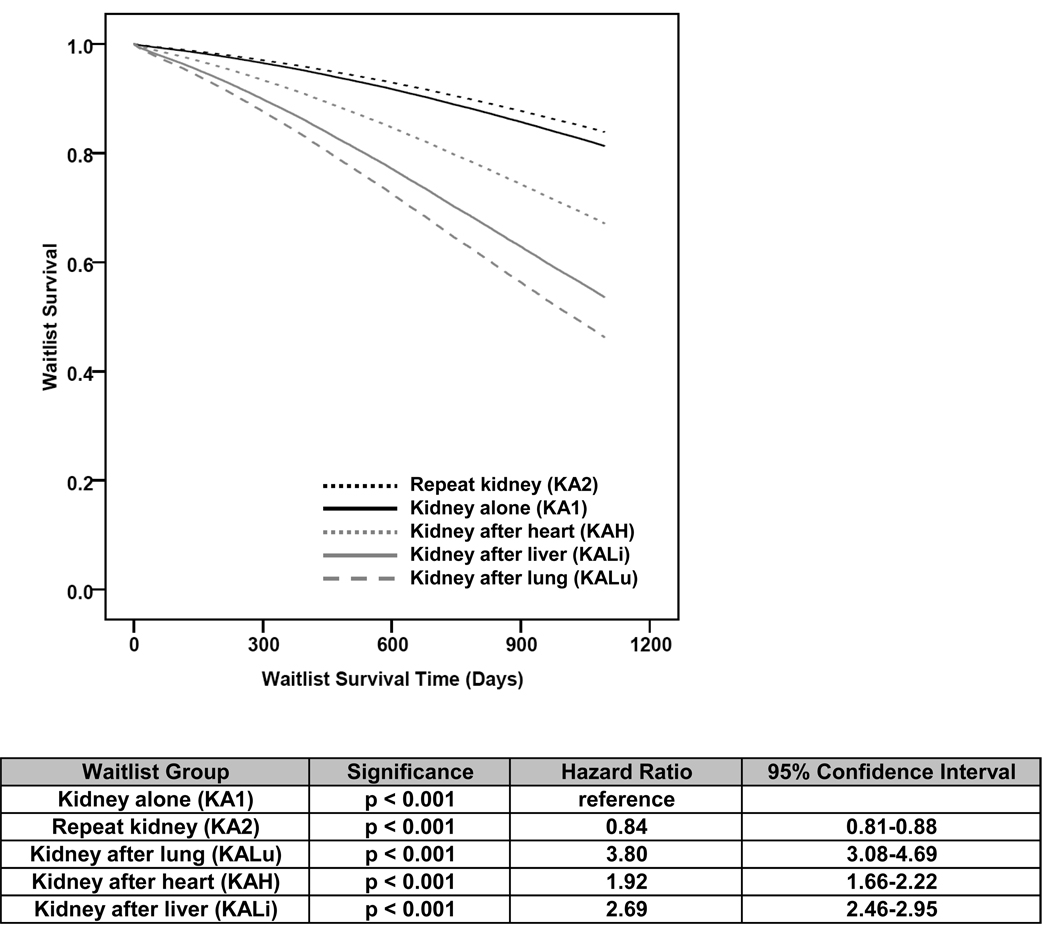
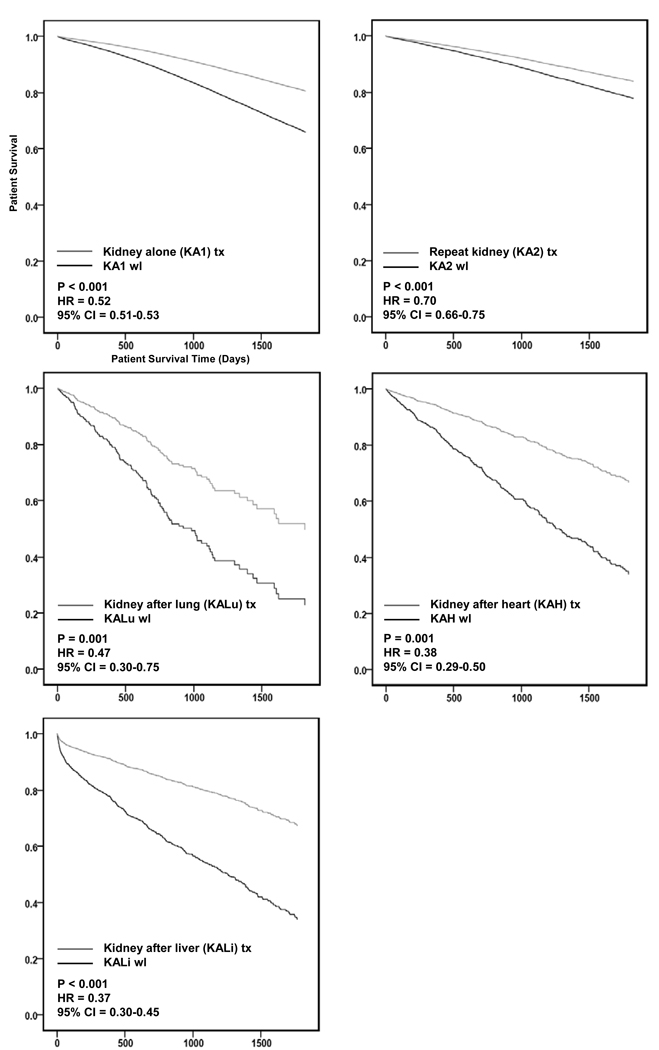
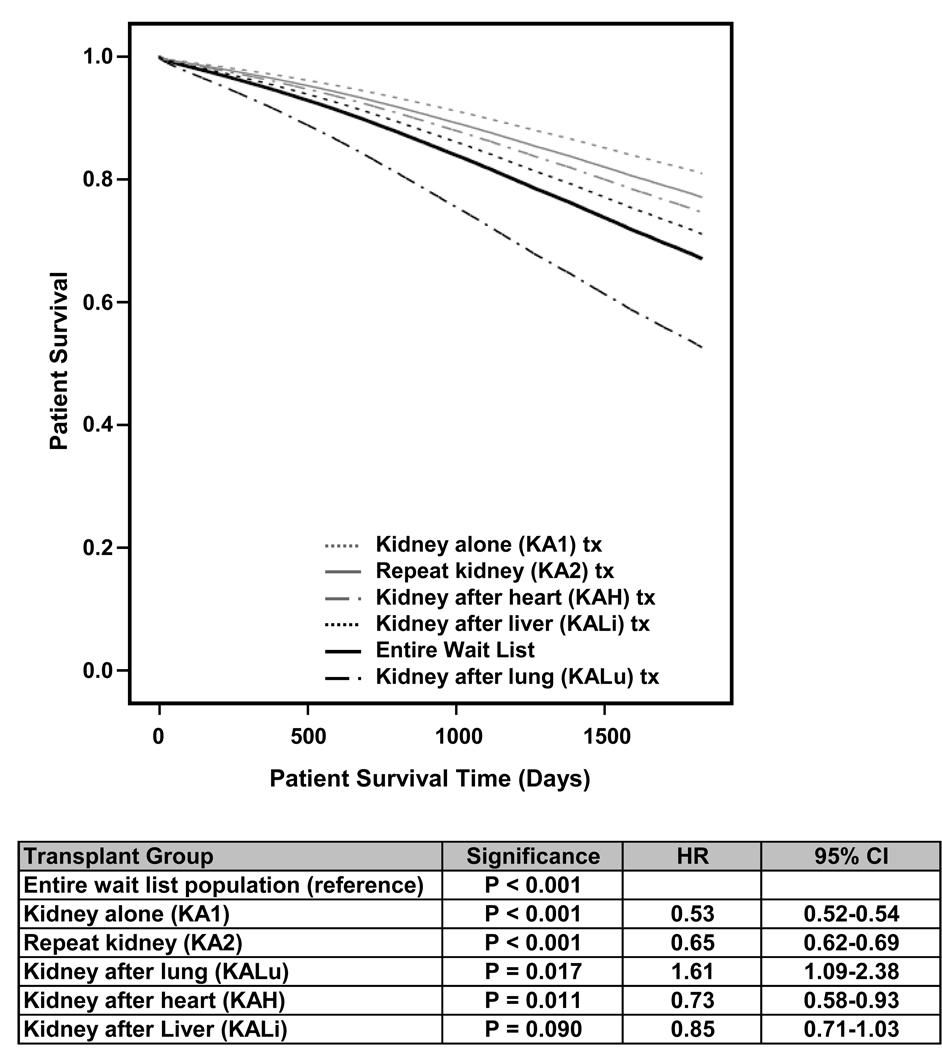
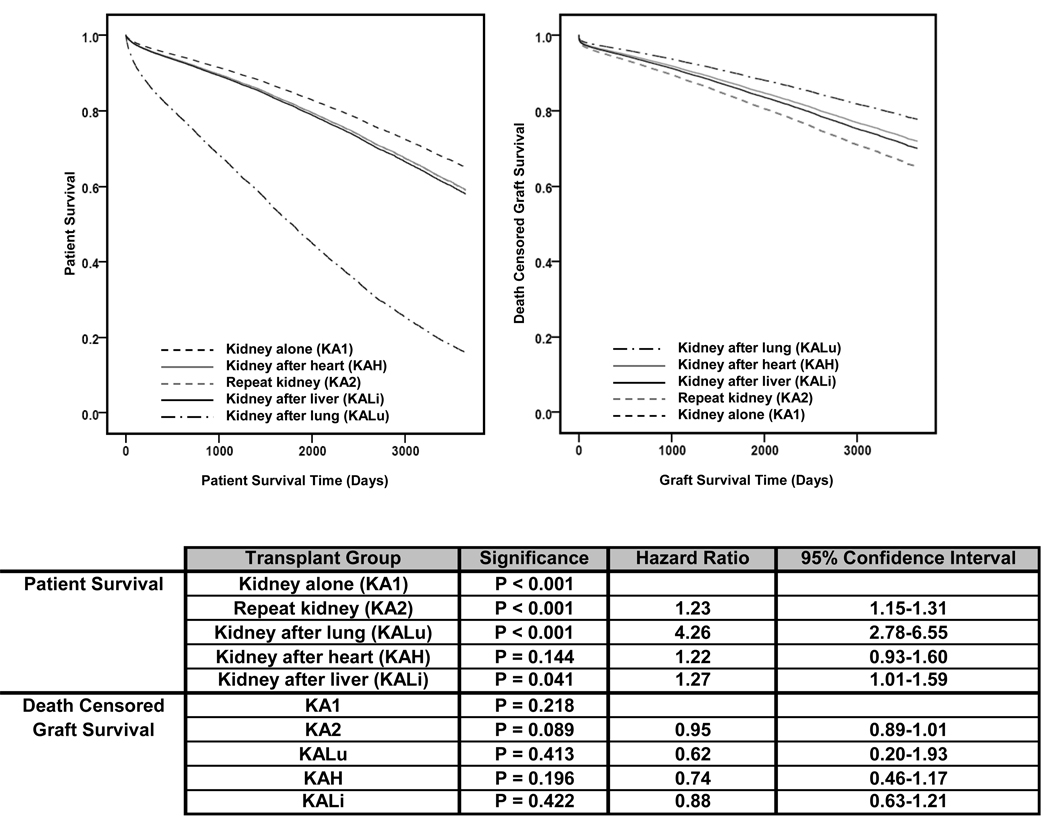
The disparity between the number of patients waiting for kidney transplantation and the limited supply of kidney allografts has renewed interest in the benefit from kidney transplantation experienced by different groups. This study evaluated kidney transplant survival benefit in prior nonrenal transplant recipients (kidney after liver, KALi; lung, KALu; heart, KAH) compared to primary isolated (KA1) or repeat isolated kidney (KA2) transplant. Multivariable Cox regression models were fit using UNOS data for patients wait listed and transplanted from 1995 to 2008. Compared to KA1, the risk of death on the wait list was lower for KA2 (p < 0.001;HR = 0.84;CI = 0.81-0.88), but substantially higher for KALu (p < 0.001; HR = 3.80;CI = 3.08-4.69), KAH (p < 0.001; HR = 1.92; CI = 1.66-2.22), and KALi (p < 0.001; HR = 2.69; CI = 2.46-2.95). Following kidney transplant, patient survival was greatest for KA1, similar among KA2, KALi, KAH, and inferior for KALu. Compared to the entire wait list, renal transplantation was associated with a survival benefit among all groups except KALu (p = 0.017; HR = 1.61; CI = 1.09-2.38), where posttransplant survival was inferior to the wait list population. Recipients of KA1 kidney transplantation have the greatest posttransplant survival and compared to the overall kidney wait list, the greatest survival benefit.
©2010 The Authors Journal compilation©2010 The American Society of Transplantation and the American Society of Transplant Surgeons.
Conflict of interest statement
The other authors report no financial disclosures. There are no conflicts of interest to disclose.
Figures
References
-
- Magee JC, Barr ML, Basadonna GP, et al. Repeat organ transplantation in the United States, 1996–2005. Am J Transplant. 2007;7:1424–1433. - PubMed
-
- Chandrakantan A, de Mattos AM, Naftel D, Crosswy A, Kirklin J, Curtis JJ. Increasing referral for renal transplant evaluation in recipients of nonrenal solid-organ transplants: a single-center experience. Clin J Am Soc Nephrol. 2006;1:832–836. - PubMed
-
- Cohen DJ, St Martin L, Christensen LL, Bloom RD, Sung RS. Kidney and pancreas transplantation in the United States, 1995–2004. Am J Transplant. 2006;6:1153–1169. - PubMed
-
- Myers BD, Ross J, Newton L, Luetscher J, Perlroth M. Cyclosporine-associated chronic nephropathy. N Engl J Med. 1984;311:699–705. - PubMed
-
- Bennett WM, DeMattos A, Meyer MM, Andoh T, Barry JM. Chronic cyclosporine nephropathy: the Achilles’ heel of immunosuppressive therapy. Kidney Int. 1996;50:1089–1100. - PubMed
Publication types
MeSH terms
Grants and funding
LinkOut - more resources
Full Text Sources
Other Literature Sources
Medical
