


Epistatic QTL pairs associated with meat quality and carcass composition traits in a porcine Duroc × Pietrain population
- PMID: 20977705
- PMCID: PMC2984386
- DOI: 10.1186/1297-9686-42-39
Epistatic QTL pairs associated with meat quality and carcass composition traits in a porcine Duroc × Pietrain population
Abstract
Background: Quantitative trait loci (QTL) analyses in pig have revealed numerous individual QTL affecting growth, carcass composition, reproduction and meat quality, indicating a complex genetic architecture. In general, statistical QTL models consider only additive and dominance effects and identification of epistatic effects in livestock is not yet widespread. The aim of this study was to identify and characterize epistatic effects between common and novel QTL regions for carcass composition and meat quality traits in pig.
Methods: Five hundred and eighty five F₂ pigs from a Duroc × Pietrain resource population were genotyped using 131 genetic markers (microsatellites and SNP) spread over the 18 pig autosomes. Phenotypic information for 26 carcass composition and meat quality traits was available for all F₂ animals. Linkage analysis was performed in a two-step procedure using a maximum likelihood approach implemented in the QxPak program.
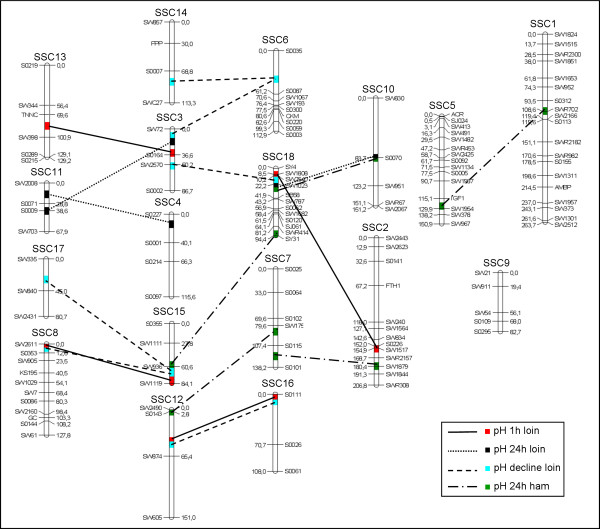
Results: A number of interacting QTL was observed for different traits, leading to the identification of a variety of networks among chromosomal regions throughout the porcine genome. We distinguished 17 epistatic QTL pairs for carcass composition and 39 for meat quality traits. These interacting QTL pairs explained up to 8% of the phenotypic variance.
Conclusions: Our findings demonstrate the significance of epistasis in pigs. We have revealed evidence for epistatic relationships between different chromosomal regions, confirmed known QTL loci and connected regions reported in other studies. Considering interactions between loci allowed us to identify several novel QTL and trait-specific relationships of loci within and across chromosomes.
Figures
References
Publication types
MeSH terms
Substances
LinkOut - more resources
Full Text Sources
Miscellaneous
