


Phylogeography, colonization and population history of the Midas cichlid species complex (Amphilophus spp.) in the Nicaraguan crater lakes
- PMID: 20977752
- PMCID: PMC3087546
- DOI: 10.1186/1471-2148-10-326
Phylogeography, colonization and population history of the Midas cichlid species complex (Amphilophus spp.) in the Nicaraguan crater lakes
Abstract
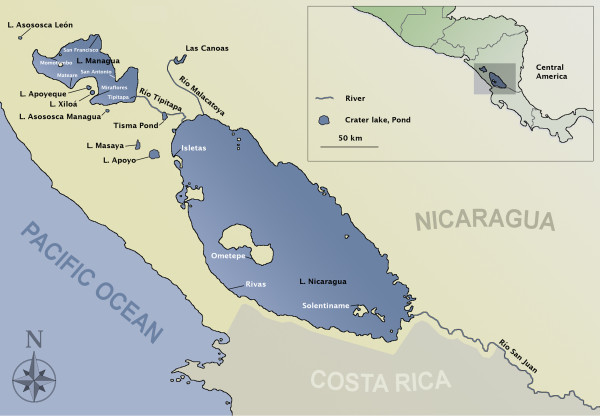
Background: Elucidation of the mechanisms driving speciation requires detailed knowledge about the phylogenetic relationships and phylogeography of the incipient species within their entire ranges as well as their colonization history. The Midas cichlid species complex Amphilophus spp. has been proven to be a powerful model system for the study of ecological specialization, sexual selection and the mechanisms of sympatric speciation. Here we present a comprehensive and integrative phylogeographic analysis of the complete Midas Cichlid species complex in Nicaragua (> 2000 individuals) covering the entire distributional range, using two types of molecular markers (the mitochondrial DNA control region and 15 microsatellites). We investigated the majority of known lake populations of this species complex and reconstructed their colonization history in order to distinguish between alternative speciation scenarios.
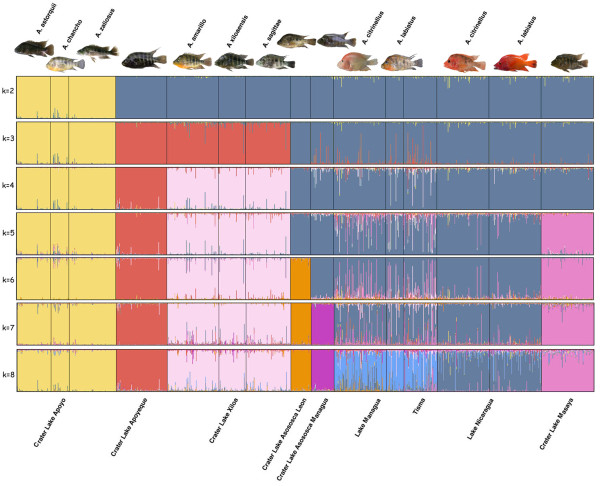
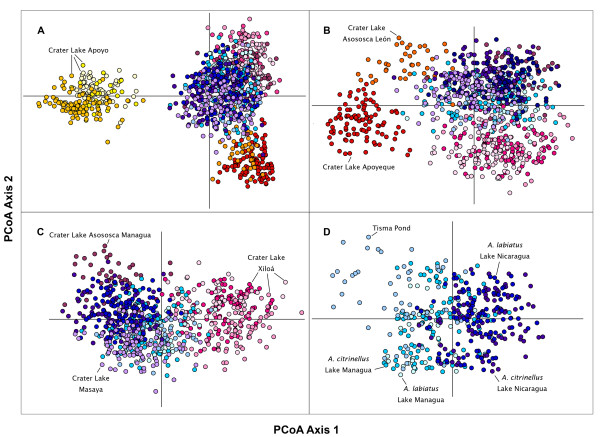
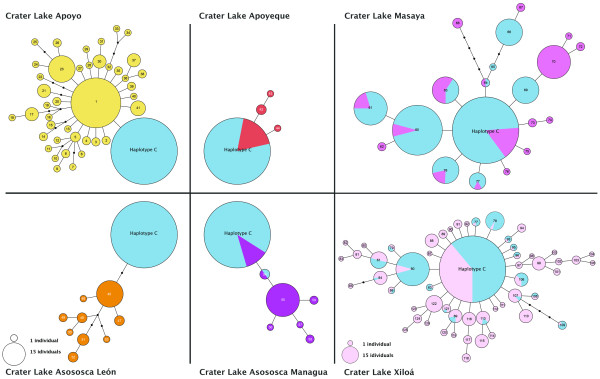
Results: We found that the large lakes contain older and more diverse Midas Cichlid populations, while all crater lakes hold younger and genetically less variable species assemblages. The large lakes appear to have repeatedly acted as source populations for all crater lakes, and our data indicate that faunal exchange among crater lakes is extremely unlikely. Despite their very recent (often only a few thousand years old) and common origin from the two large Nicaraguan lakes, all crater lake Midas Cichlid radiations underwent independent, but parallel, evolution, and comprise distinct genetic units. Indeed several of these crater lakes contain multiple genetically distinct incipient species that most likely arose through sympatric speciation. Several crater lake radiations can be traced back to a single ancestral line, but some appear to have more than one founding lineage. The timing of the colonization(s) of each crater lake differs, although most of them occurred more (probably much more) recently than 20,000 years ago.
Conclusion: The genetic differentiation of the crater lake populations is directly related to the number of founding lineages, but independent of the timing of colonization. Interestingly, levels of phenotypic differentiation, and speciation events, appeared independent of both factors.
Figures
References
-
- Ritchie M. Sexual selection and speciation. Annual Review of Ecology, Evolution and Systematics. 2007;38:79–102. doi: 10.1146/annurev.ecolsys.38.091206.095733. - DOI
-
- Dieckmann U, Doebeli M, Metz JAJ, Tautz D. Adaptive speciation. Cambridge, UK: Cambridge University Press; 2004.
-
- Coyne JA, Orr HA. Speciation. Sunderland, MA: Sinauer Associates; 2004.
-
- Mayr E. Systematics and the origin of species. New York: Columbia University Press; 1942.
Publication types
MeSH terms
Substances
LinkOut - more resources
Full Text Sources
Miscellaneous
