


The future of the oceans past
- PMID: 20980323
- PMCID: PMC2982006
- DOI: 10.1098/rstb.2010.0278
The future of the oceans past
Abstract
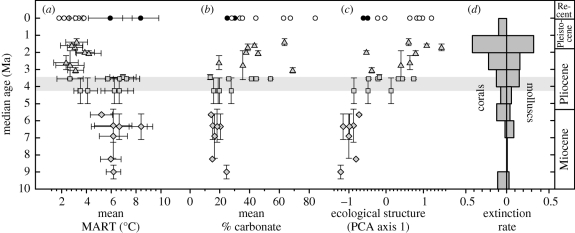
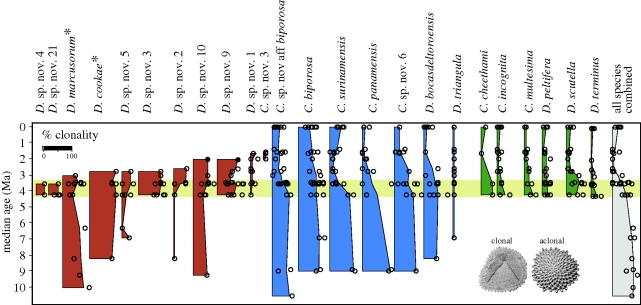
Major macroevolutionary events in the history of the oceans are linked to changes in oceanographic conditions and environments on regional to global scales. Even small changes in climate and productivity, such as those that occurred after the rise of the Isthmus of Panama, caused major changes in Caribbean coastal ecosystems and mass extinctions of major taxa. In contrast, massive influxes of carbon at the end of the Palaeocene caused intense global warming, ocean acidification, mass extinction throughout the deep sea and the worldwide disappearance of coral reefs. Today, overfishing, pollution and increases in greenhouse gases are causing comparably great changes to ocean environments and ecosystems. Some of these changes are potentially reversible on very short time scales, but warming and ocean acidification will intensify before they decline even with immediate reduction in emissions. There is an urgent need for immediate and decisive conservation action. Otherwise, another great mass extinction affecting all ocean ecosystems and comparable to the upheavals of the geological past appears inevitable.
Figures
References
-
- Albins M. A., Hixon M. A.2008Invasive Indo-Pacific lionfish Pterois volitans reduce recruitment of Atlantic coral reef fishes. Mar. Ecol. Prog. Ser. 367, 233–238 (doi:10.3354/meps07620) - DOI
-
- Alter S. E., Rynes E., Palumbi S. R.2007DNA evidence for historical population size and past ecological impacts of gray whales. Proc. Natl Acad. Sci. USA 104, 15 162–15 167 (doi:10.1073/pnas.0706056104) - DOI - PMC - PubMed
-
- Atkinson A., Siegel V., Pakhomov E., Rothery P.2004Long-term decline in krill stock and increase in salps in the Southern Ocean. Nature 432, 100–103 (doi:10.1038/nature02996) - DOI - PubMed
-
- Azzarello M. Y., Van Fleet E. S.1987Marine birds and plastic pellets. Mar. Ecol. Prog. Ser. 37, 295–303 (doi:10.3354/meps037295) - DOI
-
- Bartoli G., Sarnthein M., Weinelt M., Erlenkeuser H., Garbe-Schönberg D., Lea D. W.2005Final closure of Panama and the onset of northern hemisphere glaciation. Earth Planet. Sci. Lett. 237, 33–44 (doi:10.1016/j.epsl.2005.06.020) - DOI
MeSH terms
LinkOut - more resources
Full Text Sources
Medical
Miscellaneous