. 2010:2010:187373.
doi: 10.1155/2010/187373. Epub 2010 Oct 20.

Functional Promiscuity of Homologues of the Bacterial ArsA ATPases

Affiliations

Functional Promiscuity of Homologues of the Bacterial ArsA ATPases

Rostislav Castillo et al. Int J Microbiol. 2010.

Abstract

The ArsA ATPase of E. coli plays an essential role in arsenic detoxification. Published evidence implicates ArsA in the energization of As(III) efflux via the formation of an oxyanion-translocating complex with ArsB. In addition, eukaryotic ArsA homologues have several recognized functions unrelated to arsenic resistance. By aligning ArsA homologues, constructing phylogenetic trees, examining ArsA encoding operons, and estimating the probable coevolution of these homologues with putative transporters and auxiliary proteins unrelated to ArsB, we provide evidence for new functions for ArsA homologues. They may play roles in carbon starvation, gas vesicle biogenesis, and arsenic resistance. The results lead to the proposal that ArsA homologues energize four distinct and nonhomologous transporters, ArsB, ArsP, CstA, and Acr3.


Figures
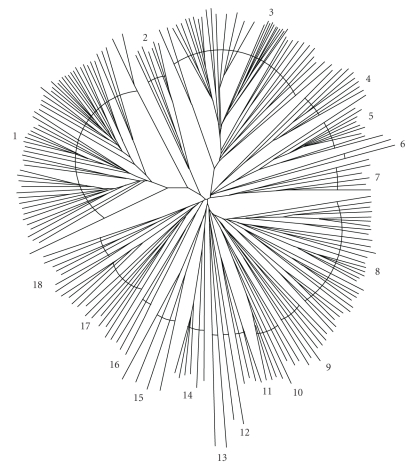
Figure 1
Figure 1
Phylogenetic tree of full length prokaryotic and eukaryotic ArsA homologues. The CLUSTAL X program [23] was used to create a multiple alignment of the protein sequences, while TreeView [24] generated the tree. The phylogenetic clusters are labeled 1–18 clockwise. Specific proteins can be found in Table 1, first according to cluster number and then according to position within the cluster. The dendrogram is shown in Figure S1.
Figure 2
Figure 2
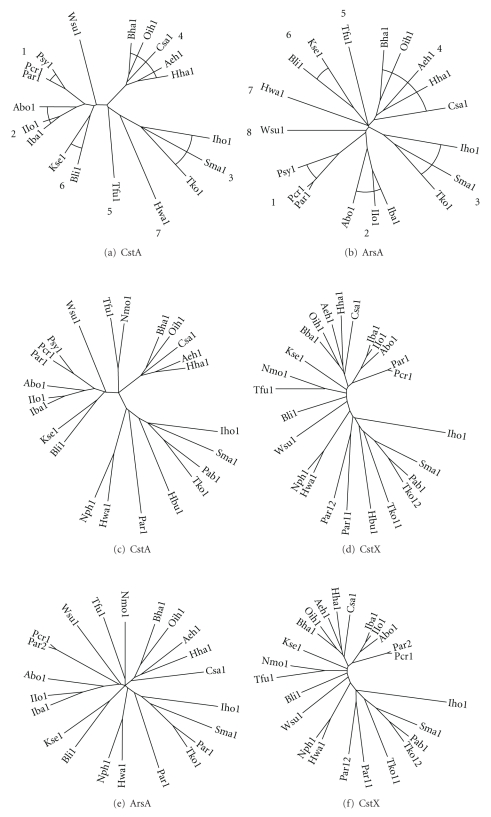
Phylogenetic trees showing the coevolution of (a) CstA and (b) ArsA homologues, (c) CstA and (d) CstX homologues, and (e) ArsA and (f) CstX homologues, each pair being encoded within the same operons. The methodology was as described in Figure 1. Cluster numbers are assigned counterclockwise in (b) and retained in (a). Paralogues are distinguished with a second digit, either 1 or 2, in the protein abbreviations.
Figure 3
Figure 3
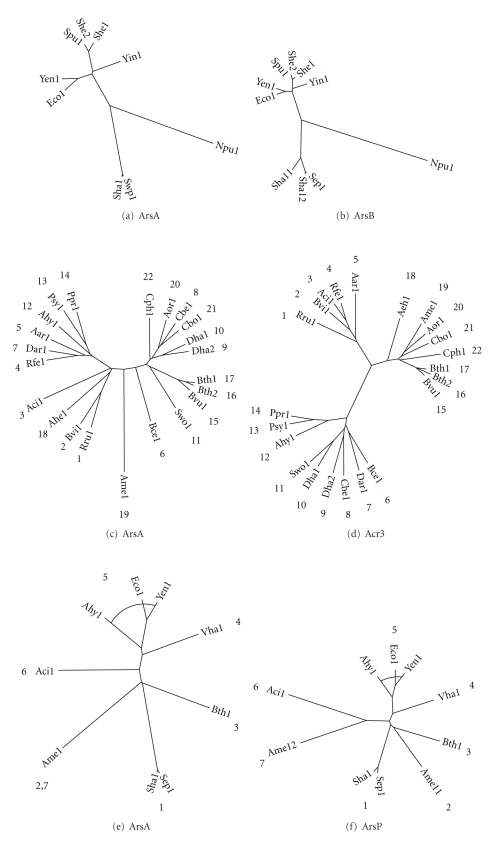
Phylogenetic trees showing the coevolution of (a) ArsA and (b) ArsB homologues, (c) ArsA and (d) Acr3 homologues, and (e) ArsA and (f) ArsP homologues, each pair encoded within the same operons. Numbers are assigned in (d) and retained in (c). Numbers are assigned counterclockwise in (f) and retained in (e). Paralogues are distinguished with a second digit, either 1 or 2, in the protein abbreviations. gi numbers are provided in Table 1.
Figure 4
Figure 4
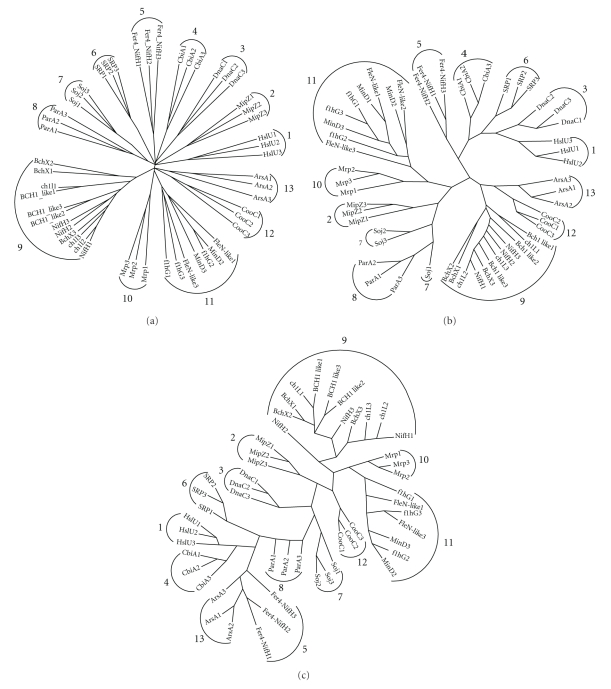
(a) CLUSTALX multiple alignment showing the relationships of the representative proteins to each other. Representative proteins from each family were selected following an NCBI BLASTP search, selecting sequences with 30%–50% identity and an e-value less than e −60. (b) SuperfamilyTree created with representative proteins using the SFT1 program [22] without a multiple alignment and using TreeView [24]. (c) Representative proteins were analyzed, and the tree was generated using ProtPars [25]. Both CLUSTALX and SFT1 use neighbor-joining algorithms to generate the trees while ProtPars uses parsimony. These trees show the evolutionary relationships of ArsA homologues to each other. Numbers are assigned in (a) and retained in (b) and (c).
Figure 5
Figure 5
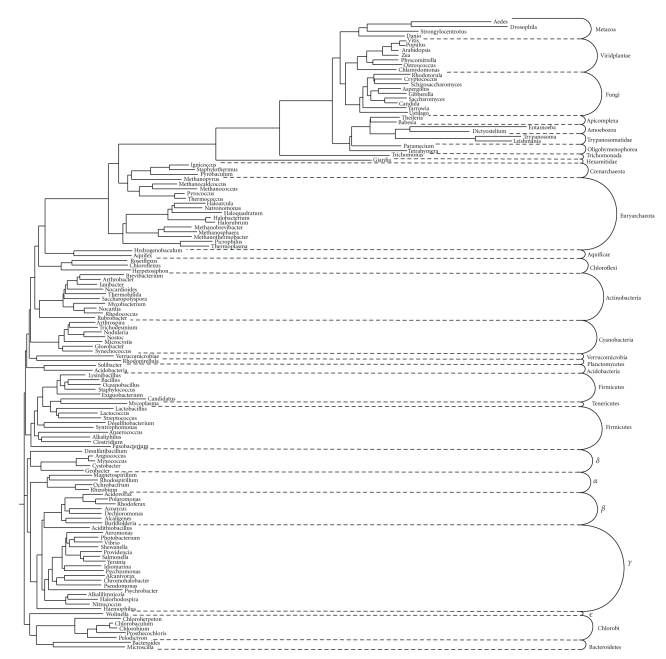
Phylogenetic tree of 16S and 18S rRNA nucleotide sequences of genera represented in this study. The methodology was as described in Figure 1. Sequences were derived from the NCBI nucleotide database. Clusters correlate with organismal type.
Figure 6
Figure 6
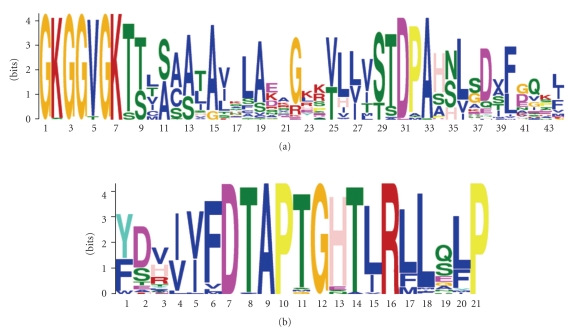
MEME [30] sequence logos illustrating the conserved residues of (a) motif 1 and (b) motif 2 found in ArsA homologues. The size of the letters indicates amino acid conservation, with larger letters representing more conserved residues.

References

    1. Oremland RS, Stolz JF. Arsenic, microbes and contaminated aquifers. Trends in Microbiology. 2005;13(2):45–49. - PubMed
    1. Jackson CR, Dugas SL. Phylogenetic analysis of bacterial and archaeal arsC gene sequences suggests an ancient, common origin for arsenate reductase. BMC Evolutionary Biology. 2003;3, article no. 18 - PMC - PubMed
    1. Lin Y-F, Walmsley AR, Rosen BP. An arsenic metallochaperone for an arsenic detoxification pump. Proceedings of the National Academy of Sciences of the United States of America. 2006;103(42):15617–15622. - PMC - PubMed
    1. Vorontsov II, Minasov G, Brunzelle JS, et al. Crystal structure of an apo form of Shigella flexneri ArsH protein with an NADPH-dependent FMN reductase activity. Protein Science. 2007;16(11):2483–2490. - PMC - PubMed
    1. Wang L, Jeon B, Sahin O, Zhang Q. Identification of an arsenic resistance and arsenic-sensing system in Campylobacter jejuni . Applied and Environmental Microbiology. 2009;75(15):5064–5073. - PMC - PubMed