


GPR56 is essential for testis development and male fertility in mice
- PMID: 20981830
- PMCID: PMC2991479
- DOI: 10.1002/dvdy.22468
GPR56 is essential for testis development and male fertility in mice
Abstract
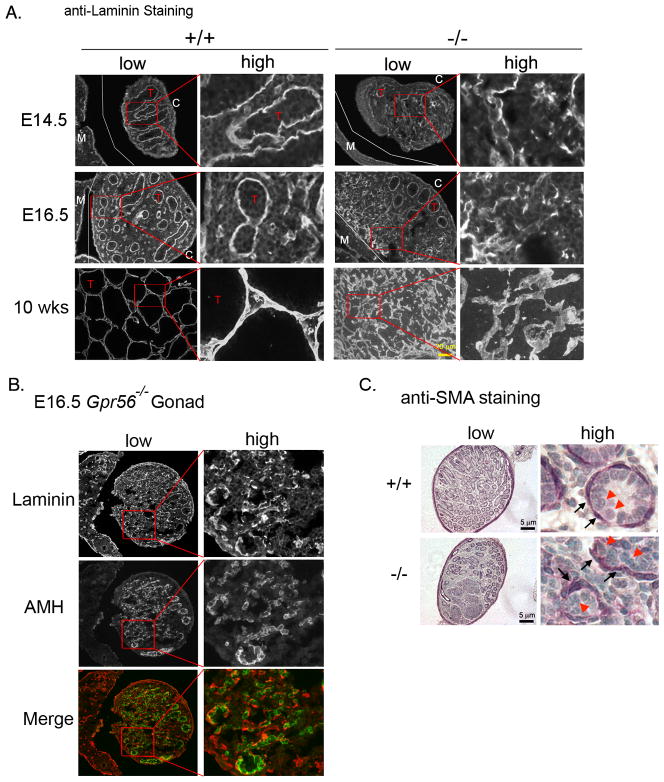
Testis development is critical for male fertility and continuation of the mammalian species. Essential structural components of testes are seminiferous tubules, which are lined by Sertoli cells and provide nutrients and physical protection for the maturation of sperm. Seminiferous tubule formation is initiated in embryos as testis cords and relies on their remodeling for maturation during development. Recently, three-dimensional image analyses showed that testis cords in different parts of embryonic gonads undergo distinct remodeling processes. How this asymmetric remodeling is regulated has not been investigated. We report here that the absence of an adhesion G protein-coupled receptor, GPR56, leads to partial disruption of seminiferous tubules and reduced fertility in male mice. The defects appear to originate asymmetrically in embryonic gonads, but subsequent to the initial establishment of testis cords, suggesting that GPR56 might act to establish a spatial and/or temporal cue for asymmetric cord remodeling during male gonad development.
© 2010 Wiley-Liss, Inc.
Figures
References
-
- Barrionuevo F, Bagheri-Fam S, Klattig J, Kist R, Taketo MM, Englert C, Scherer G. Homozygous inactivation of Sox9 causes complete XY sex reversal in mice. Biol Reprod. 2006;74:195–201. - PubMed
-
- Behringer RR, Finegold MJ, Cate RL. Mullerian-inhibiting substance function during mammalian sexual development. Cell. 1994;79:415–425. - PubMed
-
- Bitgood MJ, Shen L, McMahon AP. Sertoli cell signaling by Desert hedgehog regulates the male germline. Curr Biol. 1996;6:298–304. - PubMed
Publication types
MeSH terms
Substances
Grants and funding
LinkOut - more resources
Full Text Sources
Other Literature Sources
Molecular Biology Databases
