. 2010 Oct 28;1(1):18.
doi: 10.1186/1758-907X-1-18.

MicroR159 regulation of most conserved targets in Arabidopsis has negligible phenotypic effects

Affiliations

MicroR159 regulation of most conserved targets in Arabidopsis has negligible phenotypic effects

Robert S Allen et al. Silence. .

Abstract

Background: A current challenge of microRNA (miRNA) research is the identification of biologically relevant miRNA:target gene relationships. In plants, high miRNA:target gene complementarity has enabled accurate target predictions, and slicing of target mRNAs has facilitated target validation through rapid amplification of 5' cDNA ends (5'-RACE) analysis. Together, these approaches have identified more than 20 targets potentially regulated by the deeply conserved miR159 family in Arabidopsis, including eight MYB genes with highly conserved miR159 target sites. However, genetic analysis has revealed the functional specificity of the major family members, miR159a and miR159b is limited to only two targets, MYB33 and MYB65. Here, we examine the functional role of miR159 regulation for the other potential MYB target genes.

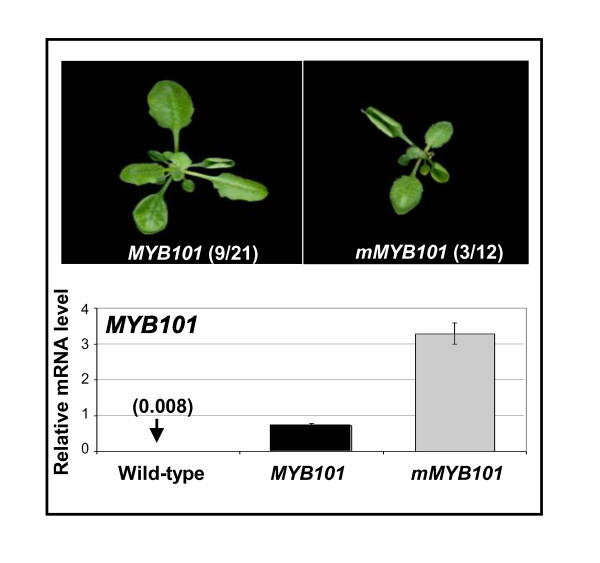
Results: For these target genes, functional analysis failed to identify miR159 regulation that resulted in any major phenotypic impact, either at the morphological or molecular level. This appears to be mainly due to the quiescent nature of the remaining family member, MIR159c. Although its expression overlaps in a temporal and spatial cell-specific manner with a subset of these targets in anthers, the abundance of miR159c is extremely low and concomitantly a mir159c mutant displays no anther defects. Examination of potential miR159c targets with conserved miR159 binding sites found neither their spatial or temporal expression domains appeared miR159 regulated, despite the detection of miR159-guided cleavage products by 5'-RACE. Moreover, expression of a miR159-resistant target (mMYB101) resulted predominantly in plants that are indistinguishable from wild type. Plants that displayed altered morphological phenotypes were found to be ectopically expressing the mMYB101 transgene, and hence were misrepresentative of the in vivo functional role of miR159.

Conclusions: This study presents a novel explanation for a paradox common to plant and animal miRNA systems, where among many potential miRNA-target relationships usually only a few appear physiologically relevant. The identification of a quiescent miR159c:target gene regulatory module in anthers provides a likely rationale for the presence of conserved miR159 binding sites in many targets for which miR159 regulation has no obvious functional role. Remnants from the demise of such modules may lead to an overestimation of miRNA regulatory complexity when investigated using bioinformatic, 5'-RACE or transgenic approaches.


Figures
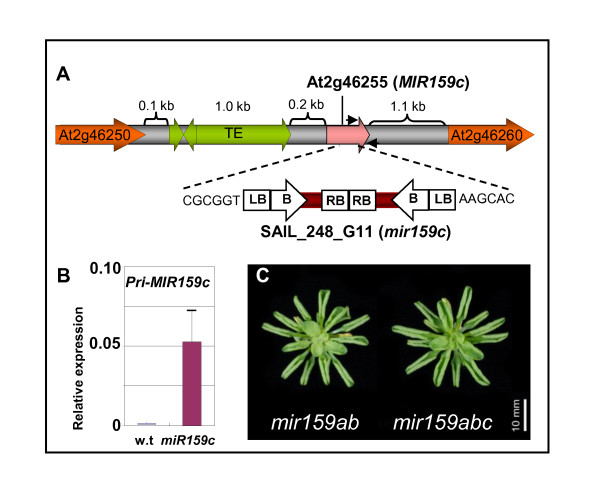
Figure 1
Figure 1
A potential null allele of MIR159c does not result in any developmental or molecular alterations. (A) The genomic context of the MIR159c (At2g46255) gene showing the position of transposable elements (TE, green) that are located 214 bp upstream of the stem-loop region (pink). The insertion site of the transfer DNA (T-DNA) in the SAIL_248_G11 (mir159c) line is indicated by the dashed line. Large arrows indicate the location and direction of the transcriptional units, B = basta resistance gene; LB = left border; RB = right border. (B) Real-time quantitative (qRT)-PCR on inflorescences of wild-type and mir159c plants. The approximate positions of the primers used for qRT-PCR are indicated with small black arrows in (A). Expression values were normalised to cyclophilin, with measurements being the average of three replicates and error bars representing the standard error of the mean. (C) Rosette phenotypes of short-day grown mir159ab and mir159abc.
Figure 2
Figure 2
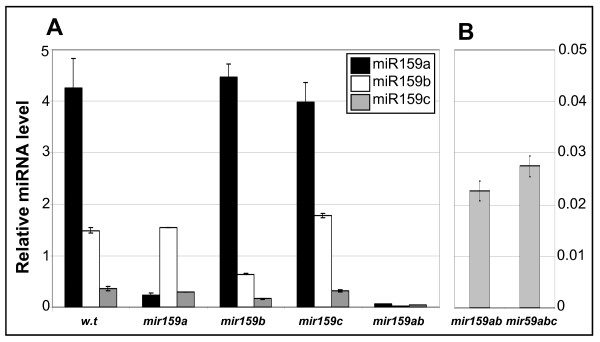
TaqMan microRNA assay measurement of mature miR159 isoforms in wild type and the various mir159 mutants. Analysis was performed on RNA extracted from inflorescences, and miRNA abundance was normalised to sno101 with measurements being the average of three replicates with error bars representing the standard error of the mean. (A) Measurement of miR159a, miR159b and miR159c in wild type, the three single mir159 mutants and mir159ab. (B) Measurement of miR159c in mir159ab and mir159abc.
Figure 3
Figure 3
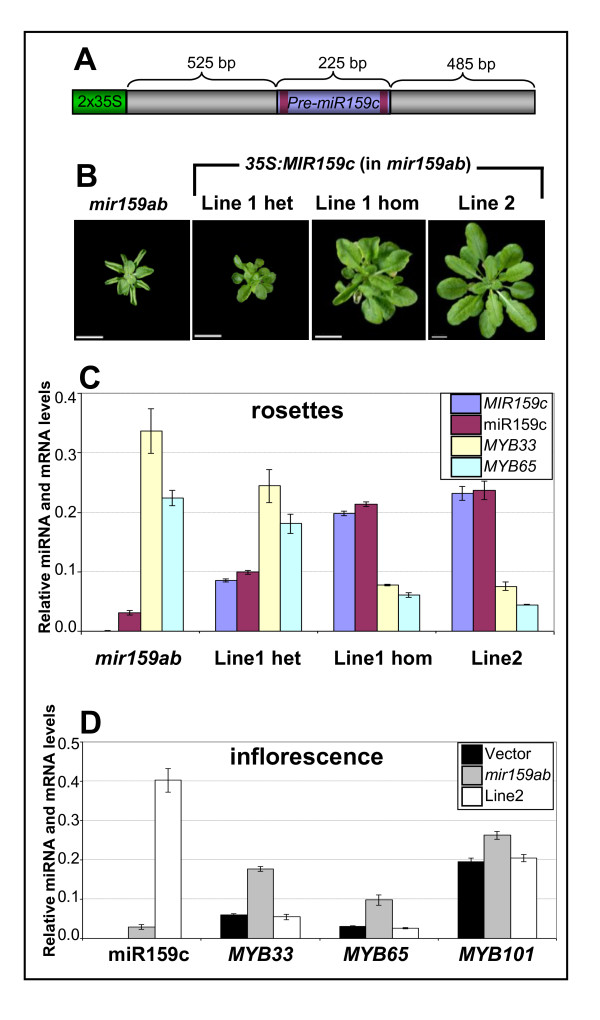
A 35S:MIR159c transgene can complement mir159ab. (A) The 35S:MIR159c transgene with relevant regions shown. The dark purple bars represent miR159c* and miR159c sequences of MIR159c. 2X35S = tandem 35S promoter of the plasmid vector pMDC32. Figure is not to scale. (B) Rosette phenotypes of transgenic mir159ab lines transformed with the 35S:MIR159c construct. For line 1, both heterozygous and homozygous segregants are shown. (C) Analysis of MIR159c transcript and mature miR159c, and MYB33 and MYB65 expression in 35S:MIR159c (mir159ab) transgenic rosettes. (D) Analysis of mature miR159c and MYB levels in; wild type transformed with empty (vector), mir159ab and 35S:MIR159c (mir159ab) line 2 inflorescences. Measurement of miR159c is not shown in the empty vector line due to crossreaction of the assay with miR159a and miR159b (Figure 2), which overstates the absolute abundance of miR159c. Measurements represent the average of three replicates with error bars showing the standard error of the mean. mRNA levels were normalised to cyclophilin and miR159c abundance was normalised to sno101.
Figure 4
Figure 4
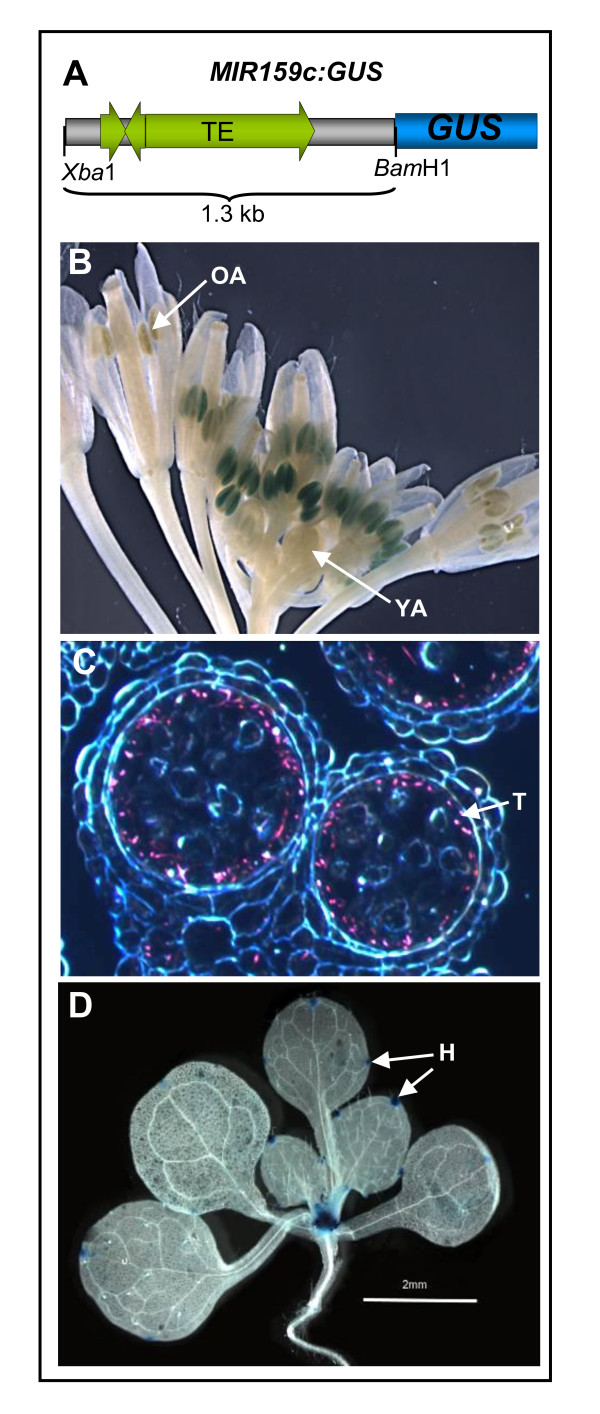
Expression of a MIR159c:GUS transgene is restricted to specific cell types. (A) Diagram showing the sequences used for construction of the MIR159c:GUS transgene in the vector pBI101.1. (B) β-Glucuronidase (GUS)-stained MIR159c:GUS inflorescences. OA = old anthers; YA = young anthers. (C) Dark field microscopy of a transverse section of a MIR159c:GUS anther. GUS staining is shown by pink crystals. T = tapetum. (D) GUS staining (48 h) in a 14-day-old MIR159c:GUS plant. H = hydanthodes.
Figure 5
Figure 5
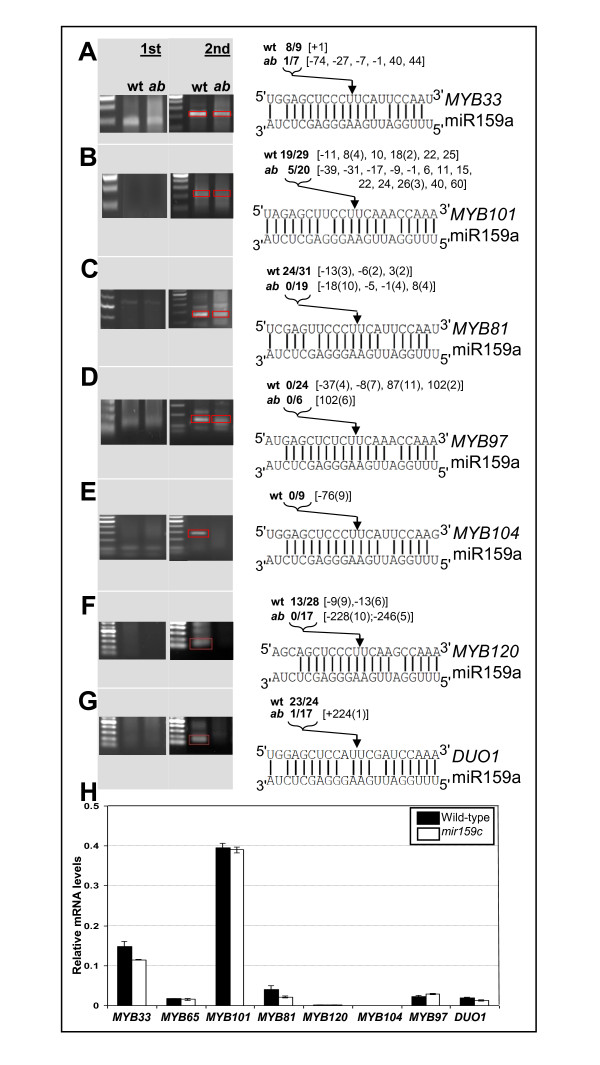
miR159 cleavage assays of potential target genes. Inflorescence purified mRNA from wild type and mir159ab was ligated with rapid amplification of 5' complementary DNA ends (5'-RACE) adapters and subject to 5'-RACE PCR. The products from first (1st) and nested (2nd) rounds of PCR were analysed by agarose gel electrophoresis. DNA from the nested PCR reactions was either directly cloned or the expected size PCR products gel purified before cloning (indicated by red box). Clones were then sequenced and mapped. The sequence similarity of each target is shown compared to miR159a. Numbers in bold indicate the proportion of clones out of the total number analysed that mapped to the canonical miR159 cleavage position (indicated by arrow) either in wild type (wt) or mir159ab (ab). Numbers inside square brackets indicate the position of any further clones relative to the miR159 cleavage site, with (-) numbers indicating fragments that map upstream of the miR159 cleavage site and (+) numbers indicating fragments that are further downstream of the miR159 cleavage site. Numbers in round brackets indicate the number of multiple clones found at that position. Analysis was carried out for: (A) MYB33, (B) MYB101, (C) MYB81, (D) MYB97, (E) MYB104, (F) MYB120 and (G) DUO1 (MYB125). (H) Real-time quantitative (qRT)-PCR analysis of mRNA abundance of putative miR159c target genes in wild type (black bars) and mir159c (white bars). Analysis was performed on RNA extracted from inflorescences with measurements being the average of three replicates with error bars representing the standard error of the mean.
Figure 6
Figure 6
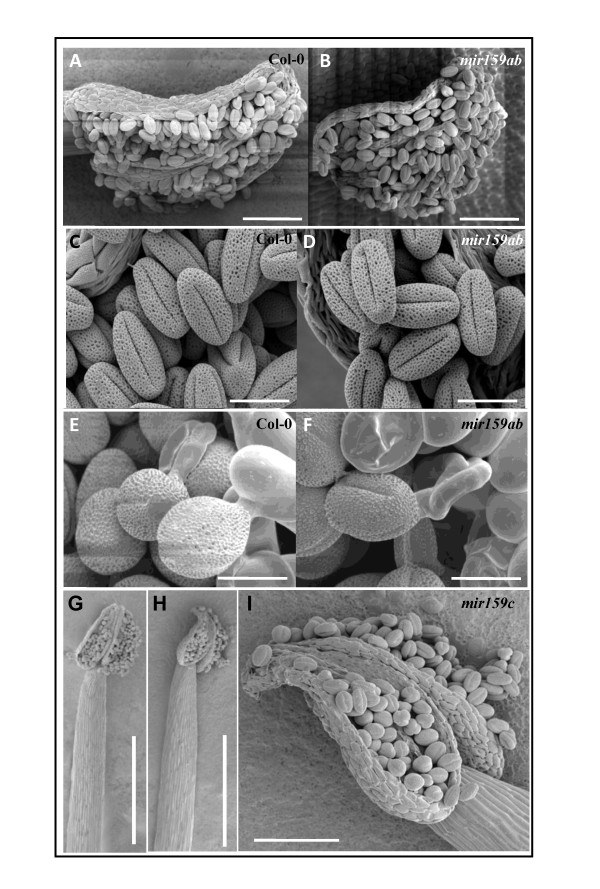
Wild-type and mir159ab pollen grains are indistinguishable. Scanning electron microscope (SEM) images of wild-type (A,C,E,G) and mir159ab (B,D,F) anthers, pollen grains and germinating pollen grains, respectively. (H,I) SEM images of miR159c anthers and pollen. Scale bars represent 100 (A,B,I), 20 (C-F) and 500 (G,H) μm.
Figure 7
Figure 7
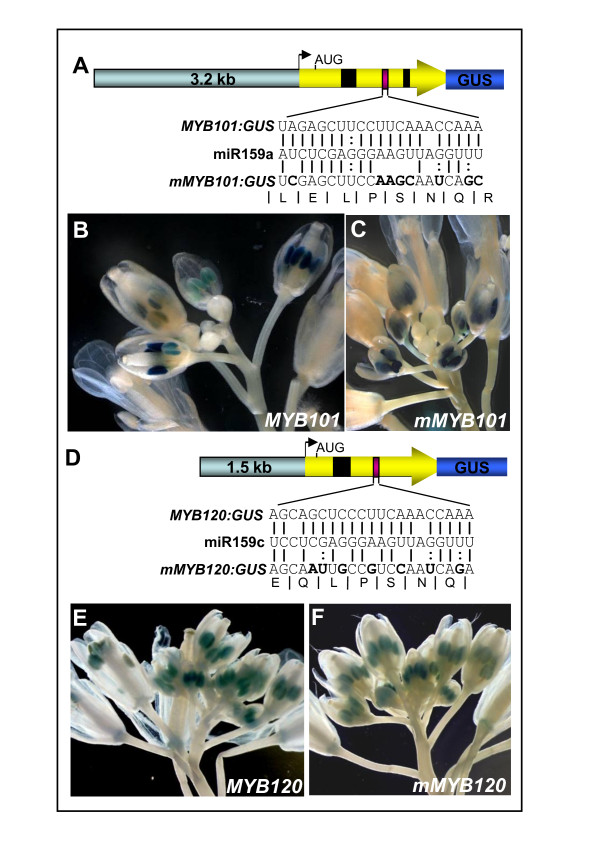
Expression of MYB101 and MYB120 is not regulated by miR159 in inflorescences. (A) The MYB101:GUS transgene consisted of 5171 bp of genomic sequence that included, 3.2 kb of 5' flanking region extending to the adjacent upstream gene (At2g32470), and 1.9 kb of the transcribed region of MYB101 (yellow arrow) that includes introns (black boxes) and the miR159 binding site (purple box) fused in frame to the β-glucuronidase (GUS) reporter gene to encode a full length MYB101:GUS translational fusion protein. Eight synonymous nucleotide substitutions were made in the miR159 binding site of MYB101:GUS to generate mMYB101:GUS. Figure is not to scale. (B) GUS staining of the inflorescence of a MYB101:GUS transgenic plant. (C) GUS staining of the inflorescence of a mMYB101:GUS transgenic plant. (D) The MYB120:GUS transgene consisted of 3125 bp of genomic sequence that included, 1.5 kb of 5' flanking region and 1.6 kb of the coding region of MYB120 (yellow arrow) that includes an intron (black box) and the miR159 binding site (purple box) fused in frame to the GUS reporter gene to encode a full length MYB120:GUS translational fusion protein. Seven synonymous nucleotide substitutions were made in the miR159 binding site of MYB120:GUS to generate the MYB120:GUS transgene. Figure is not to scale. (E) GUS staining of the inflorescence of a MYB120:GUS transgenic plant. (F) GUS staining of the inflorescence of a mMYB120:GUS transgenic plant.
Figure 8
Figure 8
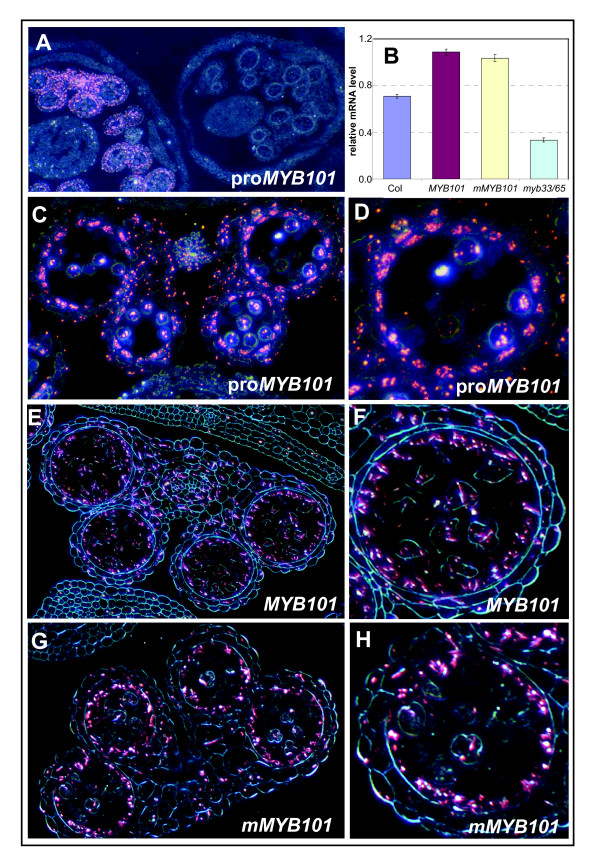
MYB101 and mMYB101 transgenes have indistinguishable expression patterns. Anthers were stained overnight and embedded in paraffin. Transverse sections were examined by dark field microscopy. β-Glucuronidase (GUS) staining is shown by pink crystals. (A) Low magnification of proMYB101:GUS inflorescence showing MYB101 transcription is restricted to postmeiotic anthers. (B) Relative expression of MYB101 in wild type, MYB101/mMYB101 GUS lines and myb33.myb65. Analysis was performed on RNA extracted from inflorescences with measurements being the average of three replicates with error bars representing the standard error of the mean. mRNA levels are relative to cyclophilin. (C) GUS staining in proMYB101:GUS anthers. (D) Detail of a single locule of proMYB101:GUS. (E) GUS staining in MYB101:GUS anthers. (F) Detail of a single locule of MYB101:GUS. (G) GUS staining in mMYB101:GUS anthers. (H) Detail of a single locule of mMYB101:GUS.
Figure 9
Figure 9
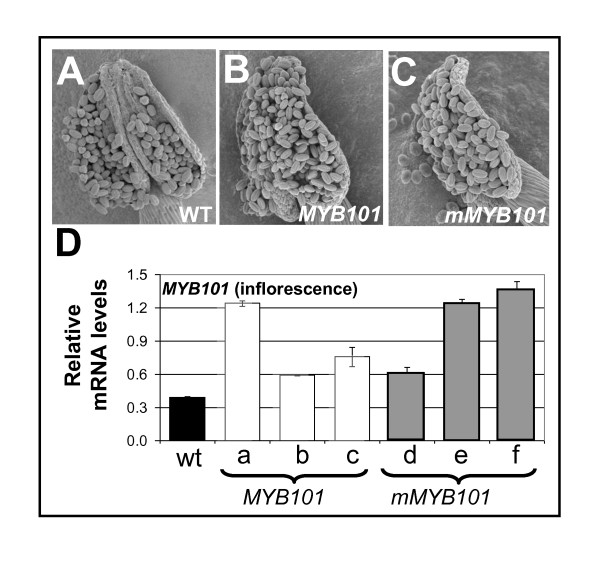
Anthers and pollen of MYB101 and mMYB101 transgenic plants are indistinguishable from wild type. Scanning electron micrographs of anthers/pollen from: (A) a wild-type plant, (B) a MYB101 transgenic plant, (C) a mMYB101 transgenic plant. (D) Real-time quantitative (qRT)-PCR analysis of MYB101 mRNA levels in inflorescences of wild type (WT) and MYB101 (lines A, B, C) and mMYB101 (lines D, E, F) transgenic lines. mRNA levels were normalised to cyclophilin, with measurements being the average of three replicates and error bars representing the standard error of the mean.
Figure 10
Figure 10
Ectopic MYB101/mMYB101 expression can result in rosette phenotypes. Aerial views of transgenic MYB101 and mMYB101 rosettes displaying leaf curling, with numbers in brackets indicating the frequency of the leaf curl phenotype. MYB101 transcripts from both MYB101 and mMYB101 leaf curl rosettes were assayed by real-time quantitative (qRT)-PCR. The numbers in brackets show the relative levels of MYB101 mRNA in wild-type rosettes. Analysis was performed on RNA extracted from rosettes with measurements being the average of three replicates with error bars representing the standard error of the mean. mRNA levels are relative to cyclophilin.

References

    1. Carthew RW, Sontheimer EJ. Origins and mechanisms of miRNAs and siRNAs. Cell. 2009;136:642–655. doi: 10.1016/j.cell.2009.01.035. - DOI - PMC - PubMed
    1. Jones-Rhoades MW, Bartel DP, Bartel B. MicroRNAS and their regulatory roles in plants. Annu Rev Plant Biol. 2006;57:19–53. doi: 10.1146/annurev.arplant.57.032905.105218. - DOI - PubMed
    1. Rhoades MW, Reinhart BJ, Lim LP, Burge CB, Bartel B, Bartel DP. Prediction of plant microRNA targets. Cell. 2002;110:513–520. doi: 10.1016/S0092-8674(02)00863-2. - DOI - PubMed
    1. Llave C, Kasschau KD, Rector MA, Carrington JC. Endogenous and silencing-associated small RNAs in plants. Plant Cell. 2002;14:1605–1619. doi: 10.1105/tpc.003210. - DOI - PMC - PubMed
    1. Zhu QH, Spriggs A, Matthew L, Fan L, Kennedy G, Gubler F, Helliwell C. A diverse set of microRNAs and microRNA-like small RNAs in developing rice grains. Genome Res. 2008;18:1456–1465. doi: 10.1101/gr.075572.107. - DOI - PMC - PubMed

LinkOut - more resources