


Dose imprecision and resistance: free-choice medicated feeds in industrial food animal production in the United States
- PMID: 21030337
- PMCID: PMC3059987
- DOI: 10.1289/ehp.1002625
Dose imprecision and resistance: free-choice medicated feeds in industrial food animal production in the United States
Abstract
Background: Industrial food animal production employs many of the same antibiotics or classes of antibiotics that are used in human medicine. These drugs can be administered to food animals in the form of free-choice medicated feeds (FCMF), where animals choose how much feed to consume. Routine administration of these drugs to livestock selects for microorganisms that are resistant to medications critical to the treatment of clinical infections in humans.
Objectives: In this commentary, we discuss the history of medicated feeds, the nature of FCMF use with regard to dose delivery, and U.S. policies that address antimicrobial drug use in food animals.
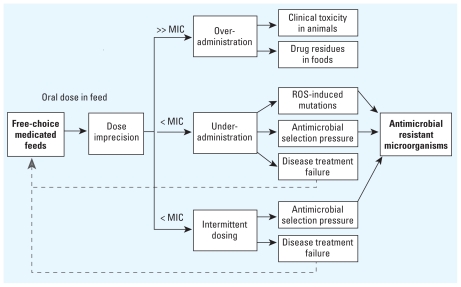
Discussion: FCMF makes delivering a predictable, accurate, and intended dose difficult. Overdosing can lead to animal toxicity; underdosing or inconsistent dosing can result in a failure to resolve animal diseases and in the development of antimicrobial-resistant microorganisms.
Conclusions: The delivery of antibiotics to food animals for reasons other than the treatment of clinically diagnosed disease, especially via free-choice feeding methods, should be reconsidered.
Figures
References
-
- Aarestrup F. Meeting with a Congress Delegation on the Danish Experience with Stop for Nontherapeutic Use of Antimicrobials. 2009. [[accessed 17 February 2010].]. Available: http://www.louise.house.gov/images/stories/attachments/2009.10.01.pamta.pdf.
-
- Andremont A. Effect of antibiotics on bacterial resistance ecology: role of the digestive tract [in French] Med Mal Infect. 2000;30(3):S178–S184.
-
- Angulo FJ, Baker NL, Olsen SJ, Anderson A, Barrett TJ. Antimicrobial use in agriculture: controlling the transfer of antimicrobial resistance to humans. Semin Pediatr Infect Dis. 2004;15(2):78–85. - PubMed
-
- Appleby MC. Modification of laying hen cages to improve behavior. Poult Sci. 1998;77(12):1828–1832. - PubMed
-
- Arikan O, Rice C, Codling E. Occurrence of antibiotics and hormones in a major agricultural watershed. Desalination. 2008;226(1–3):121–133.
Publication types
MeSH terms
Substances
LinkOut - more resources
Full Text Sources
Medical