Review
. 2010 Nov;7(6):376-80.
doi: 10.1513/pats.201001-011AW.

Intracellular processing of alpha1-antitrypsin

Affiliations
Review

Intracellular processing of alpha1-antitrypsin

Richard N Sifers. Proc Am Thorac Soc. 2010 Nov.

Abstract

α(1)-Antitrypsin (AAT) secreted from hepatocytes is an inhibitor of neutrophil elastase. Its normal circulating concentration functions to maintain the elasticity of the lung by preventing the hydrolytic destruction of elastin fibers. Severely diminished circulating concentrations of AAT, resulting from the impaired secretion of genetic variants that exhibit distinct polypeptide folding defects, can function as an etiologic agent for the development of chronic obstructive pulmonary disease. In addition, the inappropriate accumulation of structurally aberrant AAT within the hepatocyte endoplasmic reticulum can contribute to the etiology of liver disease. This article focuses on the discovery and characterization of a biosynthetic quality control system that contributes to the secretion of AAT by first facilitating its proper structural maturation, and then by orchestrating the selective elimination of those molecules that fail to attain structural maturation. Mechanistic elucidation of these interconnected quality control events recently led to the identification of an underlying genetic modifier capable of accelerating the onset of end-stage liver disease by impairing the efficiency of an initial step in the protein disposal process.


Figures
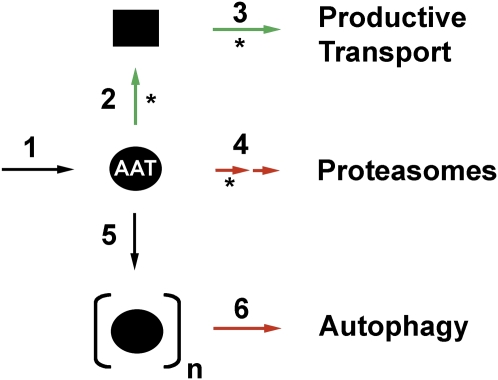
Figure 1.
Figure 1.
Intracellular fates for newly synthesized α1-antitrypsin (AAT). After biosynthesis and translocation into the endoplasmic reticulum (ER) lumen (step 1), the modification of asparagine-linked oligosaccharides promotes physical interaction with the glycoprotein-folding machinery, which promotes conformational maturation (step 2) and productive transport (step 3). The removal of mannose units and polyubiquitinylation targets misfolded polypeptides for dislocation into the cytosol for proteolytic destruction by 26S proteasomes (step 4). The PI Z variant can undergo loop-sheet polymerization (step 6), and these are removed from cells by autophagy (step 6). Events that lead to correct folding and transport are depicted with green arrows. Events that selectively target AAT for intracellular degradation are depicted with red arrows. Events that are orchestrated through the modification and/or recognition of asparagine-linked oligosaccharides are shown with asterisks.
Figure 2.
Figure 2.
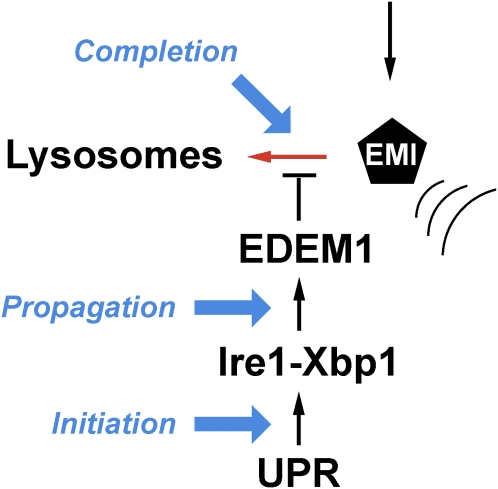
Regulation of the intracellular endoplasmic reticulum (ER) mannosidase I (EMI) concentration. The newly synthesized protein is subjected to intracellular proteolysis under basal conditions (red arrow). Its concentration is elevated as a component of the unfolded protein response (UPR). Signal generation is initiated as part of the inositol-responsive element 1 - X box binding protein 1 (Ire1-Xbp1) branch, and is propagated through the elevated transcription of the gene that encodes an ER degradation–enhancing mannosidase-like (EDEM) protein that is translocated into the ER lumen. Completion of the signal circuit, which helps to boost the efficiency of glycoprotein ER-associated degradation (GERAD) substrate selection, involves a physical interaction with EDEM1, which suppresses the lysosomal down-regulation of EMI. The sequential stages of signaling are shown in blue.
Figure 3.
Figure 3.
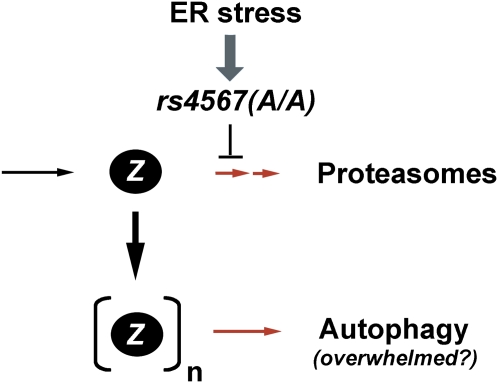
Proposed mechanism by which a single-nucleotide polymorphism (rs4567(A/A)) suppresses the translation of endoplasmic reticulum (ER) mannosidase I in response to ER stress. The model proposes that impaired proteasomal degradation of the proteinase inhibitor Z (PI Z) monomers leads to an enhanced rate at which polymers are allowed to form, thereby overwhelming the functional capacity of the autophagic system.

References

    1. Molinari M. N-glycan structure dictates extension of protein folding or onset of disposal. Nat Chem Biol 2007;3:313–320. - PubMed
    1. Balch WE, Morimoto RI, Dillin A, Kelly JW. Adapting proteostasis for disease intervention. Science 2008;319:916–919. - PubMed
    1. Lomas DA, Evans DLI, Finch JT, Carrell RW. The mechanism of Z alpha 1-antitrypsin accumulation in the liver. Nature 1992;357:605–607. - PubMed
    1. Carrell RW, Lomas DA. Alpha1-antitrypsin deficiency—a model for conformational diseases. N Engl J Med 2002;346:45–53. - PubMed
    1. Lomas DA, Mahadeva R. Alpha1-antitrypsin polymerization and the serpinopathies: pathobiology and prospects for therapy. J Clin Invest 2002;110:1585–1590. - PMC - PubMed

Publication types

MeSH terms

Substances