


Successful treatment of a severely injured soldier from Afghanistan with pumpless extracorporeal lung assist and neurally adjusted ventilatory support
- PMID: 21031042
- PMCID: PMC2926866
- DOI: 10.1007/s12245-010-0192-x
Successful treatment of a severely injured soldier from Afghanistan with pumpless extracorporeal lung assist and neurally adjusted ventilatory support
Abstract
Background: Life-threatening acute lung injury due to combat and/or terror attacks is associated with high mortality. The successful management includes the use of "rescue" extracorporeal lung assist and early transport by aeromedical evacuation teams.
Aims: Description of the pre-hospital support of a severely injured soldier with a pumpless extracorporeal arterio-venous lung assist in critical hypercapnia/hypoxemia.
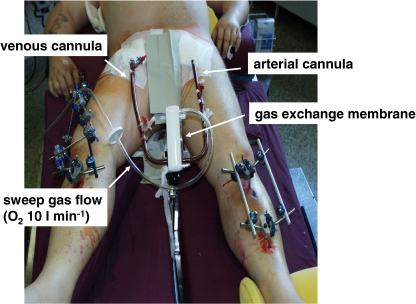
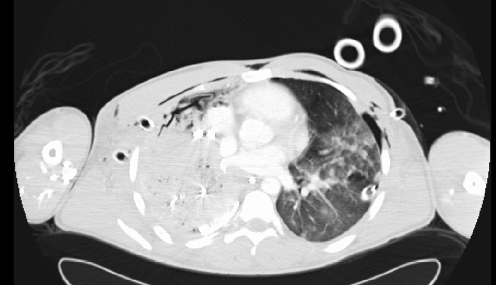
Method: A British soldier suffered from severe gunshot injuries to the chest and abdomen in Afghanistan. After traumatic pneumonectomy, he developed critical hypercapnia/hypoxemia. He was mechanically ventilated and supported with a pumpless interventional extracorporeal lung assist (iLA, Novalung, Talheim, Germany) and transferred to Germany.
Results: A sufficient CO(2) extraction and improvement in oxygenation enabled the safe transportation and lung protective ventilation. Weaning from mechanical ventilation was promoted by the application of a new neurally adjusted ventilatory assist (NAVA). The patient recovered, and he left Germany in stable condition.
Conclusion: Novel techniques in extracorporeal lung assist and in ventilatory support may help save lives even in disaster medicine.
Keywords: Disaster medicine; Extracorporeal lung assist; Neurally adjusted ventilatory assist; Traumatic lung injury.
Figures
References
-
- Bein T, Weber F, Philipp A, et al. A new pumpless extracorporeal lung assist in critical hypoxemia/hypercapnia. Crit Care Med. 2006;34:1372–1377. doi: 10.1097/01.CCM.0000215111.85483.BD. - DOI - PubMed
LinkOut - more resources
Full Text Sources
Research Materials
