Novel Technology in the Treatment of Acne Scars: The Matrix-tunable Radiofrequency Technology
- PMID: 21031069
- PMCID: PMC2956966
- DOI: 10.4103/0974-2077.69021
Novel Technology in the Treatment of Acne Scars: The Matrix-tunable Radiofrequency Technology
Abstract
Background: Despite the many advances, scarring, particularly acne or pimple scarring, does not have a satisfactory treatment. A new armamentarium in this field is this recently devised matrix-tunable radiofrequency technology, which utilizes radiofrequency emission in the treatment of acne scars.
Aims: To evaluate the efficiency of the new matrix-tunable radiofrequency technology in patients with acne scars of varying sizes.
Settings and design: A prospective study of 30 randomly selected patients with acne scars was carried out.
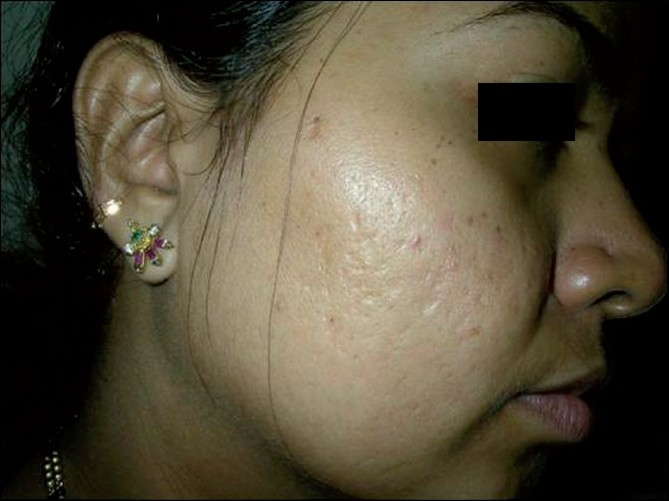
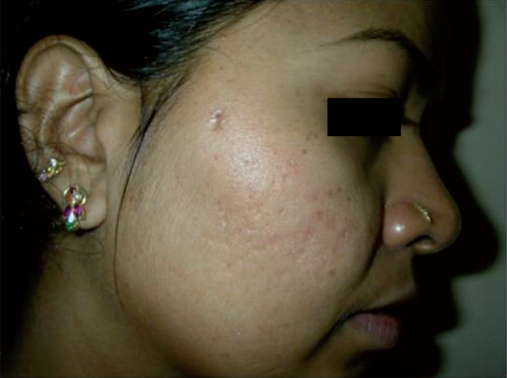
Material and methods: Thirty healthy patients with different types of acne scars - ice pick, box and rolling type - were randomly selected. The scars were either shallow or deep, varied in size from 2 to 20 mm and ranged in number from 10 to 50. These patients were first treated with broad-spectrum antibiotics and local exfoliating agents (topical tretinoin 0.025%) and then subjected to matrix-tunable radiofrequency technology. Each scar was treated at intervals of 1 month. A maximum of four such sittings were carried out. Patients were followed-up every 15 days. Results were noted at the end of 2 months and 6 months. Improvement was assessed by using the visual analog scale (VAS) at 2 months and 6 months, and results were noted in terms of percentage improvement of the whole face by calculating an average of percentage improvement on the basis of interviews of the patient and his/her accompanying relatives. The visual analog scaling was performed by means of high-resolution digital photographs taken at the baseline and at each subsequent visit.
Results: The VAS improvement in scars ranged from 10 to 50% at the end of 2 months to 20 to 70% at the end of 6 months. Of the 30 patients of acne scars, the cosmetic result was excellent (>60% improvement) in four, good (35-60% improvement) in 18 and moderate to poor (<35% improvement) in eight. A few patients reported burning sensation and a mild sunburn-like sensation for about 1 h after treatment. The patients reported a pinkish tone for 2-3 days. Importantly, with the help of some slight make up, all the 30 patients could return to work the following day.
Conclusion: Matrix-tunable radiofrequency technology is a safe and economically viable option for the dermatologists for the treatment of acne scars, because of the effective results coupled with a low downtime.
Keywords: Acne scars; lasers; radiofrequency.
Conflict of interest statement
Figures
References
-
- Bob, Kronemyer Matrix RF fractional skin resurfacing technology treats darker skin types. The aesthetic guide. 2009
-
- Jacobson LG, Alexiades-Armenakas MR, Bernstein L, Geronemus RG. Treatment of nasolabial folds and jowls with a non-invasive radiofrequency device. Arch Dermatol. 2003;139:1313–20. - PubMed
-
- Hodgkinson DJ. Clinical applications of radiofrequency: Nonsurgical skin tightening (Thermage) clinics in plastic surgery. 2009;35:p. 261–8. - PubMed
-
- Hsu TS, Kaminer MS. The use of nonablative radiofrequency technology to tighten the lower face and neck. Semin Cutan Med Surg. 2003;22:115–23. - PubMed
-
- Sadick N, Alexiades-Armenakas M, Bitter P, Hruza G, Mulholland S. Enhanced full-face skin rejuvenation using synchronous intense pulsed optical and conducted, bipolar radiofrequency energy (ELOS): Introducing selective radiophotothermolysis. J Drugs Dermatol. 2005;4:181–6. - PubMed