


Evidence that pneumococcal serotype replacement in Massachusetts following conjugate vaccination is now complete
- PMID: 21031138
- PMCID: PMC2963072
- DOI: 10.1016/j.epidem.2010.03.005
Evidence that pneumococcal serotype replacement in Massachusetts following conjugate vaccination is now complete
Abstract
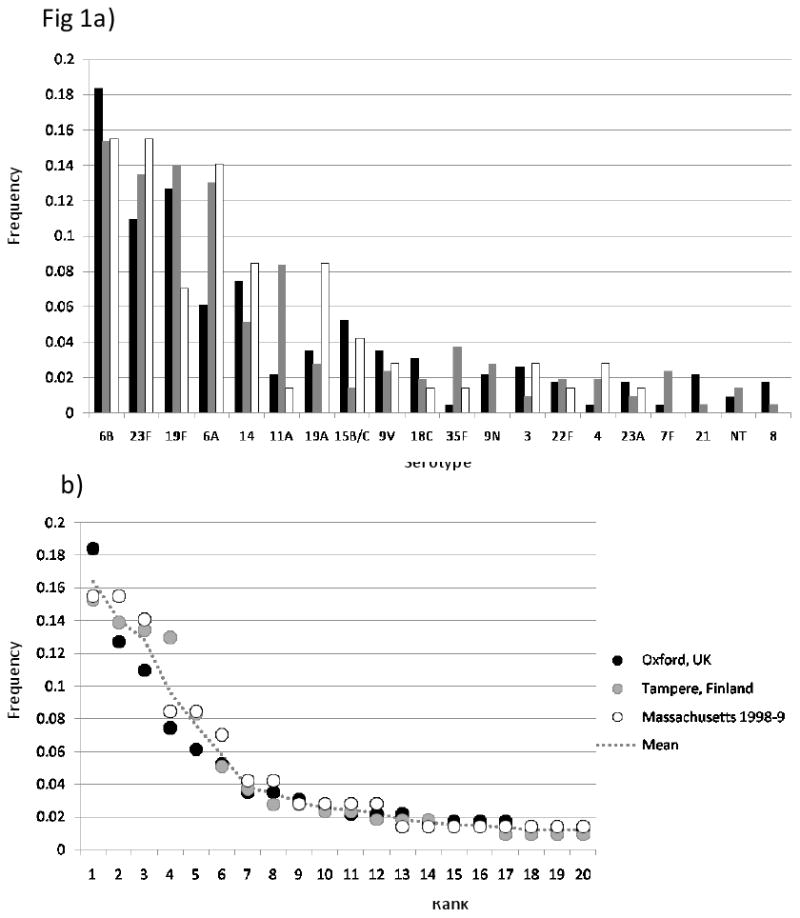
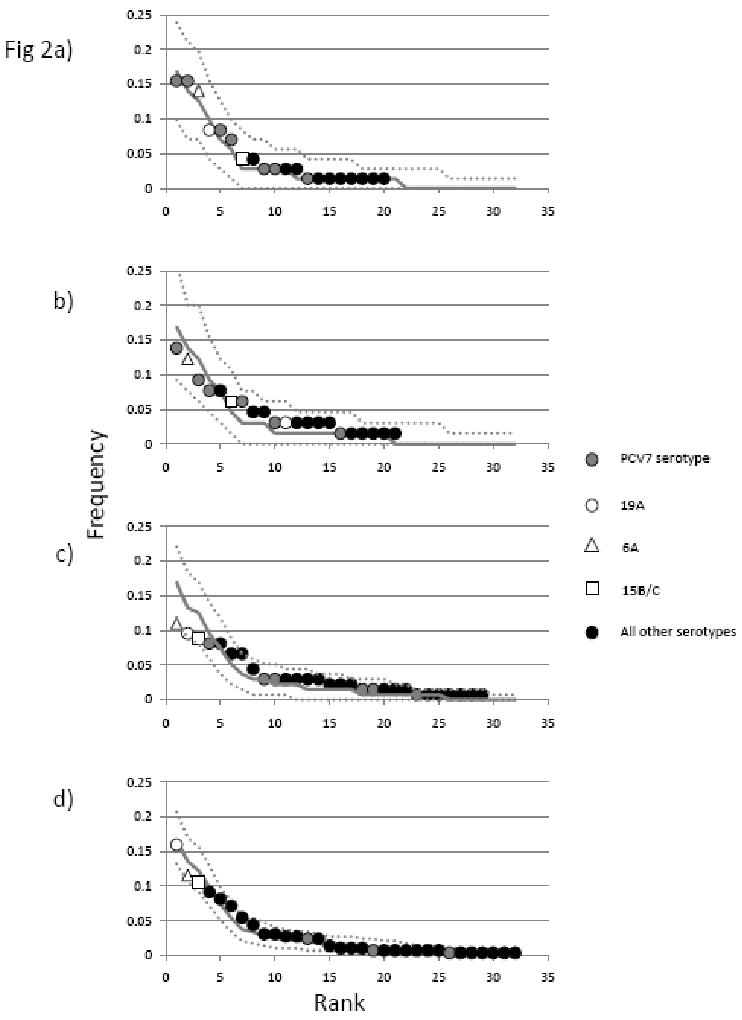
Invasive pneumococcal disease (IPD) has been reduced in the US following conjugate vaccination (PCV7) targeting seven pneumococcal serotypes in 2000. However, increases in IPD due to other serotypes have been observed, in particular 19A. How much this "serotype replacement" will erode the benefits of vaccination and over what timescale is unknown. We used a population genetic approach to test first whether the selective impact of vaccination could be detected in a longitudinal carriage sample, and secondly how long it persisted for following introduction of vaccine in 2000. To detect the selective impact of the vaccine we compared the serotype diversity of samples from pneumococcal carriage in Massachusetts children collected in 2001, 2004 and 2007 with others collected in the pre-vaccine era in Massachusetts, the UK and Finland. The 2004 sample was significantly (p >0.0001) more diverse than pre-vaccine samples, indicating the selective pressure of vaccination. The 2007 sample showed no significant difference in diversity from the pre-vaccine period, and exhibited similar population structure, but with different serotypes. In 2007 the carriage frequency of 19A was similar to that of the most common serotype in pre-vaccine samples. We suggest that serotype replacement involving 19A may be complete in Massachusetts due to similarities in population structure to pre-vaccine samples. These results suggest that the replacement phenomenon occurs rapidly with high vaccine coverage, and may allay concerns about future increases in disease due to 19A. For other serotypes, the future course of replacement disease remains to be determined.
Keywords: Infectious disease epidemiology; Nasopharyngeal carriage; Population genetics; Streptococcus pneumoniae.
Conflict of interest statement
Potential conflicts of interest: WPH has acted as an advisor to Glaxo Smithkline. SIP receives research support from Wyeth Lederle. The other authors have no conflicts of interest to report
Figures
References
-
- Direct and indirect effects of routine vaccination of children with 7-valent pneumococcal conjugate vaccine on incidence of invasive pneumococcal disease--United States, 1998-2003. MMWR Morb Mortal Wkly Rep. 2005;54:893–897. - PubMed
-
- Brueggemann AB, Griffiths DT, Meats E, Peto T, Crook DW, Spratt BG. Clonal relationships between invasive and carriage Streptococcus pneumoniae and serotype- and clone-specific differences in invasive disease potential. J Infect Dis. 2003;187:1424–1432. - PubMed
-
- Byington CL, Samore MH, Stoddard GJ, Barlow S, Daly J, Korgenski K, Firth S, Glover D, Jensen J, Mason EO, Shutt CK, Pavia AT. Temporal trends of invasive disease due to Streptococcus pneumoniae among children in the intermountain west: emergence of nonvaccine serogroups. Clin Infect Dis. 2005;41:21–29. - PubMed
-
- Enright MC, Spratt BG. A multilocus sequence typing scheme for Streptococcus pneumoniae: identification of clones associated with serious invasive disease. Microbiology. 1998;144(Pt 11):3049–3060. - PubMed
-
- Eskola J, Kilpi T, Palmu A, Jokinen J, Haapakoski J, Herva E, Takala A, Kayhty H, Karma P, Kohberger R, Siber G, Makela PH. Efficacy of a pneumococcal conjugate vaccine against acute otitis media. N Engl J Med. 2001;344:403–409. - PubMed
