. 2011 Jan;50(1):31-6.
doi: 10.1016/j.jcv.2010.09.011. Epub 2010 Oct 28.

Epstein-Barr virus replication linked to B cell proliferation in inflamed areas of colonic mucosa of patients with inflammatory bowel disease

Affiliations

Epstein-Barr virus replication linked to B cell proliferation in inflamed areas of colonic mucosa of patients with inflammatory bowel disease

Sumathi Sankaran-Walters et al. J Clin Virol. 2011 Jan.

Abstract

Background: Inflammatory bowel disease (IBD) is characterized by chronic inflammation of the gastrointestinal tract. Epstein-Barr virus (EBV) infection is associated with increased disease severity in therapeutically immunosuppressed IBD patients. The role of EBV infection in patients with IBD who are unresponsive to medical therapy is unclear. Anti-viral strategies may be a viable treatment option if severity of EBV infection, reflected in peripheral blood, contributes to IBD progression.

Objectives: We investigated the role of EBV in IBD patients unresponsive to medical therapy by examining EBV reactivation and B-cell proliferation in colonic mucosa.

Study design: EBV DNA copy numbers were measured by real-time PCR in peripheral blood mononuclear cells (PBMC) of 84 patients with IBD and 115 non-IBD controls in a retrospective cross-sectional study. EBV-infected cells in colonic mucosa were identified by immunohistochemistry.

Results: EBV load in PBMC was higher in patients with IBD than in non-IBD controls, especially in patients not responding to medication. Inflamed colonic mucosa of these patients had high levels of expression of lytic and latent EBV genes that localized to proliferating B-lymphocytes, which was not seen in patients responding to therapy.

Conclusions: EBV replication was associated with severe IBD and mucosal inflammation. Increased proliferation and EBV infection of B-lymphocytes in inflamed colonic mucosa highlight the potential role of EBV in mucosal inflammation. The immunomodulatory effects of EBV could delay the resolution of the IBD associated inflammation, thus contributing to disease progression. These results indicate that anti-viral therapeutic strategies for the resolution of IBD may be useful.


Conflict of interest statement

Conflict of Interest

The authors have no conflict of interest in this study.

This material has not been previously presented or published

Figures
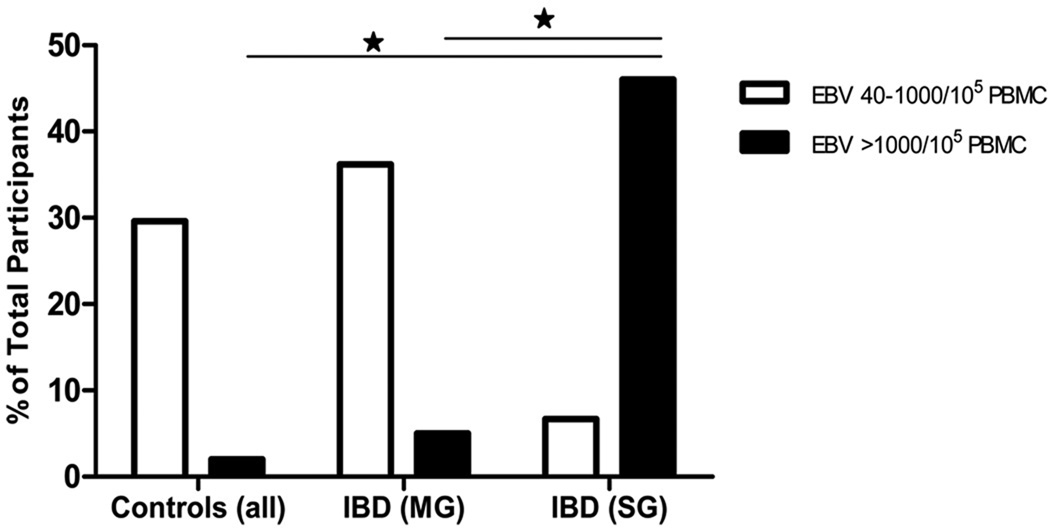
Figure 1
Figure 1
EBV positivity in PBMC is higher in IBD patients than in control subjects. Higher overall rates of EBV positivity was observed in IBD patients who were perioperative (SG), while the majority of controls were negative for cell associated virus or had very low levels of EBV. Data is presented for all for categories, as a percentage of total number of patients within each group, with viral loads 40–1000 copies/105 PBMC or viral loads >1000 copies/105 PBMC. (* indicates p<0.05)
Figure 2
Figure 2
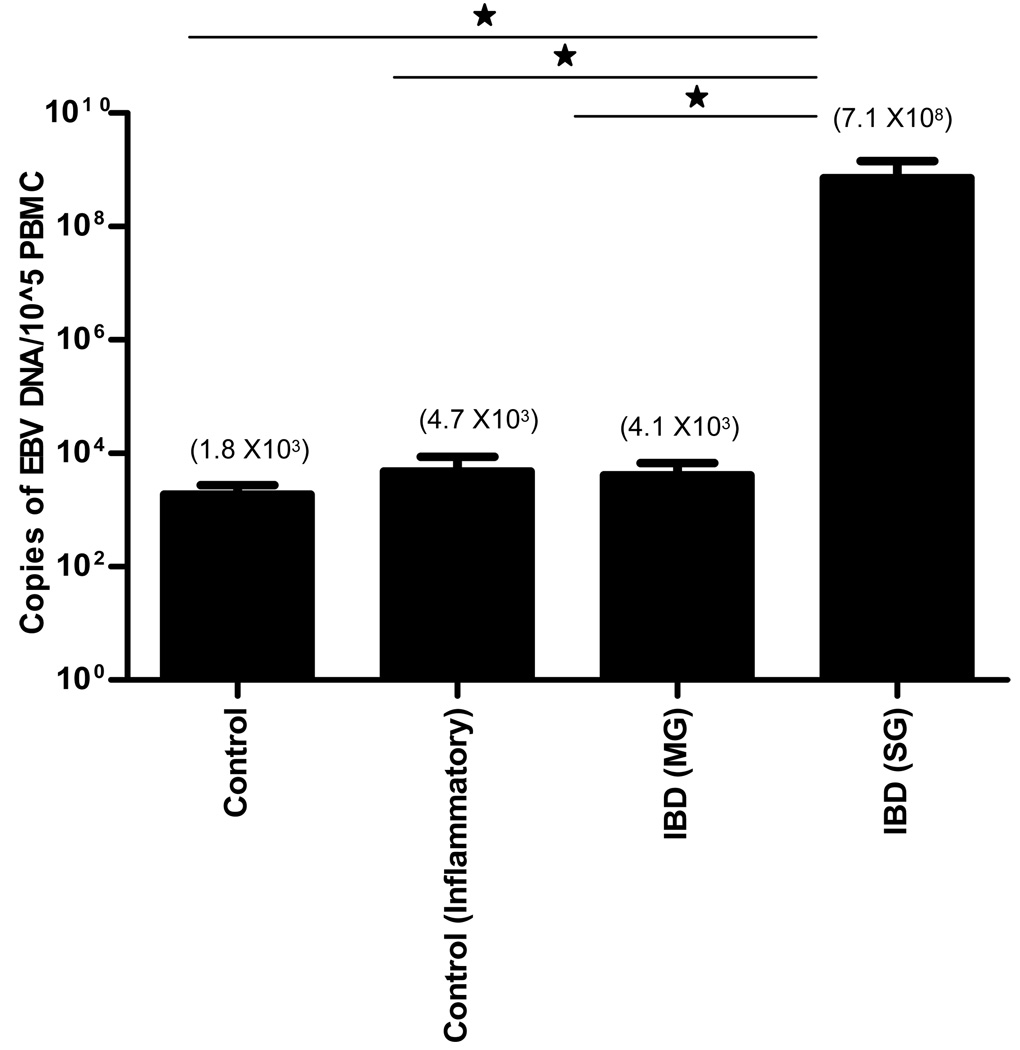
PBMC viral loads were obtained using real-time PCR. Increased mean viral loads, indicated by elevated levels of EBV DNA/cell, were observed in the IBD positive group when compared to the IBD negative control group. Significant differences were only seen in the perioperative IBD group (p = 0.002 for perioperative patients (SG) compared to controls, p=0.001 for SG compared to medically managed patients (MG), and p=0.0006 for SG compared to inflammatory controls). Patients in the perioperative group had IBD that was refractive to conventional therapies and required surgery. These patients also had very high activity of the disease at time of sample collection. (* indicated p<0.05 by Mann Whitney test for individual comparisons and 1 way ANOVA using the Kruskall-Wallis test and Dunns multiple comparison test).
Figure 3
Figure 3
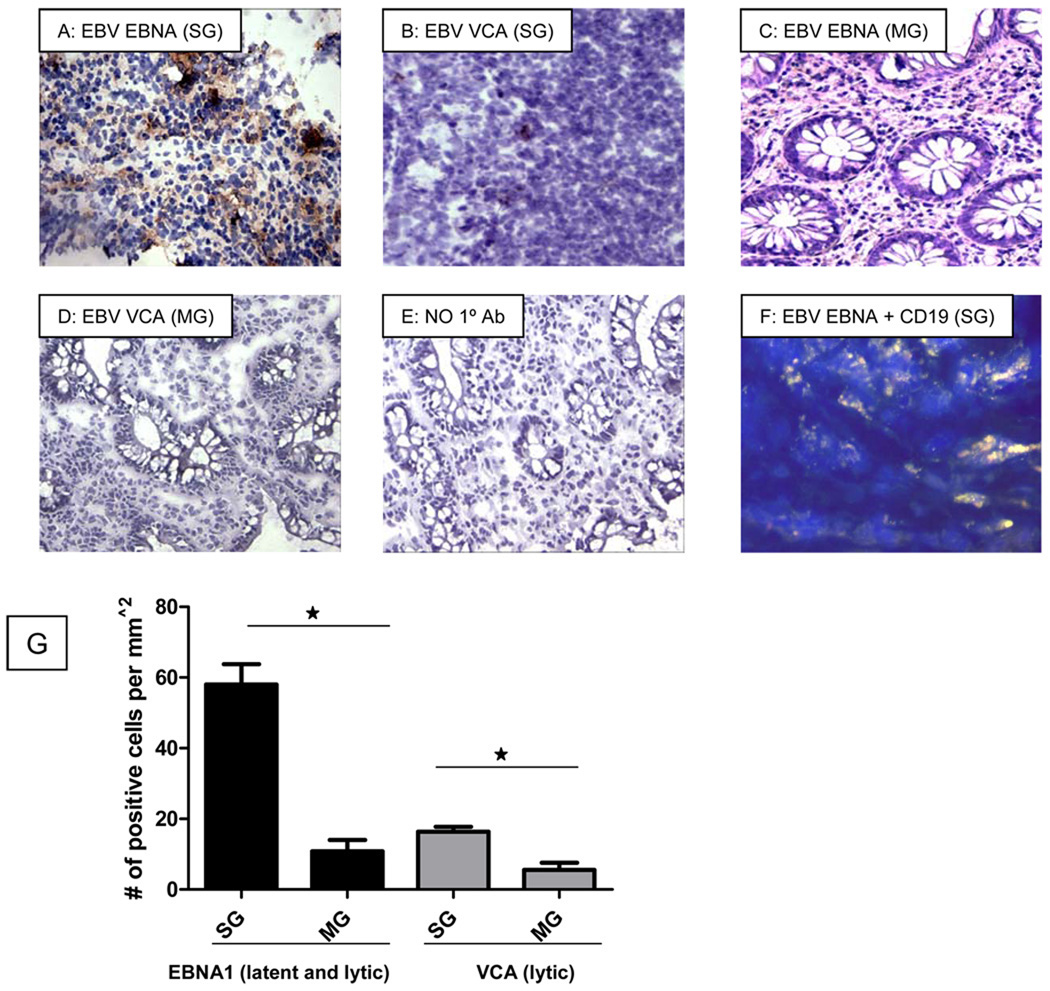
Immunohistochemical staining of colon resections of SG patients with high EBV viral loads and colonic biopsies of MG patients were performed. Tissues were stained with an antibody against the latent/lytic EBV virus marker EBNA1 (A) and the lytic EBV gene product, VCA (B), then visualized using light microscopy. EBV is stained brown. High levels of EBV EBNA1 and EBV VCA were observed in highly inflamed areas of the colon of SG patients (3A, 3B). A few EBV EBNA1 positive cells (C) and VCA positive cells (D) were observed in biopsies obtained from MG patients. There was no staining observed in the antibody negative control section (E). Double staining for EBV EBNA1 and CD19 was performed (F). In this section, EBV EBNA1+ cells appear teal, B-cells appear pink, and B-cells with EBV appear white (F). Latent EBV appears to be associated with B-cells as well as other unstained cell types in the SG patient. Ennumeration of EBV positive cells also indicated higher levels in SG patients as compared to MG patients (G). (* indicates p<0.05 using the unpaired t-test.; SG indicates patients requiring surgical management; MG indicates patients responding to medical therapy).
Figure 4
Figure 4
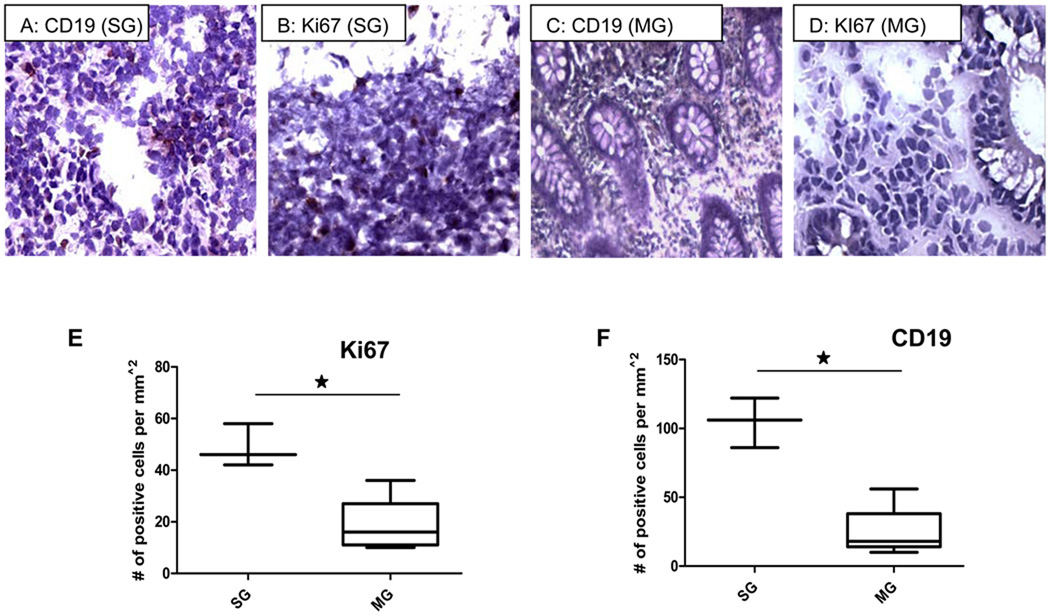
Higher levels of CD19+ cells (B-lymphocytes) (A,C,F) and Ki67 (B,D, E) were seen in highly inflamed bowel in SG patients compared to biopsy samples from MG patients. Lower levels of CD19 positive B-lymphocytes were observed in biopsy samples from patients responding to therapy (MG) with CD (4C). No staining was observed in the tissue sections not treated with primary antibody. (* indicates p<.05 using the unpaired t-test; SG indicates patients requiring surgical management; MG indicates patients responding to medical therapy).

References

    1. Himmel ME, Hardenberg G, Piccirillo CA, Steiner TS, Levings MK. The role of T-regulatory cells and Toll-like receptors in the pathogenesis of human inflammatory bowel disease. Immunology. 2008 Oct;125(2):145–153. - PMC - PubMed
    1. Macfarlane S, Steed H, Macfarlane GT. Intestinal bacteria and inflammatory bowel disease. Crit Rev Clin Lab Sci. 2009;46(1):25–54. - PubMed
    1. Niess JH. Role of mucosal dendritic cells in inflammatory bowel disease. World J Gastroenterol. 2008 Sep 7;14(33):5138–5148. - PMC - PubMed
    1. Shih DQ, Targan SR, McGovern D. Recent advances in IBD pathogenesis: genetics and immunobiology. Curr Gastroenterol Rep. 2008 Dec;10(6):568–575. - PMC - PubMed
    1. Prindiville TP, Sheikh RA, Cohen SH, Tang YJ, Cantrell MC, Silva J., Jr Bacteroides fragilis enterotoxin gene sequences in patients with inflammatory bowel disease. Emerg Infect Dis. 2000 Mar–Apr;6(2):171–174. - PMC - PubMed

Publication types

MeSH terms