


Structural determinants of inhibitor selectivity in prokaryotic IMP dehydrogenases
- PMID: 21035731
- PMCID: PMC2991053
- DOI: 10.1016/j.chembiol.2010.07.014
Structural determinants of inhibitor selectivity in prokaryotic IMP dehydrogenases
Abstract
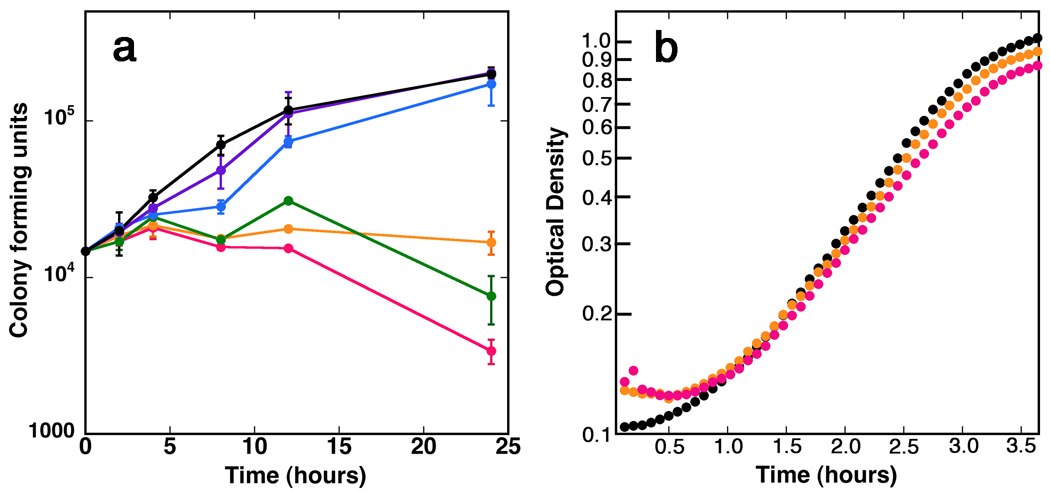
The protozoan parasite Cryptosporidium parvum is a major cause of gastrointestinal disease; no effective drug therapy exists to treat this infection. Curiously, C. parvum IMPDH (CpIMPDH) is most closely related to prokaryotic IMPDHs, suggesting that the parasite obtained its IMPDH gene via horizontal transfer. We previously identified inhibitors of CpIMPDH that do not inhibit human IMPDHs. Here, we show that these compounds also inhibit IMPDHs from Helicobacter pylori, Borrelia burgdorferi, and Streptococcus pyogenes, but not from Escherichia coli. Residues Ala165 and Tyr358 comprise a structural motif that defines susceptible enzymes. Importantly, a second-generation CpIMPDH inhibitor has bacteriocidal activity on H. pylori but not E. coli. We propose that CpIMPDH-targeted inhibitors can be developed into a new class of antibiotics that will spare some commensal bacteria.
Copyright © 2010 Elsevier Ltd. All rights reserved.
Figures
References
-
- Abrahamsen MS, Templeton TJ, Enomoto S, Abrahante JE, Zhu G, Lancto CA, Deng M, Liu C, Widmer G, Tzipori S, et al. Complete genome sequence of the apicomplexan, Cryptosporidium parvum. Science. 2004;304:441–445. - PubMed
-
- Ashbaugh CD, Wessels MR. Cloning, sequence analysis and expression of the group A streptococcal guaB gene encoding inosine monophosphate dehydrogenase. Gene. 1995;165:57–60. - PubMed
-
- Bapteste E, Philippe H. The potential value of indels as phylogenetic markers: position of trichomonads as a case study. Mol Biol Evol. 2002;19:972–977. - PubMed
Publication types
MeSH terms
Substances
Grants and funding
LinkOut - more resources
Full Text Sources
Other Literature Sources
Chemical Information
Molecular Biology Databases
