


Chemical methods to detect S-nitrosation
- PMID: 21036657
- PMCID: PMC3033964
- DOI: 10.1016/j.cbpa.2010.10.006
Chemical methods to detect S-nitrosation
Abstract
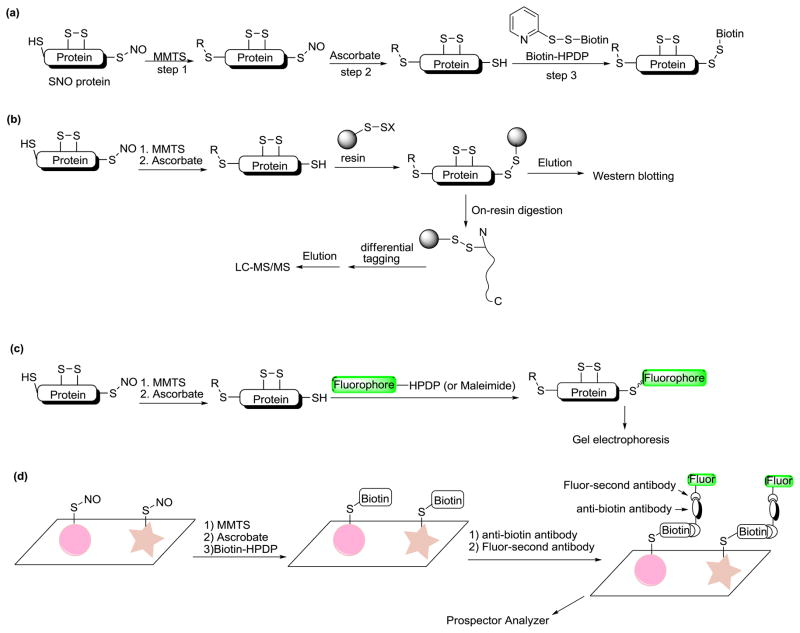
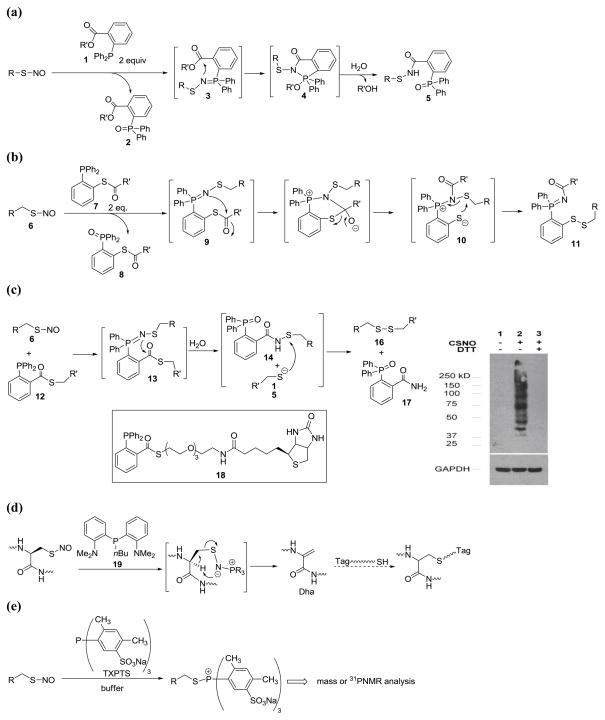
Nitric oxide (NO) is a cell-signaling molecule involved in a number of physiological and pathophysiological processes. Modification of cysteine residues by NO (or NO metabolites), that is S-nitrosation, changes the function of a broad spectrum of proteins. This reaction represents an important post-translational modification that transduces NO-dependent signals. However, the detection and quantification of S-nitrosation in biological samples remain a challenge mainly because of the lability of S-nitrosation products: S-nitrosothiols (SNO). In this review we summarize recent developments of the methods to detect S-nitrosation. Our focus is on the methods which can be used to directly conjugate the site(s) of S-nitrosation.
Copyright © 2010 Elsevier Ltd. All rights reserved.
Figures

References
-
- Gladwin MT, Wang X, Hogg N. Methodological vexation about thiol oxidation versus S-nitrosation-A commentary on “An ascorbate-dependent artifact that interferes with the interpretation of the biotin-switch assay”. Free Radic Biol Med. 561;2006:41–557. The authors point out possible problems of the biotin switch method and suggest that careful control experiments be necessary when biotin switch is used to analyze protein S-nitrosation. - PubMed
-
- Giustarini D, Milzani A, Dale-Donne I, Rossi R. Detection of s-nitrosothiol in biological fluids: a comparison among the most widely applied methodologies. J Chromatogr B Analyt Technol biomed Life Sci. 2007;851:124–139. - PubMed
-
- MacArthur PH, Shiva S, Galdwin MT. Measurement of circulating nitrite and S-nitrosothiols by reductive chemiluminescence. J Chromatogr B Analyt Technol biomed Life Sci. 2007;851:93–105. - PubMed
Publication types
MeSH terms
Substances
Grants and funding
LinkOut - more resources
Full Text Sources
