doi: 10.4269/ajtmh.2010.10-0306.
Pathogenicity of high-dose enteral inoculation of Burkholderia pseudomallei to mice
Affiliations
- PMID: 21036839
- PMCID: PMC2963971
- DOI: 10.4269/ajtmh.2010.10-0306
Item in Clipboard
Pathogenicity of high-dose enteral inoculation of Burkholderia pseudomallei to mice
Am J Trop Med Hyg.
2010 Nov.
Abstract
Melioidosis is a frequently lethal tropical infection caused by the environmental saprophyte Burkholderia pseudomallei. Although transcutaneous inoculation and inhalation are considered the primary routes of infection, suggestive clinical evidence implicates ingestion as a possible alternative route. We show that in BALB/c and C57BL/6 mice, direct gastric inoculation of high doses of B. pseudomallei causes systemic infection that may be lethal or cause chronic disseminated infection. Mice may shed bacteria in the stool for weeks after infection, and high titers of B. pseudomallei-specific IgG are detectable. This report of enteric murine melioidosis supports further consideration of this route of infection.
Figures
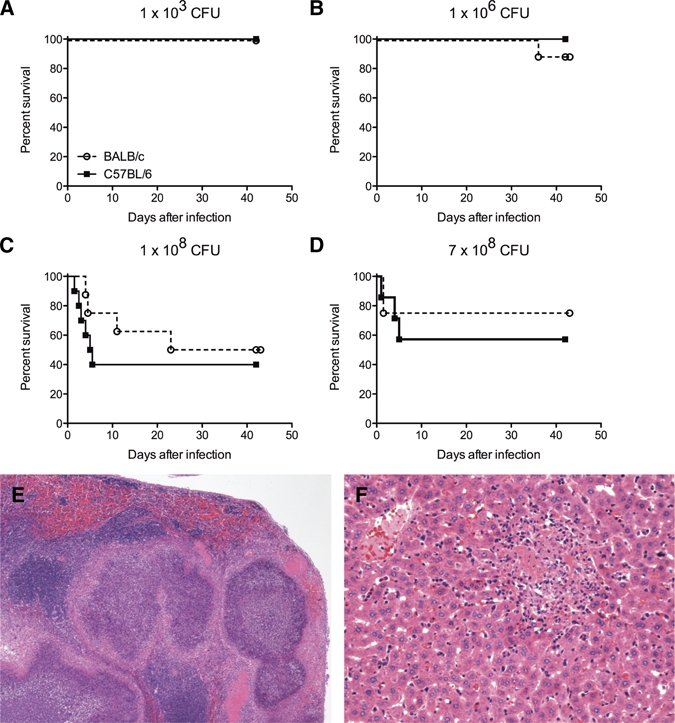
Combined survival data from pilot and confirmatory experiments showing partial lethality at the higher inoculating doses of Burkholderia pseudomallei. A–D, BALB/c and C57BL/6 mice inoculated with 1 × 10³, 1 × 10⁶, 1 × 10⁸, or 7 × 10⁸ colony-forming units (CFU) of B. pseudomallei by gavage and observed for survival. The 1 × 10⁶ and 1 × 10⁸ CFU data represent two independent experiments combined. BALB/c: n = 3, 9, 8, and 4, respectively. C57BL/6: n = 5, 10, 10, and 7, respectively. There was no difference in survival between mouse strains at any dose by the log rank test. E and F, Spleen section photographed with a 4× objective (E) and liver section photographed with a 20× objective (F) stained with hematoxylin and eosin from a BALB/c mouse inoculated with 1 × 10⁶ CFU six weeks earlier. Multiple, large, confluent abscesses with dark blue necrotic cores efface the normal architecture of the spleen (E). In the liver (F), a focal area of hepatocellular necrosis contains clusters of neutrophilic and mononuclear inflammatory cells. The hypercellular appearance of surrounding sinusoids is caused by increased numbers of inflammatory cells. This figure appears in color at www.ajtmh.org .
References
-
- White NJ. Melioidosis. Lancet. 2003;361:1715–1722. - PubMed
-
- Inglis TJ, Garrow SC, Adams C, Henderson M, Mayo M. Dry-season outbreak of melioidosis in western Australia. Lancet. 1998;352:1600. - PubMed
-
- Currie BJ, Mayo M, Anstey NM, Donohoe P, Haase A, Kemp DJ. A cluster of melioidosis cases from an endemic region is clonal and is linked to the water supply using molecular typing of Burkholderia pseudomallei isolates. Am J Trop Med Hyg. 2001;65:177–179. - PubMed
Publication types
MeSH terms
Substances
Grants and funding
LinkOut - more resources
Full Text Sources