


Exposure to diesel motor exhaust and lung cancer risk in a pooled analysis from case-control studies in Europe and Canada
- PMID: 21037020
- PMCID: PMC7259806
- DOI: 10.1164/rccm.201006-0940OC
Exposure to diesel motor exhaust and lung cancer risk in a pooled analysis from case-control studies in Europe and Canada
Abstract
Rationale: Diesel motor exhaust is classified by the International Agency for Research on Cancer as probably carcinogenic to humans. The epidemiologic evidence is evaluated as limited because most studies lack adequate control for potential confounders and only a few studies have reported on exposure-response relationships.
Objectives: Investigate lung cancer risk associated with occupational exposure to diesel motor exhaust, while controlling for potential confounders.
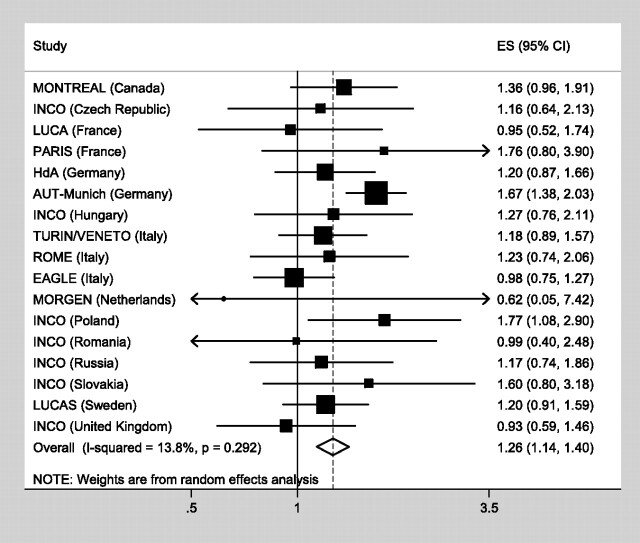
Methods: The SYNERGY project pooled information on lifetime work histories and tobacco smoking from 13,304 cases and 16,282 controls from 11 case-control studies conducted in Europe and Canada. A general population job exposure matrix based on ISCO-68 occupational codes, assigning no, low, or high exposure to diesel motor exhaust, was applied to determine level of exposure.
Measurements and main results: Odds ratios of lung cancer and 95% confidence intervals were estimated by unconditional logistic regression, adjusted for age, sex, study, ever-employment in an occupation with established lung cancer risk, cigarette pack-years, and time-since-quitting smoking. Cumulative diesel exposure was associated with an increased lung cancer risk highest quartile versus unexposed (odds ratio 1.31; 95% confidence interval, 1.19-1.43), and a significant exposure-response relationship (P value < 0.01). Corresponding effect estimates were similar in workers never employed in occupations with established lung cancer risk, and in women and never-smokers, although not statistically significant.
Conclusions: Our results show a consistent association between occupational exposure to diesel motor exhaust and increased risk of lung cancer. This association is unlikely explained by bias or confounding, which we addressed by adjusted models and subgroup analyses.
Figures
Comment in
-
Does diesel exhaust cause lung cancer (yet)?Am J Respir Crit Care Med. 2011 Apr 1;183(7):843-4. doi: 10.1164/rccm.201011-1870ED. Am J Respir Crit Care Med. 2011. PMID: 21471076 No abstract available.
-
Diesel motor exhaust and lung cancer: additional perspectives.Am J Respir Crit Care Med. 2011 Sep 1;184(5):619; author reply 619-20. doi: 10.1164/ajrccm.184.5.619a. Am J Respir Crit Care Med. 2011. PMID: 21885639 No abstract available.
-
Exposures to diesel motor exhaust and lung cancer: are findings of a large pooled analysis really consistent?Am J Respir Crit Care Med. 2012 Jan 1;185(1):104; author reply 106-7. doi: 10.1164/ajrccm.185.1.104. Am J Respir Crit Care Med. 2012. PMID: 22210790 No abstract available.
-
The impact of selection bias due to increasing response rates among population controls in occupational case-control studies.Am J Respir Crit Care Med. 2012 Jan 1;185(1):104-6; author reply 106-7. doi: 10.1164/ajrccm.185.1.104a. Am J Respir Crit Care Med. 2012. PMID: 22210791 No abstract available.
References
-
- Lewne M, Plato N, Gustavsson P. Exposure to particles, elemental carbon and nitrogen dioxide in workers exposed to motor exhaust. Ann Occup Hyg 2007;51:693–701. - PubMed
-
- Wichmann HE. Diesel exhaust particles. Inhal Toxicol 2007;19:241–244. - PubMed
-
- California Environmental Protection Agency, Air Resources Board. Key events in the history of air quality in California [accessed 2010 May 27]. Available from: http://www.arb.ca.gov/html/brochure/history.htm
-
- DieselNet. Summary of worldwide diesel emission standards [accessed 2010 May 27]. Available from: http://www.dieselnet.com/standards/
Publication types
MeSH terms
Substances
LinkOut - more resources
Full Text Sources
Medical
