


Features, as well as space and time, guide object persistence
- PMID: 21037174
- PMCID: PMC6999814
- DOI: 10.3758/PBR.17.5.731
Features, as well as space and time, guide object persistence
Abstract
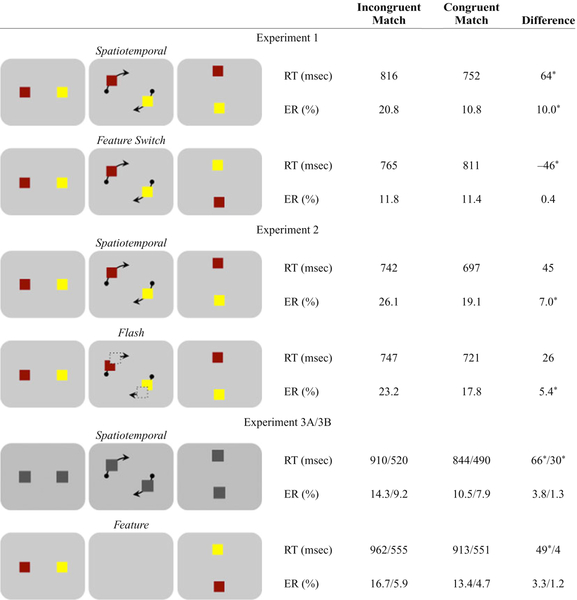
What role do surface features (e.g., color) play in the establishment and maintenance of episodic representations of objects (object files)? Mitroff and Alvarez (2007) showed that stimuli that were linked by a continuous spatiotemporal history yielded object-specific preview benefits--a standard index of object files-whereas stimuli linked only by shared surface features did not. Here, it is shown that abruptly changing the features of an object that has been established on the basis of spatiotemporal history can disrupt object-specific preview benefits (Experiments 1 and 2). Moreover, under some conditions, feature match alone can give rise to the preview benefits (Experiment 3). These results indicate that surface features, as well as spatiotemporal factors, play an important role in establishing and maintaining episodic object representations.
Figures
References
-
- Brainard DH (1997). The Psychophysics Toolbox. Spatial Vision, 10, 433–436. - PubMed
-
- Burt P, & Sperling G (1981). Time, distance, and feature trade-offs in visual apparent motion. Psychological Review, 88, 171–195. - PubMed
-
- Dawson MR (1991). The how and why of what went where in apparent motion: Modeling solutions to the motion correspondence problem. Psychological Review, 98, 569–603. - PubMed
-
- Flombaum JI, & Scholl BJ (2006). A temporal same-object advantage in the tunnel effect: Facilitated change detection for persisting objects. Journal of Experimental Psychology: Human Perception & Performance, 32, 840–853. - PubMed
-
- Flombaum JI, Scholl BJ, & Santos LR (2009). Spatiotemporal priority as a fundamental principle of object persistence In Hood B & Santos L (Eds.), The origins of object knowledge (pp. 135–164). Oxford: Oxford University Press.
Publication types
MeSH terms
Grants and funding
LinkOut - more resources
Full Text Sources