


RegPhos: a system to explore the protein kinase-substrate phosphorylation network in humans
- PMID: 21037261
- PMCID: PMC3013804
- DOI: 10.1093/nar/gkq970
RegPhos: a system to explore the protein kinase-substrate phosphorylation network in humans
Abstract
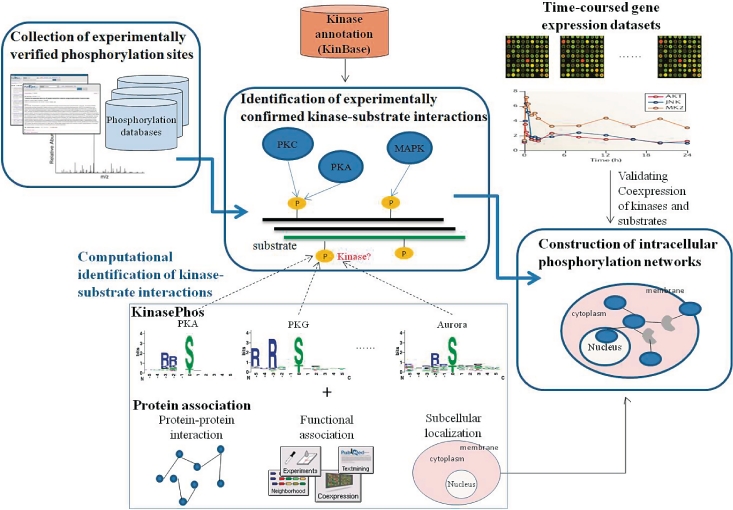
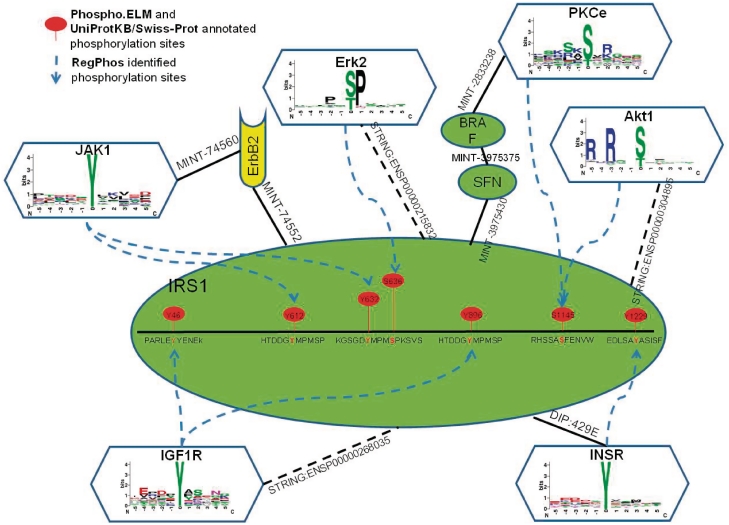
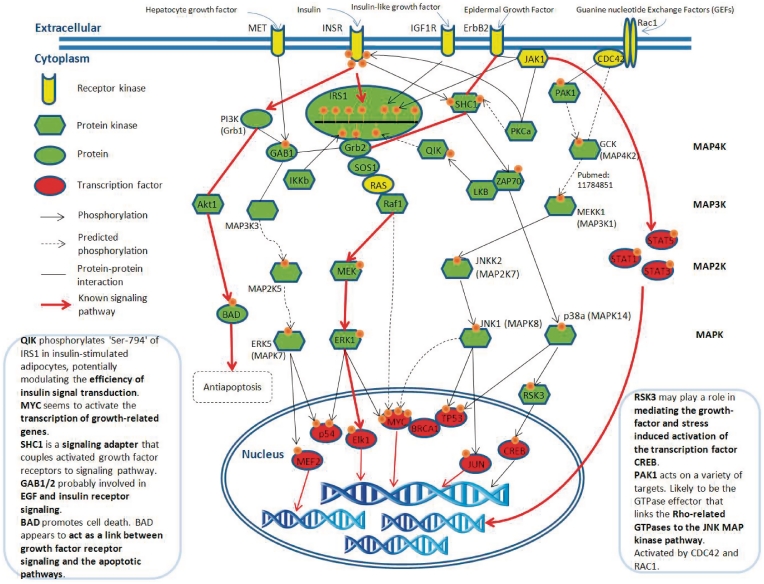
Protein phosphorylation catalyzed by kinases plays crucial regulatory roles in intracellular signal transduction. With the increasing number of experimental phosphorylation sites that has been identified by mass spectrometry-based proteomics, the desire to explore the networks of protein kinases and substrates is motivated. Manning et al. have identified 518 human kinase genes, which provide a starting point for comprehensive analysis of protein phosphorylation networks. In this study, a knowledgebase is developed to integrate experimentally verified protein phosphorylation data and protein-protein interaction data for constructing the protein kinase-substrate phosphorylation networks in human. A total of 21,110 experimental verified phosphorylation sites within 5092 human proteins are collected. However, only 4138 phosphorylation sites (∼20%) have the annotation of catalytic kinases from public domain. In order to fully investigate how protein kinases regulate the intracellular processes, a published kinase-specific phosphorylation site prediction tool, named KinasePhos is incorporated for assigning the potential kinase. The web-based system, RegPhos, can let users input a group of human proteins; consequently, the phosphorylation network associated with the protein subcellular localization can be explored. Additionally, time-coursed microarray expression data is subsequently used to represent the degree of similarity in the expression profiles of network members. A case study demonstrates that the proposed scheme not only identify the correct network of insulin signaling but also detect a novel signaling pathway that may cross-talk with insulin signaling network. This effective system is now freely available at http://RegPhos.mbc.nctu.edu.tw.
Figures
References
-
- Hubbard MJ, Cohen P. On target with a new mechanism for the regulation of protein phosphorylation. Trends Biochem. Sci. 1993;18:172–177. - PubMed
-
- Aebersold R, Mann M. Mass spectrometry-based proteomics. Nature. 2003;422:198–207. - PubMed
-
- Hornbeck PV, Chabra I, Kornhauser JM, Skrzypek E, Zhang B. PhosphoSite: A bioinformatics resource dedicated to physiological protein phosphorylation. Proteomics. 2004;4:1551–1561. - PubMed
Publication types
MeSH terms
Substances
LinkOut - more resources
Full Text Sources
