Population-based longitudinal study of follow-up care for breast cancer survivors
- PMID: 21037867
- PMCID: PMC2900866
- DOI: 10.1200/JOP.200009
Population-based longitudinal study of follow-up care for breast cancer survivors
Abstract
Purpose: To describe the patterns of follow-up care provided to a population-based cohort of breast cancer survivors, and to assess factors associated with adherence to guidelines on follow-up care.
Patients and methods: We conducted a retrospective longitudinal study of all women with surgically treated breast cancer who were without evidence of recurrence, advanced breast cancer, or new primary cancer and were diagnosed in Ontario, Canada, within a 2-year period (n = 11,219). They were followed for 5 years. The cohort was identified through the Ontario Cancer Registry, and individuals were linked across population-based administrative health databases. Frequency of and adherence to guideline recommendations for oncologist and primary care physician (PCP) visits; surveillance imaging for metastatic disease; and surveillance mammograms by year from diagnosis, age group, and income quintile were analyzed. Factors associated with adherence to guideline recommendations were analyzed.
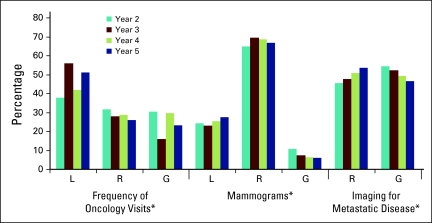
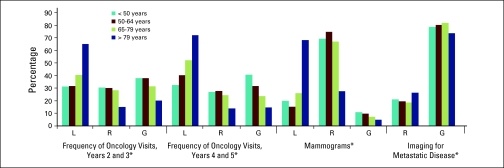
Results: Most women saw both oncologists and PCPs in each follow-up year. Approximately two thirds had surveillance mammograms in each follow-up year. Overall, two thirds had either fewer or greater than recommended oncology visits, one quarter had fewer than recommended surveillance mammograms, and half had greater than recommended surveillance imaging for metastatic disease.
Conclusion: This population-based study shows substantial variation in adherence to guideline recommendations, with both overuse and underuse of surveillance visits and tests. Most importantly, a substantial proportion are receiving more than recommended imaging for metastatic disease but fewer than recommended mammograms for detection of local recurrence or new primary cancer, for which effective intervention is possible.
Figures
References
-
- Rosselli Del Turco M, Palli D, Cariddi A, et al. Intensive diagnostic follow-up after treatment of primary breast cancer. A randomized trial. national Research Council Project on Breast Cancer follow-up. JAMA. 1994;271:1593–1597. - PubMed
-
- Impact of follow-up testing on survival and health-related quality of life in breast cancer patients. A multicenter randomized controlled trial. The Givio Investigators. JAMA. 1994;271:1587–1592. - PubMed
-
- Grunfeld E, Levine MN, Julian JA, et al. Randomized trial of long-term follow-up for early-stage breast cancer: A comparison of family physician versus specialist care. J Clin Oncol. 2006;24:848–855. - PubMed
-
- Paszat L, Sutradhar R, Grunfeld E, et al. Outcomes of surveillance mammography after treatment of primary breast cancer: A population-based case series. Breast Cancer Res Treat. 2009;114:169–178. - PubMed
LinkOut - more resources
Full Text Sources