


Estimating differences in restricted mean lifetime using observational data subject to dependent censoring
- PMID: 21039400
- PMCID: PMC4190616
- DOI: 10.1111/j.1541-0420.2010.01503.x
Estimating differences in restricted mean lifetime using observational data subject to dependent censoring
Abstract
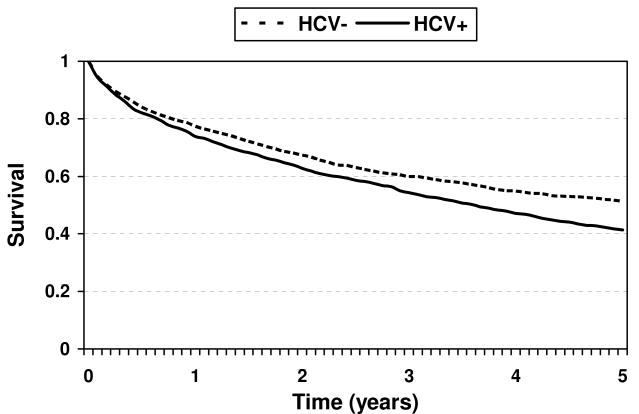
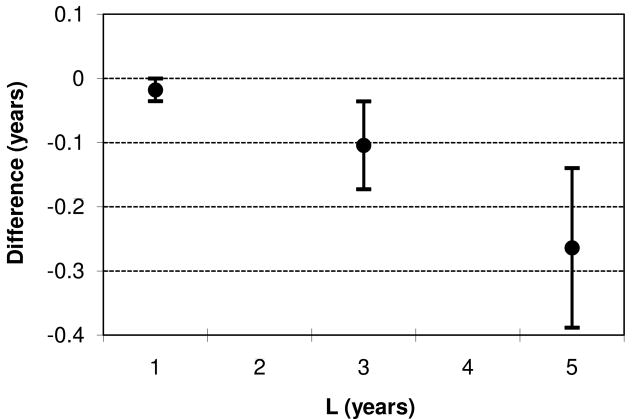
In epidemiologic studies of time to an event, mean lifetime is often of direct interest. We propose methods to estimate group- (e.g., treatment-) specific differences in restricted mean lifetime for studies where treatment is not randomized and lifetimes are subject to both dependent and independent censoring. The proposed methods may be viewed as a hybrid of two general approaches to accounting for confounders. Specifically, treatment-specific proportional hazards models are employed to account for baseline covariates, while inverse probability of censoring weighting is used to accommodate time-dependent predictors of censoring. The average causal effect is then obtained by averaging over differences in fitted values based on the proportional hazards models. Large-sample properties of the proposed estimators are derived and simulation studies are conducted to assess their finite-sample applicability. We apply the proposed methods to liver wait list mortality data from the Scientific Registry of Transplant Recipients.
© 2010, The International Biometric Society.
Figures
References
-
- Andersen PK, Hansen MG, Klein JP. Regression Analysis of Restricted Mean Survival Time Based on Pseudo-Observations. Lifetime Data Analysis. 2004;10:335–350. - PubMed
-
- Chen P, Tsiatis AA. Causal inference on the difference of the restricted mean life between two groups. Biometrics. 2001;57:1030–1038. - PubMed
-
- Cox DR. Regression models and life tables (with Discussion) Journal of the Royal Statistical Society, Series B. 1972;34:187–200.
-
- Cox DR. Partial likelihood. Biometrika. 1975;62:269–275.
-
- Hernán MA, Brumback B, Robins JM. Marginal structural models to estimate the causal effect on the survival of HIV-positive men. Epidemiology. 2000;11:561–570. - PubMed
Publication types
MeSH terms
Grants and funding
LinkOut - more resources
Full Text Sources
