


Directly-observed therapy (DOT) for the radical 14-day primaquine treatment of Plasmodium vivax malaria on the Thai-Myanmar border
- PMID: 21040545
- PMCID: PMC2988041
- DOI: 10.1186/1475-2875-9-308
Directly-observed therapy (DOT) for the radical 14-day primaquine treatment of Plasmodium vivax malaria on the Thai-Myanmar border
Abstract
Background: Plasmodium vivax has a dormant hepatic stage, called the hypnozoite, which can cause relapse months after the initial attack. For 50 years, primaquine has been used as a hypnozoitocide to radically cure P. vivax infection, but major concerns remain regarding the side-effects of the drug and adherence to the 14-day regimen. This study examined the effectiveness of using the directly-observed therapy (DOT) method for the radical treatment of P. vivax malaria infection, to prevent reappearance of the parasite within the 90-day follow-up period. Other potential risk factors for the reappearance of P. vivax were also explored.
Methods: A randomized trial was conducted from May 2007 to January 2009 in a low malaria transmission area along the Thai-Myanmar border. Patients aged ≥ 3 years diagnosed with P. vivax by microscopy, were recruited. All patients were treated with the national standard regimen of chloroquine for three days followed by primaquine for 14 days. Patients were randomized to receive DOT or self-administered therapy (SAT). All patients were followed for three months to check for any reappearance of P. vivax.
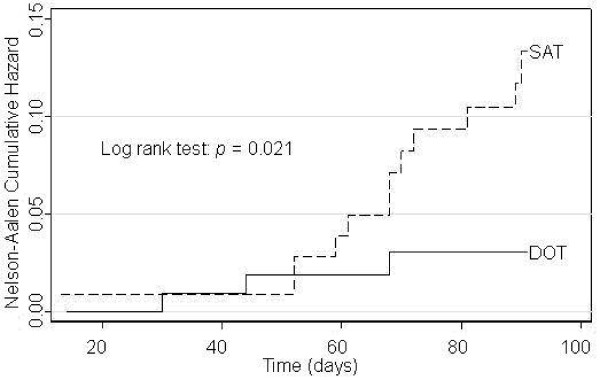
Results: Of the 216 patients enrolled, 109 were randomized to DOT and 107 to SAT. All patients recovered without serious adverse effects. The vivax reappearance rate was significantly lower in the DOT group than the SAT group (3.4/10,000 person-days vs. 13.5/10,000 person-days, p = 0.021). Factors related to the reappearance of vivax malaria included inadequate total primaquine dosage received (< 2.75 mg/kg), duration of fever ≤ 2 days before initiation of treatment, parasite count on admission ≥ 10,000/µl, multiple P. vivax-genotype infection, and presence of P. falciparum infection during the follow-up period.
Conclusions: Adherence to the 14-day primaquine regimen is important for the radical cure of P. vivax malaria infection. Implementation of DOT reduces the reappearance rate of the parasite, and may subsequently decrease P. vivax transmission in the area.
Figures
References
-
- Mendis K, Sina BJ, Marchesini P, Carter R. The neglected burden of Plasmodium vivax malaria. Am J Trop Med Hyg. 2001;64:97–106. - PubMed
-
- World Health Organization. World Malaria Report 2008. http://www.who.int/malaria/publications/atoz/9789241563697/en/index.html Accessed 09/05, 2009.
-
- World Health Organization. WHO SEARO, Malaria situation in SEAR countries. http://www.searo.who.int/EN/Section10/Section21/Section340_4027.htm Accessed 09/05, 2009.
-
- World Health Organization. Guidelines for the treatment of malaria 2006. 2006.
-
- Looareesuwan S, Wilairatana P, Krudsood S, Treeprasertsuk S, Singhasivanon P, Bussaratid V, Chokjindachai W, Viriyavejakul P, Chalermrut K, Walsh DS, White NJ. Chloroquine sensitivity of Plasmodium vivax in Thailand. Ann Trop Med Parasitol. 1999;93:225–230. doi: 10.1080/00034989958474. - DOI - PubMed
Publication types
MeSH terms
Substances
Grants and funding
LinkOut - more resources
Full Text Sources
Other Literature Sources
Research Materials
