


Reproductive health care for asylum-seeking women - a challenge for health professionals
- PMID: 21040588
- PMCID: PMC2988736
- DOI: 10.1186/1471-2458-10-659
Reproductive health care for asylum-seeking women - a challenge for health professionals
Abstract
Background: Dealing with pregnancy, childbirth and the care of newborn babies is a challenge for female asylum seekers and their health care providers. The aim of our study was to identify reproductive health issues in a population of women seeking asylum in Switzerland, and to examine the care they received. The women were insured through a special Health Maintenance Organisation (HMO) and were attending the Women's Clinic of the University Hospital in Basel. We also investigated how the health professionals involved perceived the experience of providing health care for these patients.
Methods: A mixed methods approach combined the analysis of quantitative descriptive data and qualitative data obtained from semi-structured interviews with health care providers and from patients' files. We analysed the records of 80 asylum-seeking patients attending the Women's Clinic insured through an HMO. We conducted semi-structured interviews with 10 care providers from different professional groups. Quantitative data were analysed descriptively. Qualitative data analysis was guided by Grounded Theory.
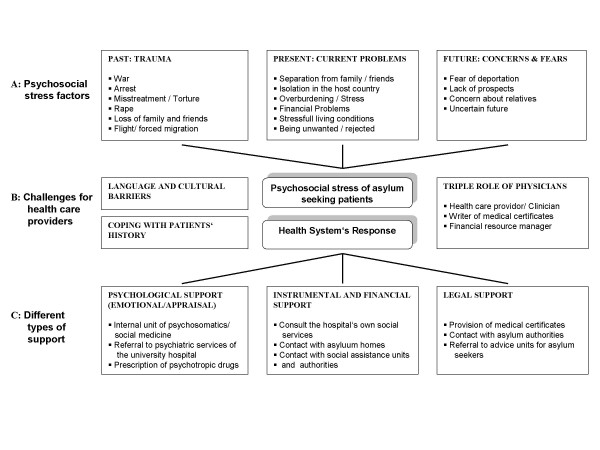
Results: The principal health problems among the asylum seekers were a high rate of induced abortions (2.5 times higher than in the local population), due to inadequate contraception, and psychosocial stress due to the experience of forced migration and their current difficult life situation. The language barriers were identified as a major difficulty for health professionals in providing care. Health care providers also faced major emotional challenges when taking care of asylum seekers. Additional problems for physicians were that they were often required to act in an official capacity on behalf of the authorities in charge of the asylum process, and they also had to make decisions about controlling expenditure to fulfil the requirements of the HMO. They felt that these decisions sometimes conflicted with their duty towards the patient.
Conclusion: Health policies for asylum seekers need to be designed to assure access to adequate contraception, and to provide psychological care for this vulnerable group of patients. Care for asylum seekers may be emotionally very challenging for health professionals.
Figures
References
-
- A passage to hope. Woman and international migration. State of the world population 2006. http://www.unfpa.org/swp/2006/english/print/introduction.html
-
- Federal Office for Gender Equality. Female asylum seekers in Switzerland. Bern: EDMZ; 1993.
-
- Médecins sans frontière. Women. Zürich; 2004.
-
- WHO. Women and health: today's evidence tomorrow's agenda. WHO, Geneva; 2009.
-
- Baines EK. A practical guide to empowerment: UNHCR Good practices on gender equality Mainstreaming. Geneva: United Nations High Comissioner for Refugees; 2001.
MeSH terms
LinkOut - more resources
Full Text Sources
