


Simulating trait evolution for cross-cultural comparison
- PMID: 21041206
- PMCID: PMC2981906
- DOI: 10.1098/rstb.2010.0009
Simulating trait evolution for cross-cultural comparison
Abstract
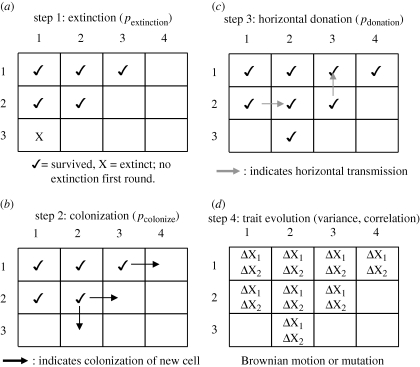
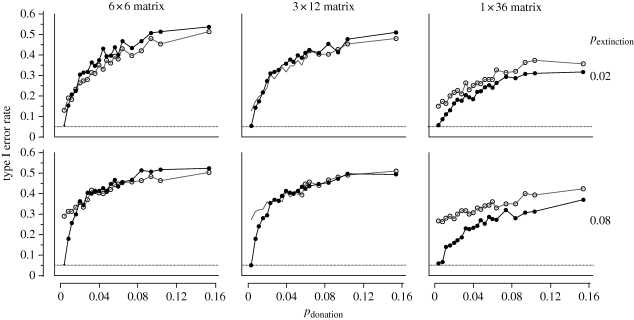
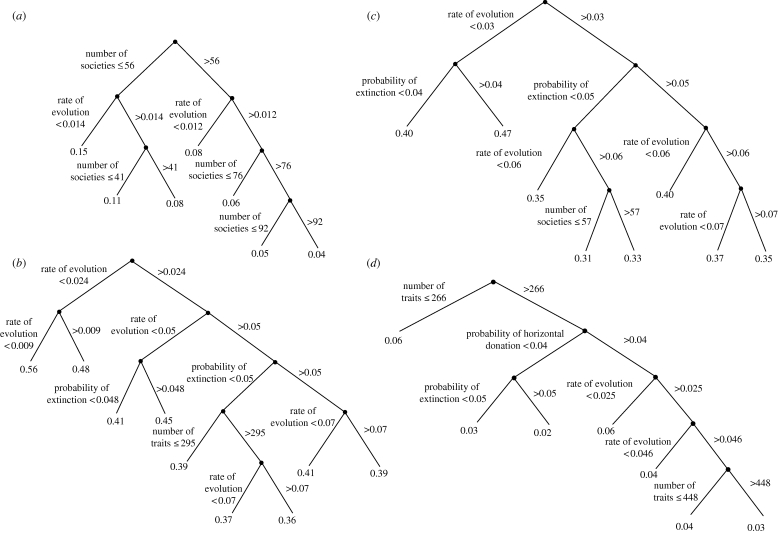
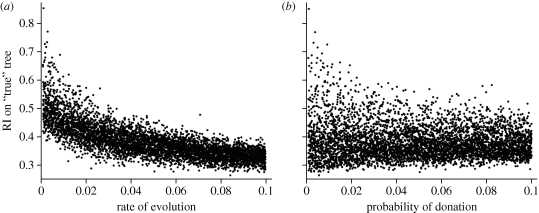
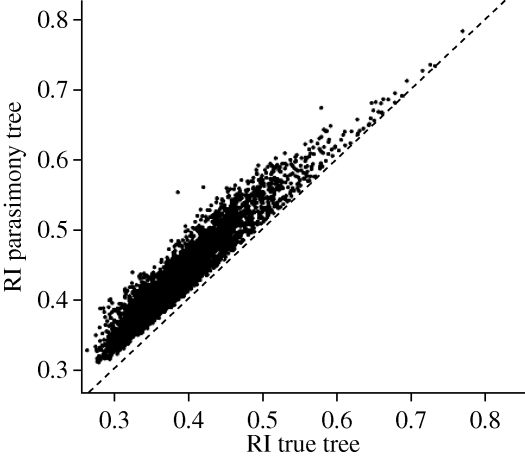
Cross-cultural anthropologists have increasingly used phylogenetic methods to study cultural variation. Because cultural behaviours can be transmitted horizontally among socially defined groups, however, it is important to assess whether phylogeny-based methods--which were developed to study vertically transmitted traits among biological taxa--are appropriate for studying group-level cultural variation. Here, we describe a spatially explicit simulation model that can be used to generate data with known degrees of horizontal donation. We review previous results from this model showing that horizontal transmission increases the type I error rate of phylogenetically independent contrasts in studies of correlated evolution. These conclusions apply to cases in which two traits are transmitted as a pair, but horizontal transmission may be less problematic when traits are unlinked. We also use the simulation model to investigate whether measures of homology (the consistency index and the retention index) can detect horizontal transmission of cultural traits. Higher rates of evolutionary change have a stronger depressive impact on measures of homology than higher rates of horizontal transmission; thus, low consistency or retention indices are not necessarily indicative of 'ethnogenesis'. Collectively, these studies demonstrate the importance of using simulations to assess the validity of methods in cross-cultural research.
Figures
References
-
- Archie J. W.1989Homoplasy excess ratios: new indices for measuring levels of homoplasy in phylogenetic systematics and a critique of the consistency index. Syst. Zool. 38, 253–269 (doi:10.2307/2992286) - DOI
-
- Archie J. W.1990Homoplasy excess statistics and retention indices: a reply to Farris. Syst. Zool. 39, 169–174 (doi:10.2307/2992454) - DOI
-
- Billing J., Sherman P. W.1998Antimicrobial functions of spices: why some like it hot. Q. Rev. Biol. 73, 3–49 (doi:10.1086/420058) - DOI - PubMed
-
- Bininda-Emonds O. R. P., et al. 2007The delayed rise of present-day mammals. Nature 446, 507–512 (doi:10.1038/nature05634) - DOI - PubMed
-
- Blower S. M., Dowlatabadi H.1994Sensitivity and uncertainty analysis of complex-models of disease transmission—an HIV model as an example. Int. Stat. Rev. 62, 229–243 (doi:10.2307/1403510) - DOI
Publication types
MeSH terms
LinkOut - more resources
Full Text Sources
