Adding monounsaturated fatty acids to a dietary portfolio of cholesterol-lowering foods in hypercholesterolemia
- PMID: 21041432
- PMCID: PMC3001502
- DOI: 10.1503/cmaj.092128
Adding monounsaturated fatty acids to a dietary portfolio of cholesterol-lowering foods in hypercholesterolemia
Abstract
Background: Higher intake of monounsaturated fat may raise high-density lipoprotein (HDL) cholesterol without raising low-density lipoprotein (LDL) cholesterol. We tested whether increasing the monounsaturated fat content of a diet proven effective for lowering LDL cholesterol (dietary portfolio) also modified other risk factors for cardiovascular disease, specifically by increasing HDL cholesterol, lowering serum triglyceride and further reducing the ratio of total to HDL cholesterol.
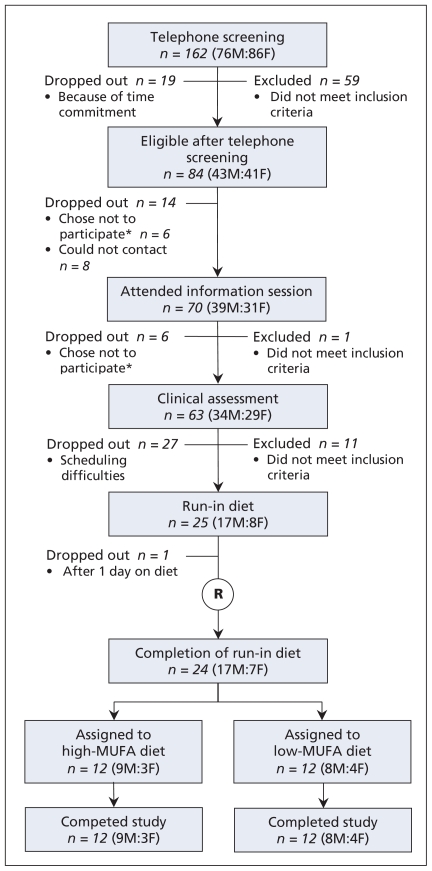
Methods: Twenty-four patients with hyperlipidemia consumed a therapeutic diet very low in saturated fat for one month and were then randomly assigned to a dietary portfolio low or high in monounsaturated fatty acid for another month. We supplied participants' food for the two-month period. Calorie intake was based on Harris-Benedict estimates for energy requirements.
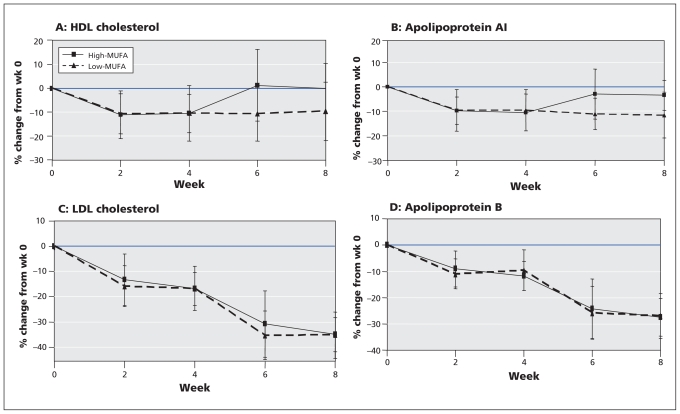
Results: For patients who consumed the dietary portfolio high in monounsaturated fat, HDL cholesterol rose, whereas for those consuming the dietary portfolio low in monounsaturated fat, HDL cholesterol did not change. The 12.5% treatment difference was significant (0.12 mmol/L, 95% confidence interval [CI] 0.05 to 0.21, p = 0.003). The ratio of total to HDL cholesterol was reduced by 6.5% with the diet high in monounsaturated fat relative to the diet low in monounsaturated fat (-0.28, 95% CI -0.59 to -0.04, p = 0.025). Patients consuming the diet high in monounsaturated fat also had significantly higher concentrations of apolipoprotein AI, and their C-reactive protein was significantly lower. No treatment differences were seen for triglycerides, other lipids or body weight, and mean weight loss was similar for the diets high in monounsaturated fat (-0.8 kg) and low in monounsaturated fat (-1.2 kg).
Interpretation: Monounsaturated fat increased the effectiveness of a cholesterol-lowering dietary portfolio, despite statin-like reductions in LDL cholesterol. The potential benefits for cardiovascular risk were achieved through increases in HDL cholesterol, further reductions in the ratio of total to HDL cholesterol and reductions in C-reactive protein. (ClinicalTrials.gov trial register no. NCT00430430.).
Figures
References
-
- Grundy SM, Cleeman JI, Merz CN, et al. Implications of recent clinical trials for the National Cholesterol Education Program Adult Treatment Panel III guidelines [erratum published in: Circulation 2004;110:763]. Circulation 2004;110:227–39 - PubMed
-
- Executive Summary of the Third Report of the National Cholesterol Education Program (NCEP) Expert Panel on Detection, Evaluation, and Treatment of High Blood Cholesterol in Adults (Adult Treatment Panel III). JAMA 2001;285:2486–97 - PubMed
-
- Jenkins DJ, Kendall CW, Marchie A, et al. Effects of a dietary portfolio of cholesterollowering foods vs lovastatin on serum lipids and C-reactive protein. JAMA 2003;290:502–10 - PubMed
-
- Jenkins DJ, Kendall CW, Faulkner DA, et al. Assessment of the longer-term effects of a dietary portfolio of cholesterol-lowering foods in hypercholesterolemia. Am J Clin Nutr 2006;83:582–91 - PubMed
-
- Barter P, Gotto AM, LaRosa JC, et al. HDL cholesterol, very low levels of LDL cholesterol, and cardiovascular events. N Engl J Med 2007;357:1301–10 - PubMed
Publication types
MeSH terms
Substances
Associated data
Grants and funding
LinkOut - more resources
Full Text Sources
Medical
Research Materials