. 2010 Nov 16;107(46):19933-8.
doi: 10.1073/pnas.1007799107. Epub 2010 Nov 1.

Dually inducible TetON systems for tissue-specific conditional gene expression in zebrafish

Affiliations

Dually inducible TetON systems for tissue-specific conditional gene expression in zebrafish

Franziska Knopf et al. Proc Natl Acad Sci U S A. .

Abstract

Systems for spatial and temporal control of gene expression are essential for developmental studies and are of particular importance for research in adult model organisms. We present two modified dually inducible TetON systems for tissue-specific conditional control of gene expression in zebrafish based on (i) a tetracycline inducible transcriptional activator (TetActivator) fused to the ligand binding domain of a mutated glucocorticoid receptor (TetA-GBD) and (ii) a TetActivator fused with a domain of the Ecdysone receptor (TetA-EcR). Both systems showed strong induction of tetracycline-responsive promoters upon administration of the appropriate ligands (doxycycline and dexamethasone for TetA-GBD, and doxycycline and tebufenozide for TetA-EcR), and undetectable leakiness when compared with classical TetActivators. Combinations of transgenic lines expressing TetA-GBD specifically in the heart or the CNS with different Tet-responsive transgenic lines allows conditional and tissue-specific control of gene expression in embryos and adults. Importantly, induction is fully reversible and tunable by the doses of drugs used. The TetA-EcR system avoids the possible side effects of dexamethasone and displays improved sensitivity both in zebrafish and in mammalian cells. These results show that dually inducible TetON systems are convenient tools for reversible and very tightly controlled conditional gene expression in zebrafish.


Conflict of interest statement

The authors declare no conflict of interest.

Figures
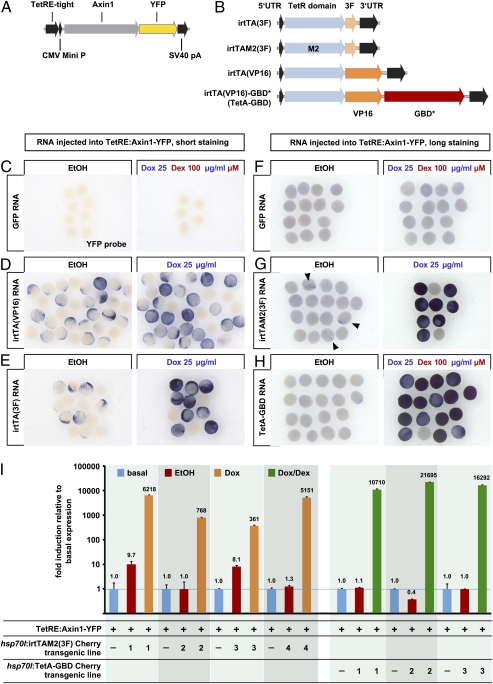
Fig. 1.
Fig. 1.
Dually inducible TetA-GBD activates transgene transcription in a nonleaky fashion in zebrafish embryos. (A) Transgenic Tet responder construct. (B) Human codon optimized (“improved”) variants of the reverse tetracycline-responsive transactivator (irtTA) used in this study. (C–H) YFP RNA expression detected by whole-mount in situ hybridization in TetRE:Axin1-YFP transgenic embryos injected with equimolar amounts of GFP (25 pg), irtTA(VP16) (30 pg), irtTA(3F) (25 pg), irtTAM2(3F) (30 pg), or irtTA(VP16)-GBD* (TetA-GBD, 50 pg) and treated with EtOH vehicle or 25 μg/mL Dox or 25 μg/mL Dox plus 100 μM Dex from 5 hpf for 4.5h (C–E) or 3.5h (F–H). Samples in F–H were stained significantly longer than those in C–E to reveal even low levels of leakiness. Note severe leaky induction in irtTA(VP16) and irtTA(3F) injected embryos and weak leakiness in irtM2(3F) injected embryos (arrowheads). (I) Axin1-YFP RNA expression detected by QPCR in progeny of TetRE:Axin1-YFP fish crossed with individual sublines of hsp70l:irtTAM2(3F)-p2a-mCherry or hsp70l:TetA-GBD-p2a-mCherry transgenic fish, heatshocked at 24 hpf, and treated with EtOH or 25 μg/mL Dox or Dox plus 100 μM Dex for 4 h. Levels are normalized to expression in TetRE:Axin1-YFP embryos containing no TetActivator transgene (“basal”).
Fig. 2.
Fig. 2.
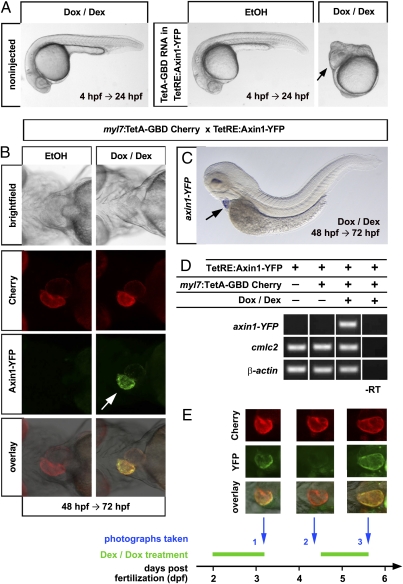
Tissue-specific, reversible gene expression using the dually inducible TetA-GBD/TetRE-tight system in embryonic and adult zebrafish. (A) Severe Wnt/β-catenin loss-of-function phenotypes as evidenced by posterior truncations and expanded eyes (arrow) in TetRE:Axin1-YFP embryos injected with 100 ng/μl TetA-GBD RNA and treated with Dox/Dex from 4 h postfertilization (hpf) until 24 hpf. Note that embryos treated with EtOH vehicle and noninjected embryos treated with Dox/Dex develop normally. n = 30 noninj, 7 EtOH, 9 Dox/Dex. (B) Induction of Axin1-YFP expression in ventricle (arrow) in myl7:TetA-GBD Cherry; TetRE:Axin1-YFP double transgenic embryos treated with Dox/Dex for 24 h from 48 hpf. n = 15 EtOH, 18 Dox/Dex. (C) Heart-specific induction of Axin1-YFP RNA (arrow) after Dox/Dex treatment. n = 15. (D) Semiquantitative PCR detects axin1-YFP expression only in myl7:TetA-GBD Cherry; TetRE:Axin1-YFP double transgenic embryos treated with Dox/Dex (lane 3), but not in EtOH treated embryos (lane 2) or embryos only containing the TetRE:Axin1-YFP transgene (lane 1). myl7 and β-actin are shown as loading controls. (E) Fast reversibility and reinducibility of Axin1-YFP induction. Fluorescent images of the heart of one individual myl7:TetA-GBD; TetRE:Axin1-YFP double transgenic embryo is shown that was treated with Dox/Dex and photographed at the times indicated. Note that YFP signal is not detectable 24 h after drug withdrawal (Middle, column 2) and reexpressed after additional 24 h of drug treatment (Middle, column 3). n = 5.
Fig. 3.
Fig. 3.
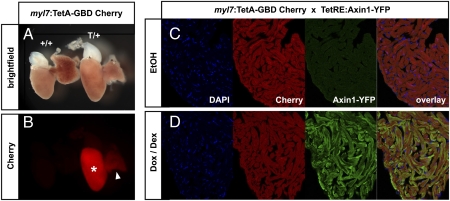
(A and B) The myl7:TetA-GBD Cherry transgene is expressed in the adult heart. (A) Brightfield images of whole extracted adult hearts: (Left) WT; (Right) myl7:TetA-GBD Cherry heterozygous. (B) Cherry channel. Note Cherry expression in ventricle (*) and weakly in atrium (arrowhead). (C and D) Inducibility in adult hearts. Cryosections of adult hearts of myl7:TetA-GBD Cherry; TetRE:Axin1-YFP double transgenic fish that had been injected intraperitoneally with EtOH (C) or 20 μg Dox plus 5 μg Dex (D). Axin1-YFP is detected by anti-GFP antibody. n = 6 EtOH and Dox/Dex.
Fig. 4.
Fig. 4.
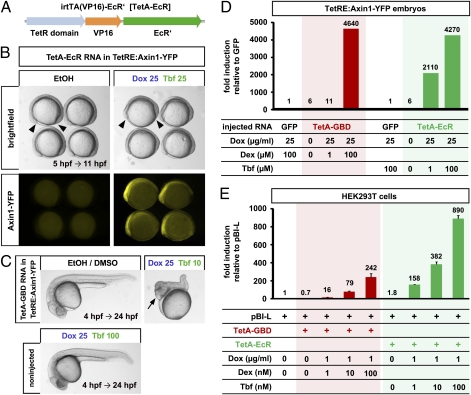
An ecdysone receptor-based dually inducible TetActivator. (A) TetA-EcR construct. (B) Induction of Axin1-YFP in TetRE:Axin1-YFP transgenic embryos injected with 100 pg of TetA-EcR RNA, treated with 25 μg/mL Dox and 25 μM Tebufenozide (Tbf) from 5 hpf and photographed at 11 hpf. Note shortened body axes (arrowheads) indicative of Axin1 gain-of-function phenotypes in drug-treated embryos. n = 10/group. (C) Severe Axin1 overexpression phenotype (posterior truncations and expanded anterior fates; arrow) in 25 μg/mL Dox and 10 μM Tbf drug-treated embryos at 24 hpf. Note that embryos treated with EtOH/DMSO vehicle and noninjected embryos treated with even higher doses of Dox/Tbf develop normally. n = 32 noninj, 6 EtOH/DMSO, 6 Dox/Tbf. (D) TetA-EcR induces more strongly than TetA-GBD at low drug doses in zebrafish. TetRE:Axin1-YFP embryos were injected with equimolar amounts of GFP (25 pg), TetA-GBD (50 pg) or TetA-EcR (55 pg) RNA, treated with the indicated drugs at 5 hpf for 3 h, YFP expression was quantified using QPCR and is shown relative to GFP controls treated with the same drugs. Zero indicates EtOH vehicle only. (E) TetA-EcR is more efficient than TetA-GBD in mammalian cells. HEK293 cells were transiently transfected with the Tet responsive luciferase reporter pBI-L and the activators TetA-GBD or TetA-EcR, and luciferase levels were measured after treatment with indicated doses of drugs. Levels are shown relative to cells transfected with pBI-L only. Error bars represent SEM.

References

    1. Ingham PW. The power of the zebrafish for disease analysis. Hum Mol Genet. 2009;18:R107–R112. - PubMed
    1. Stoletov K, Klemke R. Catch of the day: Zebrafish as a human cancer model. Oncogene. 2008;27:4509–4520. - PubMed
    1. Stoick-Cooper CL, Moon RT, Weidinger G. Advances in signaling in vertebrate regeneration as a prelude to regenerative medicine. Genes Dev. 2007;21:1292–1315. - PubMed
    1. Stoick-Cooper CL, et al. Distinct Wnt signaling pathways have opposing roles in appendage regeneration. Development. 2007;134:479–489. - PubMed
    1. Lee Y, Grill S, Sanchez A, Murphy-Ryan M, Poss KD. Fgf signaling instructs position-dependent growth rate during zebrafish fin regeneration. Development. 2005;132:5173–5183. - PubMed

Publication types

LinkOut - more resources