. 2010 Nov 16;107(46):20093-8.
doi: 10.1073/pnas.1005554107. Epub 2010 Nov 1.

Role for mammalian target of rapamycin complex 1 signaling in neuroadaptations underlying alcohol-related disorders

Affiliations

Role for mammalian target of rapamycin complex 1 signaling in neuroadaptations underlying alcohol-related disorders

Jérémie Neasta et al. Proc Natl Acad Sci U S A. .

Abstract

Alcohol addiction is a chronically relapsing disorder that includes certain maladaptive learning and memory. The serine and threonine kinase complex, mammalian target of rapamycin complex 1 (mTORC1), has been implicated in synaptic plasticity, learning, and memory by controlling protein translation. Here we show that administration of alcohol and excessive voluntary consumption of alcohol induce the activation of the mTORC1-mediated signaling pathway in the nucleus accumbens (NAc) of rodents. We further show that the protein expression levels of GluR1 and Homer, two synaptic proteins whose translation has been shown to be modulated by mTORC1, are up-regulated in the NAc of rodents with a history of excessive alcohol consumption. In addition, our results document that the Food and Drug Administration-approved inhibitor of mTORC1, rapamycin, decreases expression of alcohol-induced locomotor sensitization and place preference, as well as excessive alcohol intake and seeking in preclinical rodent models of alcohol abuse. Together, our results suggest that mTORC1 within the NAc is a contributor to molecular mechanisms underlying alcohol-drinking behaviors. Furthermore, despite its massive health and socioeconomic impact worldwide, pharmacotherapies for alcohol abuse and addiction remain limited. Our data therefore put forward the possibility that targeting the mTORC1 signaling cascade is an innovative and valuable strategy for the treatment of alcohol use and abuse disorders.


Conflict of interest statement

The authors declare no conflict of interest.

Figures
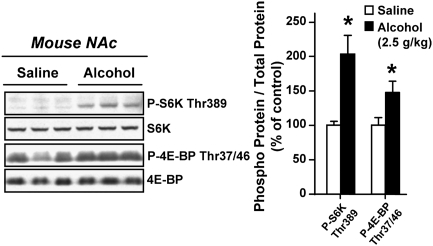
Fig. 1.
Fig. 1.
Alcohol administration activates the mTORC1-mediated signaling pathway in the NAc of mice. C57BL/6J mice were systemically treated (i.p.) with 2.5 g/kg of alcohol or saline solution and the NAc was removed 30 min later. The levels of S6K and 4E-BP phosphorylation were determined by Western blot analyses (n = 6 per group). Data are presented as mean ± SEM and expressed as percentage of control; *P < 0.05, two-tailed unpaired t test.
Fig. 2.
Fig. 2.
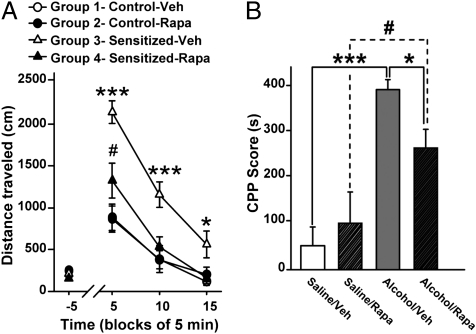
Systemic administration of rapamycin reduces the expression of alcohol-induced locomotor sensitization and CPP in mice. (A) Locomotor sensitization experiment. DBA/2J mice were administered daily with saline solution (groups 1 and 2) or with 2 g/kg of alcohol (groups 3 and 4) for 10 successive days. On day 11, mice were treated (i.p.) with vehicle (Veh) or rapamycin (Rapa, 10 mg/kg). Three hours later, all mice received alcohol (2 g/kg, i.p.). Locomotor activity was recorded 5 min before and after alcohol injection for 15 min (n = 15–17 per group). Data are represented as mean ± SEM. Two-way ANOVA with repeated measures showed an interaction between treatment and time [F(3,180) = 10.67, P < 0.001] (Newman-Keuls post hoc test), #P < 0.05 (group 4 vs. group 1 and group 2), ***P < 0.001 (group 3 vs. group 1, group 2, and group 4), and *P < 0.05 (group 4 vs. group 3). (B) CPP experiment. During the conditioning phase (6 d), DBA/2J mice were daily administered (i.p.) alcohol (1.8 g/kg) or saline solution and were then confined in the drug- or non-drug-paired compartment. One day after the sixth session, saline solution- and alcohol-conditioned mice were treated (i.p.) with vehicle (saline/veh, alcohol/veh) or 10 mg/kg of rapamycin (saline/Rapa, alcohol/Rapa). Three hours later, a 15-min postconditioning test was conducted (n = 11 per group). Data are represented as mean ± SEM. Two-way ANOVA showed an interaction between drug (saline solution or alcohol) and treatment (Veh or Rapa) factors [F(1,40) = 4.20, P < 0.05]. *P < 0.05, #P < 0.05, and ***P < 0.001 (Newman-Keuls post hoc test).
Fig. 3.
Fig. 3.
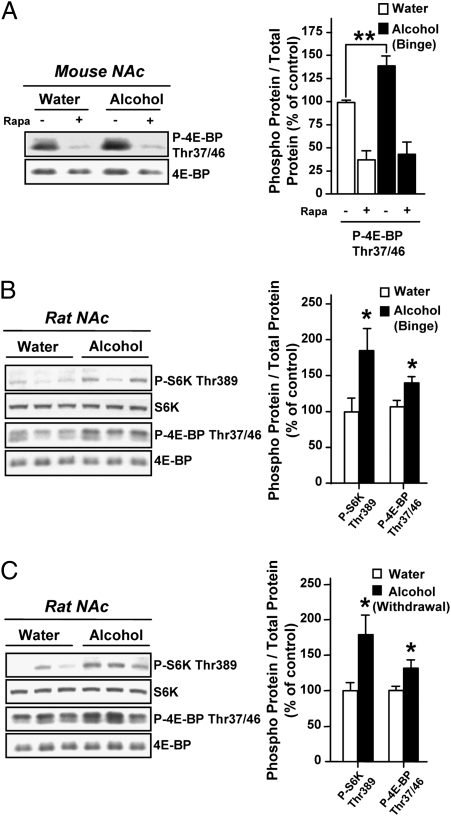
Excessive alcohol consumption activates the mTORC1-mediated signaling pathway in the NAc of rodents. (A) C57BL/6J mice had access to a 20% solution of alcohol for 4 h every other day for 3 wk. Three hours before the tenth 4-h alcohol-drinking session, mice were treated (i.p.) with vehicle or 20 mg/kg of rapamycin (Rapa), and the NAc were removed immediately after the alcohol-drinking session (n = 8 per group). Two-way ANOVA showed a significant main effect of the fluid [water or alcohol; F(1,28) = 5.27, P < 0.05] and treatment [Veh or rapamycin; F(1,28) = 63.26, P < 0.001] but no interaction [F(1,28) = 2.86, P = 0.10]. Subsequent analysis using the method of contrasts detected a significant difference between water and alcohol within the vehicle group (**P < 0.01) but not within the rapamycin group. The level of 4E-BP phosphorylation was determined by Western blot (the level of S6K phosphorylation was too low to be accurately quantified). (B and C) Rats experienced at least 3 mo of intermittent-access 20% alcohol two-bottle choice drinking sessions. Control animals underwent the same paradigms but did not have access to alcohol. (B) After the last 24 h of alcohol deprivation, rats had access to a 20% solution of alcohol for 30 min, leading to an average intake of 1.16 ± 0.06 g/kg, and the NAc were immediately removed. (C) The NAc were removed after the last 24 h of alcohol deprivation session (withdrawal). The levels of S6K and 4E-BP phosphorylation were determined by Western blot (n = 9 per group in B and C). Data are presented as mean ± SEM and expressed as percentage of control; *P < 0.05, two-tailed unpaired t test.
Fig. 4.
Fig. 4.
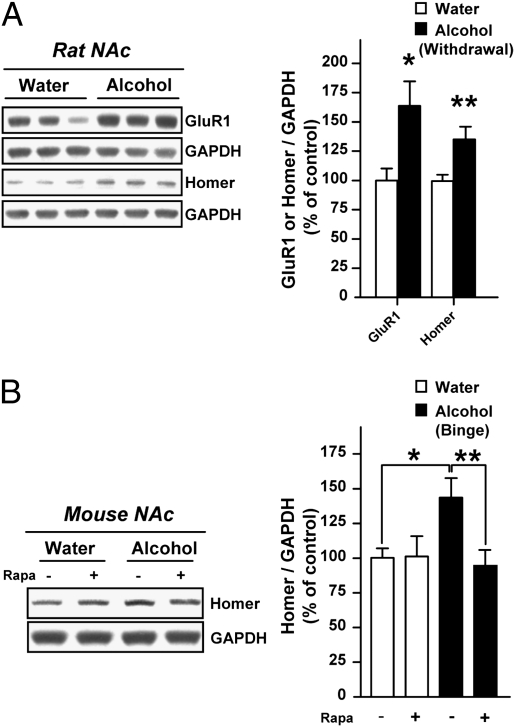
The synaptic proteins GluR1 and Homer are up-regulated in the NAc of rodents with a history of excessive alcohol drinking. (A) Rats experienced the same procedure as Fig. 3C (n = 12–13 per group); *P < 0.05 and **P < 0.01, two-tailed unpaired t test. (B) C57BL/6J mice experienced the same procedure as Fig. 3A (n = 10 per group). Two-way ANOVA detected an interaction between the fluid (water or alcohol) and the treatment (Veh or Rapa) [F(1,36) = 4.34, P < 0.05]; *P < 0.05 and **P < 0.01 by Newman-Keuls post hoc test. The levels of GluR1 and Homer proteins were determined by Western blot analyses using pan antibodies. Data are presented as mean ± SEM and expressed as percentage of control.
Fig. 5.
Fig. 5.
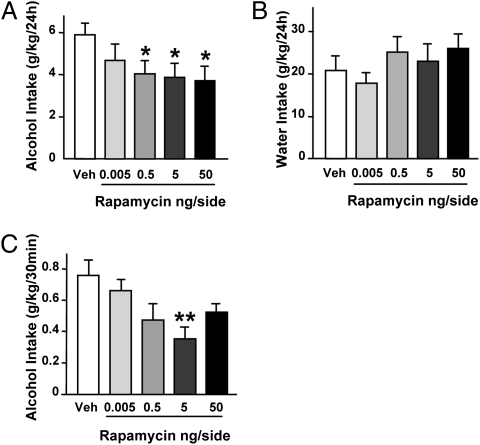
Intra-NAc infusion of rapamycin reduces alcohol drinking in rats. Vehicle (Veh) or 0.005, 0.5, 5, or 50 ng rapamycin per side was infused into the NAc 3 h before the beginning of the 24-h alcohol-drinking session in rats trained to consume a high amount of a 20% solution of alcohol in a two-bottle choice paradigm. (A) Alcohol intake after 24 h. One-way ANOVA with repeated measures showed significant effects of treatment [F(4,32) = 3.58, P < 0.05]. (B) Water intake at the end of the 24-h session. (C) Alcohol intake after the first 30 min of the session. One-way ANOVA with repeated measures showed significant effects of treatment [F(4,32) = 4.11, P < 0.01]. Alcohol and water consumptions are expressed in g/kg body weight (n = 9 per group in AC). Data are presented as mean ± SEM; *P < 0.05 and **P < 0.01 compared with vehicle (Newman-Keuls post hoc test).
Fig. 6
Fig. 6
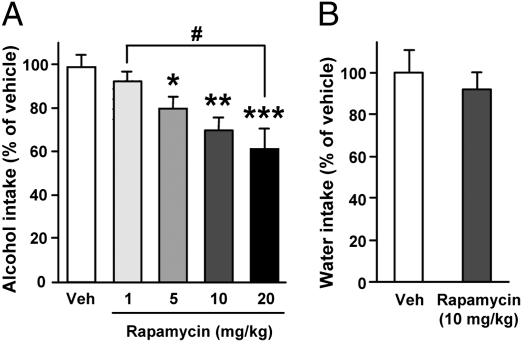
Systemic administration of rapamycin in mice dose-dependently reduces alcohol intake. (A) C57BL/6J mice had access to a 20% solution of alcohol for 4 h every other day for 3 wk. Three hours before the tenth 4-h alcohol-drinking session, mice were treated (i.p.) with vehicle (Veh) or 1, 5, 10, or 20 mg/kg of rapamycin. Alcohol intake was measured at the end of the 4-h drinking session. One-way ANOVA showed significant effects of the treatment [F(4,68) = 6.95, P < 0.001; n = 26 (vehicle) and n = 11–12 per rapamycin group]. (B) After 2 wk without access to alcohol, mice were systemically treated with 10 mg/kg of rapamycin or vehicle 3 h before the beginning of a water-drinking session. Water intake was measured 4 h later (n = 11–12 per group). Data are presented as mean ± SEM and expressed as percentage of vehicle. *P < 0.05, **P < 0.01, and ***P < 0.001 compared with the vehicle group and #P < 0.05 (Newman-Keuls post hoc test).
Fig. 7
Fig. 7
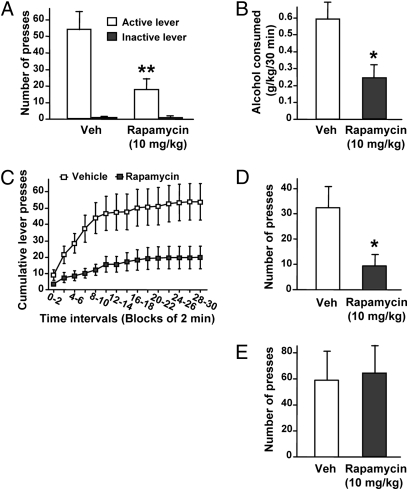
Systemic administration of rapamycin selectively decreases operant alcohol self-administration-related behaviors. (AD) Rats with a history of high levels of alcohol consumption were trained to self-administer a solution of 20% alcohol. Three hours before the beginning of a 30-min session, rats were systemically administered (i.p.) 10 mg/kg of rapamycin or vehicle (Veh). (A) Number of lever presses during the 30 min operant alcohol self-administration session. Two-way ANOVA with repeated measures showed main effects of lever [F(1,6) = 23.81, P < 0.01]; treatment [F(1,6) = 6.12, P < 0.05]; and a significant interaction [F(1,6) = 7.40, P < 0.05]. (B) Amount of alcohol consumed during the session. One-way ANOVA with repeated measures showed significant effect of treatment [F(1,6) = 7.92, P < 0.05]. (C) Cumulative mean presses in bins of 2 min, indicative of the rate of presses for alcohol during the session. Two-way ANOVA with repeated measures showed a significant main effect of time [F(14,84) = 15.86, P < 0.001] and treatment [F(1,84) = 7.49, P < 0.05]. Subsequent analysis using the method of contrasts detected a significant difference between vehicle and rapamycin treatments for all time intervals (all P values < 0.05). (D) Number of presses on the alcohol lever during a 30-min extinction session. One-way ANOVA with repeated measures showed significant effect of treatment [F(1,6) = 6.02, P < 0.05]. (E) Three hours before the beginning of a 30-min session, rats were systemically treated (i.p.) with 10 mg/kg of rapamycin or vehicle (Veh), and the number of presses on the sucrose lever in rats trained to self-administer a solution of 1.5% sucrose was recorded (n = 7 per group in AE). Data are presented as mean ± SEM; *P < 0.05 and **P < 0.01 compared with vehicle (Newman-Keuls post hoc test).

Comment in

  • Addiction: a sobering thought.
    Danovi SA. Danovi SA. Nat Rev Neurosci. 2011 Jan;12(1):4. doi: 10.1038/nrn2964. Nat Rev Neurosci. 2011. PMID: 21218569 No abstract available.

References

    1. Koob GF, Volkow ND. Neurocircuitry of addiction. Neuropsychopharmacology. 2010;35:217–238. - PMC - PubMed
    1. Spanagel R. Alcoholism: A systems approach from molecular physiology to addictive behavior. Physiol Rev. 2009;89:649–705. - PubMed
    1. Hyman SE. Addiction: A disease of learning and memory. Am J Psychiatry. 2005;162:1414–1422. - PubMed
    1. Hyman SE, Malenka RC, Nestler EJ. Neural mechanisms of addiction: The role of reward-related learning and memory. Annu Rev Neurosci. 2006;29:565–598. - PubMed
    1. Kelley AE. Memory and addiction: Shared neural circuitry and molecular mechanisms. Neuron. 2004;44:161–179. - PubMed

Publication types

MeSH terms