Review
. 2011 Feb 10;30(6):631-41.
doi: 10.1038/onc.2010.493. Epub 2010 Nov 1.

Emerging roles for the non-canonical IKKs in cancer

Affiliations
Review

Emerging roles for the non-canonical IKKs in cancer

R R Shen et al. Oncogene. .

Abstract

The IκB Kinase (IKK)-related kinases TBK1 and IKKɛ have essential roles as regulators of innate immunity by modulating interferon and NF-κB signaling. Recent work has also implicated these non-canonical IKKs in malignant transformation. IKKɛ is amplified in ∼30% of breast cancers and transforms cells through the activation of NF-κB. TBK1 participates in RalB-mediated inflammatory responses and cell survival, and is essential for the survival of non-small cell lung cancers driven by oncogenic KRAS. The delineation of target substrates and downstream activities for TBK1 and IKKɛ has begun to define their role(s) in promoting tumorigenesis. In this review, we will highlight the mechanisms by which IKKɛ and TBK1 orchestrate pathways involved in inflammation and cancer.


Figures
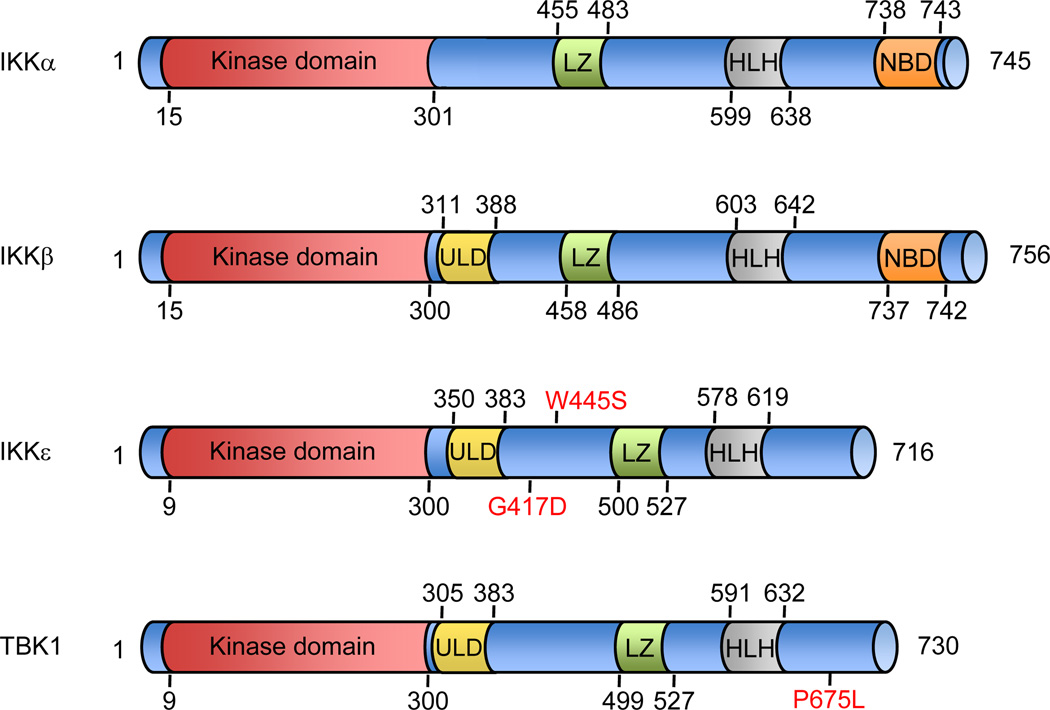
Figure 1
Figure 1. Structural comparison of the classical and non-canonical IKKs
The major domains of each IKK kinase are depicted with amino-acid numbers that correspond to the human proteins. The kinase domain of IKKε exhibits 27% and 24% identity to IKKα and IKKβ respectively, and TBK1 shares 49% identity and 65% similarity to IKKε. Somatic mutations of IKKε and TBK1 recently identified in lung adenocarcinomas are marked in red. ULD, ubiquitin-like domain; LZ, leucine zipper; HLH, helix-loop-helix; NB, NEMO-binding domain (Hiscott et al., 2006; Kan et al., 2010; May et al., 2004; Perkins, 2007).
Figure 2
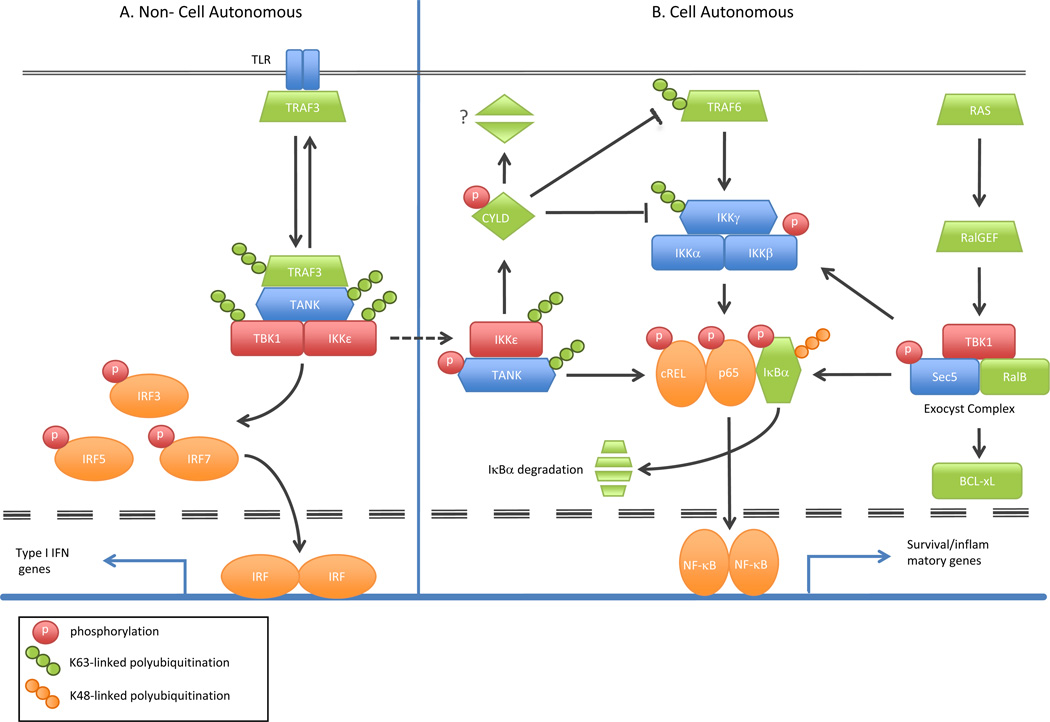
Figure 2. Cell autonomous and non-cell autonomous roles of IKKε and TBK1 in inflammation and cancer
(A) Engagement of toll-like receptors (TLRs) initiates Lys-63 linked ubiquitination of TRAF3 and recruitment of IKKε and TBK1 through the adaptor molecule TANK. This recruitment promotes Lys-63 linked ubiquitination and activation of IKKε/TBK1. TANK is modified by both ubiquitination and phosphorylation through IKKε/TBK1, although it is unclear how these activities are related. The TANK/IKKε/TBK1 complex can then target interferon response factors (IRF3, IRF5, and IRF7) for phosphorylation and promote translocation to the nucleus where IFN target genes are activated. This cascade primarily defines the non-cell autonomous functions of the IKK-related kinases. In parallel to the interferon pathways, IKKε and TBK1 also phosphorylate many NF-κB effectors such as IκBα, p65 and cREL in response to cellular stimuli. This activity facilitates NF-κB nuclear translocation as a homo- or hetero- dimer and induces numerous inflammatory and survival- related target genes. (B) The IKKε/TBK1 oncogenic pathways function in a cell autonomous manner and are predominantly driven by aberrant levels of IKKε/TBK1. In this context, oncogenic RAS activates RalGEF, which in turn recruits the exocyst complex consisting of TBK1, RalB and Sec5, amongst other secretory proteins. TBK1 mediates phosphorylation of multiple effectors including Sec5, IKKβ, and IκBα that ultimately lead to the activation of both BCL-xL and NF-κB. Similarly, aberrant levels of IKKε in cancer also promote NF-κB activation through the phosphorylation of CYLD. CYLD negatively regulates NF-κB signaling by deubiquitinating Lys-63 linked ubiquitin chains on TRAF6 and IKKγ. It is hypothesized that IKKε-mediated phosphorylation of CYLD leads to either its degradation or sequestration, thereby inactivating its negative role on the NF-kB signaling cascade.

References

    1. Adli M, Baldwin AS. IKK-i/IKKepsilon controls constitutive, cancer cell-associated NF-kappaB activity via regulation of Ser-536 p65/RelA phosphorylation. J Biol Chem. 2006;281:26976–26984. - PubMed
    1. An H, Zhao W, Hou J, Zhang Y, Xie Y, Zheng Y, et al. SHP-2 phosphatase negatively regulates the TRIF adaptor protein-dependent type I interferon and proinflammatory cytokine production. Immunity. 2006;25:919–928. - PubMed
    1. Andrejeva J, Childs KS, Young DF, Carlos TS, Stock N, Goodbourn S, et al. The V proteins of paramyxoviruses bind the IFN-inducible RNA helicase, mda-5, and inhibit its activation of the IFN-beta promoter. Proc Natl Acad Sci U S A. 2004;101:17264–17269. - PMC - PubMed
    1. Annunziata CM, Davis RE, Demchenko Y, Bellamy W, Gabrea A, Zhan F, et al. Frequent engagement of the classical and alternative NF-kappaB pathways by diverse genetic abnormalities in multiple myeloma. Cancer Cell. 2007;12:115–130. - PMC - PubMed
    1. Balachandran S, Thomas E, Barber GN. A FADD-dependent innate immune mechanism in mammalian cells. Nature. 2004;432:401–405. - PubMed

Publication types

MeSH terms