


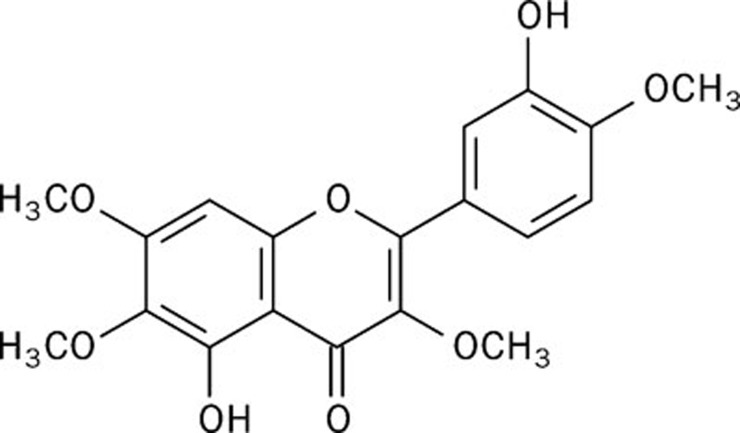
Casticin, a flavonoid isolated from Vitex rotundifolia, inhibits prolactin release in vivo and in vitro
- PMID: 21042288
- PMCID: PMC4002951
- DOI: 10.1038/aps.2010.178
Casticin, a flavonoid isolated from Vitex rotundifolia, inhibits prolactin release in vivo and in vitro
Abstract
Aim: to investigate the anti-hyperprolactinemia activity of casticin, a flavonoid isolated from Vitex rotundifolia, and elucidate its molecular mechanism.
Methods: hyperprolactinemia (MIHP) was induced by administration of metoclopramide dihydrochloride (50 mg/kg, tid, ip, for 10 d) in SD rats and the primary pituitary cells were prepared from the pituitary glands of the SD rats. Prolactin concentrations were measured using a radioimmunoassay. Cell viability was measured using an MTT assay. The mRNA expression of estrogen receptor alpha and beta in rat pituitary cells was measured using semi-quantitative RT-PCR analysis.
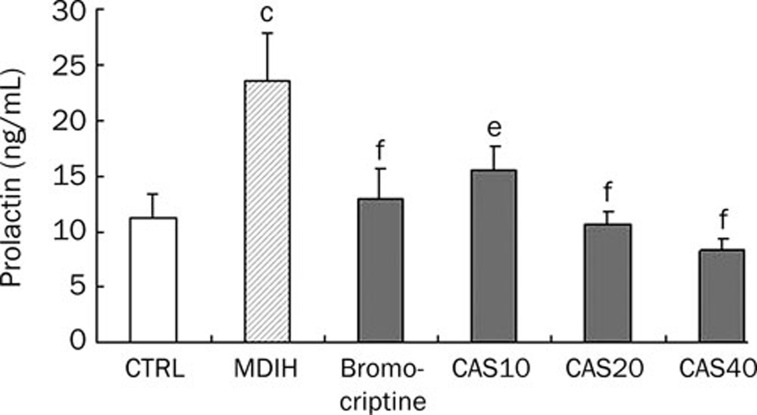
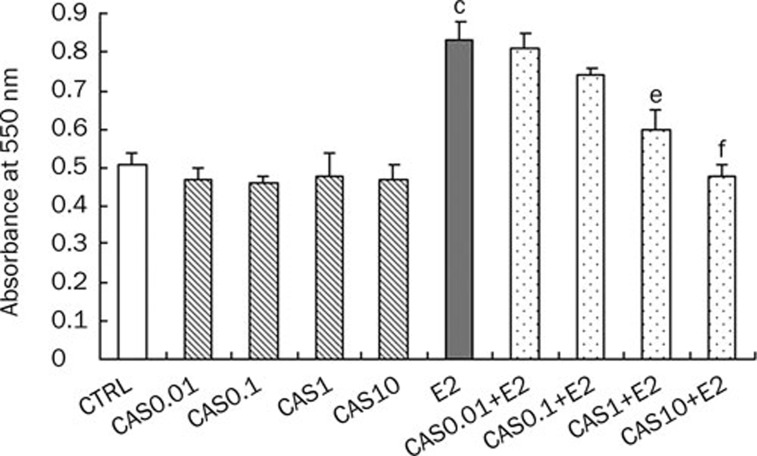
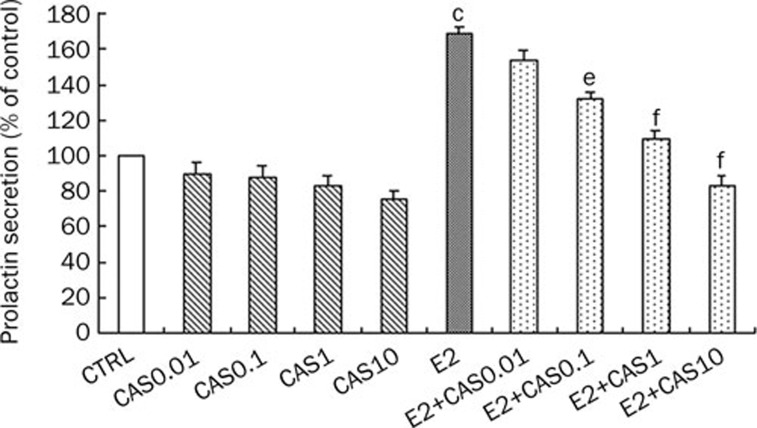
Results: the level of serum prolactin in the MIHP model group was 2.1 fold higher than that in the untreated control group (P<0.01). Casticin (10, 20, and 40 mg/kg, ip, for 7 d) reduced serum prolactin levels by 33.9%, 54.3%, and 64.7%, respectively (P<0.01). The positive control drug bromocriptine 1 mg/kg decreased the serum prolactin concentration in MIHP rats by 44.9%. 17β-Estradiol (E2) significantly increased the proliferation of pituitary cells and casticin (1 and 10 micromol/L) markedly inhibited E2-induced pituitary cell proliferation by 27.7% and 42.1%, respectively. Stimulation of pituitary cells with E2 increased prolactin secretion into the cell culture supernatants, and casticin (0.1, 1, and 10 micromol/L) significantly inhibited the prolactin release stimulated by E2 in a concentration-dependent manner. Casticin (1 and 10 micromol/L) significantly inhibited ERα mRNA expression in pituitary cells stimulated with E2 (P<0.01) but increased ERβ mRNA expression at a concentration of 10 micromol/L (P<0.01). However, casticin had no effects on proliferation and prolectin release of the unstimulated primary pituitary cells in vitro.
Conclusion: casticin inhibited the release of prolactin from pituitary cells of SD rats stimulated with E2 in vivo and in vitro. These effects might be related with inhibiting the ERα mRNA expression and increasing the ERβ mRNA expression.
Figures

References
-
- Reid RL, Yen SS. The premenstrual syndrome. Clin Obstet Gynecol. 1983;26:710–8. - PubMed
-
- Hu Y, Xin HL, Zhang QY, Zheng HC, Rahman K, Qin LP. Anti-nociceptive and anti-hyperprolactinemia activities of Fructus Viticis and its effective fractions and chemical constituents. Phytomedicine. 2007;14:668–74. - PubMed
-
- Dickerson LM, Mazyck PJ, Hunter MH. Premenstrual syndrome. Am Fam Physician. 2003;67:1743–52. - PubMed
-
- Usman SB, Indusekhar R, O'Brien S. Hormonal management of premenstrual syndrome. Best Pract Res Clin Obstet Gynaecol. 2008;22:251–60. - PubMed
-
- Lurie S, Borenstein R. The premenstrual syndrome. Obstet Gynecol Surv. 1990;45:220–8. - PubMed
Publication types
MeSH terms
Substances
LinkOut - more resources
Full Text Sources
