


Quantification of tear proteins and sPLA2-IIa alteration in patients with allergic conjunctivitis
- PMID: 21042565
- PMCID: PMC2965574
Quantification of tear proteins and sPLA2-IIa alteration in patients with allergic conjunctivitis
Abstract
Purpose: Allergic conjunctivitis (AC) has been reported to induce the instability of the tear film. The tear protein and the lipid layer play important roles in maintaining the tear film. The aim of this study was to quantify the alteration of the major tear protein components and a lipid related protein secretory type IIa phospholipase A2 (sPLA2-IIa) in tears of seasonal allergic conjunctivitis (SAC) and perennial allergic conjunctivitis (PAC) patients.
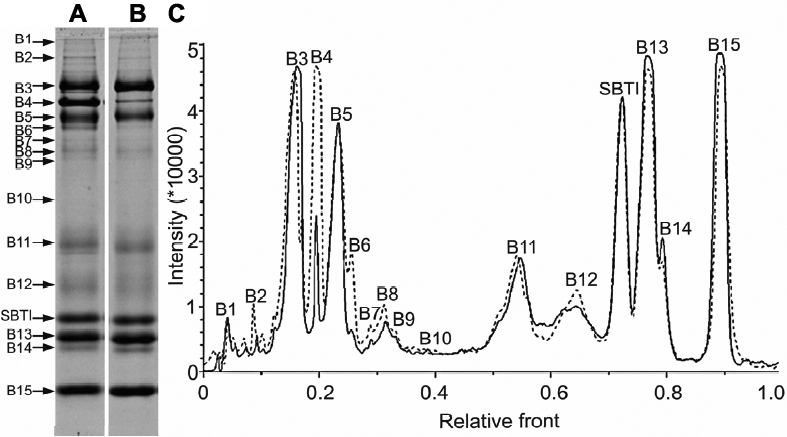
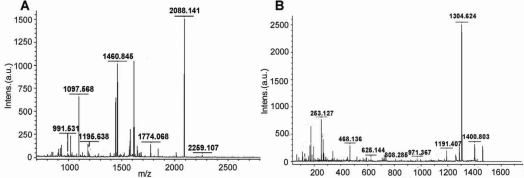
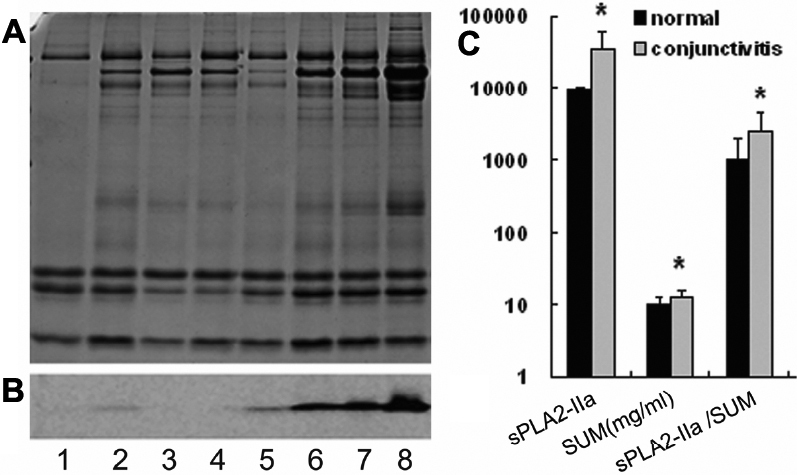
Methods: Twenty-one SAC and PAC patients and thirteen normal controls completed a symptom questionnaire and underwent regular ocular examination. SAC and PAC patients were diagnosed based on the clinical presentation and elevated serum IgE levels. Schirmer test paper was used to collect tear samples from SAC and PAC patients and normal controls. Soybean trypsin inhibitor (SBTI) was used as an internal standard to analyze tear samples in 15% SDS-PAGE gel. Total tear protein and its major components from the SAC and PAC patients and normal controls were quantified by band densitometry. The major tear protein bands were determined by MALDI-TOF/TOF spectrum analysis. Western blot was used to detect the content of sPLA2-IIa in tears of allergic conjunctivitis patients and normal controls.
Results: Schirmer test scores were more than 10 mm in all the SAC and PAC patients and control subjects. The tear film breakup time of SAC and PAC patients was much shorter than that of the normal controls. We obtained 15 bands of tear protein by one dimensional SDS-PAGE, in which 14 bands were determined by mass-spectrum analysis. The band densitometry analysis revealed that the total tear protein concentration was much higher in SAC and PAC patients than in normal controls (p<0.05). The quantity of tear protein band 4 (serum albumin precursor), band 6 (Ig gamma-2), band 9 (leukocyte elastase inhibitor) were also significantly higher in AC patients (p<0.05). Content of sPLA2-IIa, as shown by western blot, was much higher in AC patients than in controls.
Conclusions: The total tear protein concentration and some of the major tear protein components was increased in tears of SAC and PAC patients. In addition, the content of sPLA2-IIa in tears of SAC and PAC patients was elevated. The tear protein changes in SAC and PAC patients may contribute to instability of tear film.
Figures
References
-
- Riedi CA, Rosario NA. Prevalence of allergic conjunctivitis: a missed opportunity? Allergy. 2010;65:131–2. - PubMed
-
- Toda I, Shimazaki J, Tsubota K. Dry eye with only decreased tear break-up time is sometimes associated with allergic conjunctivitis. Ophthalmology. 1995;102:302–9. - PubMed
-
- Lobefalo L, D'Antonio E, Colangelo L, Della Loggia G, Di Gioacchino M, Angelucci D, Di Iorio A, Gallenga PE. Dry eye in allergic conjunctivitis: role of inflammatory infiltrate. Int J Immunopathol Pharmacol. 1999;12:133–7. - PubMed
-
- Berdy GJ, Hedqvist B. Ocular allergic disorders and dry eye disease: associations, diagnostic dilemmas, and management. Acta Ophthalmol Scand Suppl. 2000;230:32–7. - PubMed
-
- Dogru M, Katakami C, Nakagawa N, Tetsumoto K, Yamamoto M. Impression cytology in atopic dermatitis. Ophthalmology. 1998;105:1478–84. - PubMed
Publication types
MeSH terms
Substances
LinkOut - more resources
Full Text Sources
Other Literature Sources
Medical